A decade had passed since my family decided that becoming an Army physician was an embarrassment they could no longer tolerate.
I had learned to live without their approval.
Then my grandfather died.
His funeral was the first thing powerful enough to bring me back home.
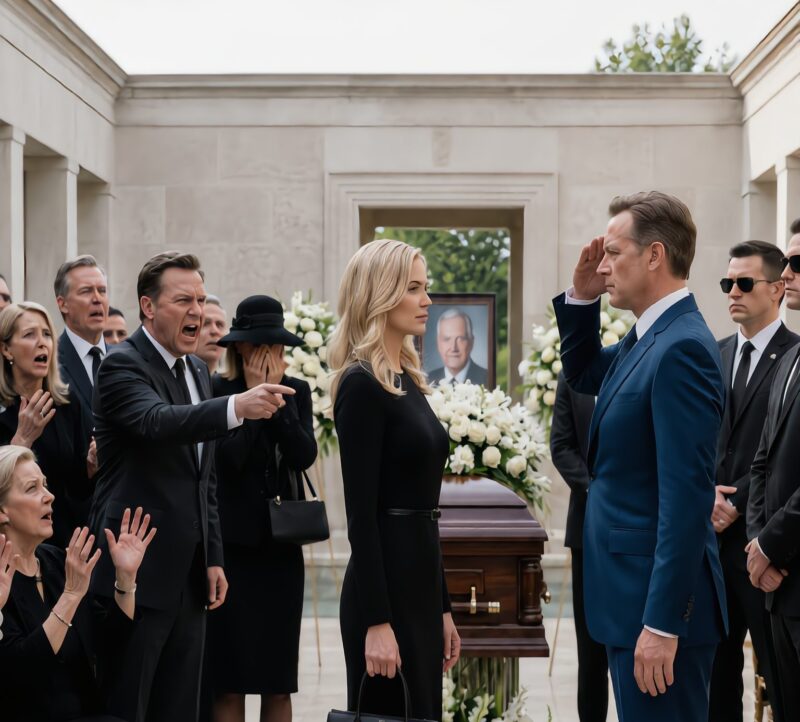
When I entered the reception in my dress uniform, my father, Richard Monroe, spotted me almost immediately.
His eyes traveled over the uniform before a mocking smile appeared.
“So you’re still playing military doctor?”
He didn’t bother lowering his voice.
Around us stood retired officers, government officials, political figures, and executives from some of the country’s largest defense companies.
My brother Caleb joined in.
“Careful, Dad. Maybe Colonel Monroe has to report back to base before dinner.”
A few uncomfortable smiles appeared around the room.
I said nothing.
Ten years earlier, their ridicule would have made me desperate to defend myself.
I wasn’t that woman anymore.
Before either of them could continue, conversations across the room suddenly stopped.
Thomas Whitmore had just entered.
Whitmore held a senior position at the Pentagon, and everyone in my father’s professional circle knew exactly who he was.
Three federal security officers accompanied him.
Dad immediately adjusted his jacket and stepped forward, clearly expecting to be greeted.
Whitmore passed him without so much as slowing down.
He came directly to me.
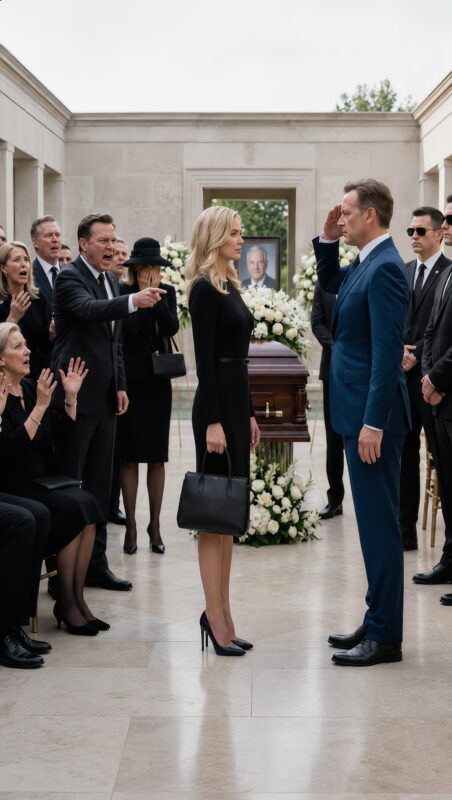
Then, in front of everyone, he saluted.
“Colonel Monroe.”
I returned the salute.
“It’s good to see you again, sir.”
“The honor is mine,” he replied. “There are people who served in Kandahar who still talk about what you did there.”
The room remained completely silent.
I glanced toward my father.
The arrogance had vanished from his face.
For perhaps the first time, he wasn’t looking at me as the daughter who had rejected the future he had chosen for her.
He was looking at an Army colonel.
Later that afternoon, Whitmore approached me outside.
“I was asked to give you this.”
He placed a familiar silver lighter in my palm.
It had belonged to my grandfather for as long as I could remember.
A tiny piece of folded paper was tucked underneath it.
I unfolded the note.
Keep Richard away from the blue folder.
Nothing else.
No explanation.
The mystery deepened during the reading of my grandfather’s will.
His attorney announced that I had been given controlling authority over the Monroe Veterans Foundation.
My father immediately objected.
“That foundation belongs with the family business.”
The attorney remained expressionless.
“Your father specifically separated the two in his final instructions.”
“This makes no sense.”
“It was his decision, Mr. Monroe.”
Dad looked across the table at me.
I could see anger beneath the disbelief.
But my thoughts were already somewhere else.
The blue folder.
That evening, I returned to my grandfather’s study.
His desk looked almost exactly as I remembered it from childhood.
I searched every drawer until I found one that was locked.
The key was hidden beneath an old wooden box.
Inside lay a thick blue file.
One word was written across its cover.
KANDAHAR.
My stomach tightened.
I opened it.
The first pages contained technical reports from Monroe Defense Systems, the military contracting company controlled by my father.
The deeper I read, the worse it became.
A series of emergency medical devices supplied to overseas military units had failed repeated safety tests under extreme heat.
The problem centered on defective locking components.
Engineers had documented the failures.
Supervisors had been warned.
Executives had received the reports.
Yet shipments had continued.
Then I reached a production record.
Batch 17-D.
I stopped breathing for a moment.
I knew that number.
Suddenly, the study disappeared around me.
I could almost smell the dust of Kandahar again.
I remembered the relentless heat.
The exhausted medical team.
The chaos of the trauma unit.
Most of all, I remembered Tyler Mercer.
Nineteen years old.
He had arrived critically injured, and my team had fought for every possible second.
Then one of our medical devices malfunctioned.
We had believed the brutal battlefield environment had caused the failure.
For years, I had accepted that explanation.
The documents in my hands told a different story.
Someone had known.
The company knew the equipment could fail before it ever reached us.
A voice came from behind me.
“Give me that file.”
I turned.
My father stood in the doorway.
“No.”
“Evelyn, you don’t understand those documents.”
“I understand them perfectly.”
“They’re preliminary reports. Technical assessments get revised all the time.”
I held up the page containing the batch number.
“Did you know about 17-D?”
His silence lasted only a second.
But it was long enough.
Before I could question him further, my phone rang.
Mara Quinn.
Mara had served beside me as a trauma nurse in Kandahar.
When I answered, she sounded nervous.
“There’s something I kept all these years.”
After Tyler died, Mara had saved a copy of an incident report because something about the equipment failure had never made sense to her.
Then she gave me the number printed on the defective device.
17-D.
I looked directly at my father.
Whatever remained between us was no longer simply a family dispute.
The folder contained potential evidence.
I brought it to Whitmore immediately.
My father followed close behind.
“Those are confidential company records,” he insisted. “She has no authority to possess them.”
Whitmore remained remarkably calm.
“That won’t be a problem.”
Dad stared at him.
“Why not?”
“Because your father already turned the original records over to federal investigators.”
For once, Richard Monroe had nothing to say.
My grandfather had discovered the safety failures years earlier.
And for years, he had done nothing.
Maybe he feared losing the company.
Maybe protecting the Monroe name had mattered more to him than admitting what had happened.
I would never know.
But near the end of his life, something had changed.
He contacted investigators.
He provided documents.
He gave them access to records that could expose his own family.
I couldn’t forgive how long he had waited.
But I could acknowledge what he had finally done.
He had broken his silence.
The federal investigation moved quickly after that.
Company servers were seized.
Emails were recovered.
Approval records were examined.
Contracts were reviewed.
Eventually, investigators found Caleb’s signature on several authorization forms.
My brother looked stunned.
“Dad told me those were standard approvals.”
He turned toward our father.
“You said the legal department had already reviewed them.”
Dad’s answer was colder than anything I expected.
“You signed them, Caleb. That makes them your responsibility.”
Caleb simply stared at him.
I recognized that expression.
It was the face of someone discovering that family loyalty had always been a one-way transaction.
Then Dad pointed at me.
“This is because of you.”
“No.”
“You’ve destroyed everything our family built.”
I shook my head.
“I didn’t destroy it. I stopped helping you hide what was already broken.”
As investigators dug deeper, the scandal grew.
Safety failures had been concealed.
Internal warnings had disappeared.
Government contracts raised serious questions.
And money connected to the veterans’ foundation had sometimes been used to strengthen Monroe Defense Systems’ public image whenever the company faced criticism.
But there was another truth.
The foundation itself had helped people.
Real people.
It had funded prosthetics for wounded veterans.
It had covered emergency housing.
It had paid for counseling, rehabilitation, and family assistance.
Whatever my father had done, I wasn’t going to sacrifice those veterans to punish him.
I legally separated the foundation from Monroe Defense Systems.
The existing board was replaced.
Independent financial oversight was introduced.
Veterans themselves were given seats in its leadership.
The Monroe name became less important than the people the organization existed to serve.
Several months later, I found my father waiting outside my apartment.
By then, federal prosecutors were preparing their case against him.
He seemed smaller somehow.
Not humbled.
Just cornered.
“I need something from you.”
Of course he did.
“What?”
“When they ask you to testify, refuse.”
I waited to see whether anything else would follow.
An apology.
Regret.
Even an acknowledgment of the soldiers affected by his decisions.
Nothing came.
He still wanted the same thing he had always expected from his family.
Protection.
“If I’m called to testify,” I said, “I’ll answer every question honestly.”
His jaw tightened.
“If you do that, you’re no longer my daughter.”
Once, hearing those words would have destroyed me.
Now they only confirmed what I had understood years ago.
I stepped closer.
“Then we finally agree on something.”
The next morning, I visited my grandfather’s grave.
I stood quietly beside the headstone, turning his silver lighter between my fingers.
“You should have spoken sooner,” I said.
The wind moved gently through the cemetery.
“But you spoke before it was too late.”
Six months passed.
My father was removed from Monroe Defense Systems.
Caleb chose to cooperate with investigators and provided everything he knew.
The veterans’ foundation continued operating independently.
Then one day, an envelope arrived at my office.
The return address belonged to Tyler Mercer’s mother.
Her letter was short.
She didn’t forgive the Monroe family.
She had no reason to.
She didn’t thank me for the investigation or for what might happen in court.
She thanked me for remembering Tyler.
For remembering that behind every report, every batch number, and every corporate decision was a human being with a name.
I placed her letter beside the photograph of my grandfather on my desk.
A few weeks later, I was at the airport preparing for another overseas medical deployment when Caleb sent me a message.
Dad is being sentenced tomorrow. I told investigators everything I knew. I should have done it sooner.
I read his words twice.
Then I replied.
Good.
I slipped the phone into my bag and walked toward the gate.
My grandfather’s silver lighter was still in my pocket.
I once thought I kept it because it was the last evidence that someone in my family had believed in me.
But that wasn’t why I carried it anymore.
It reminded me that silence is also a decision.
My grandfather had learned that lesson near the end of his life.
My father never did.
And I had learned something of my own:
Truth does not always arrive when we need it.
Sometimes it comes years too late.
But every day we choose silence, someone else may be forced to pay the price.