A heavy silence settled over the cabin when a flight attendant, composed and authoritative, ordered a passenger to leave her seat. Conversations cut off instantly.
Curious glances turned into fixed stares, and a few passengers discreetly lifted their phones.
Amara Lewis didn’t move.
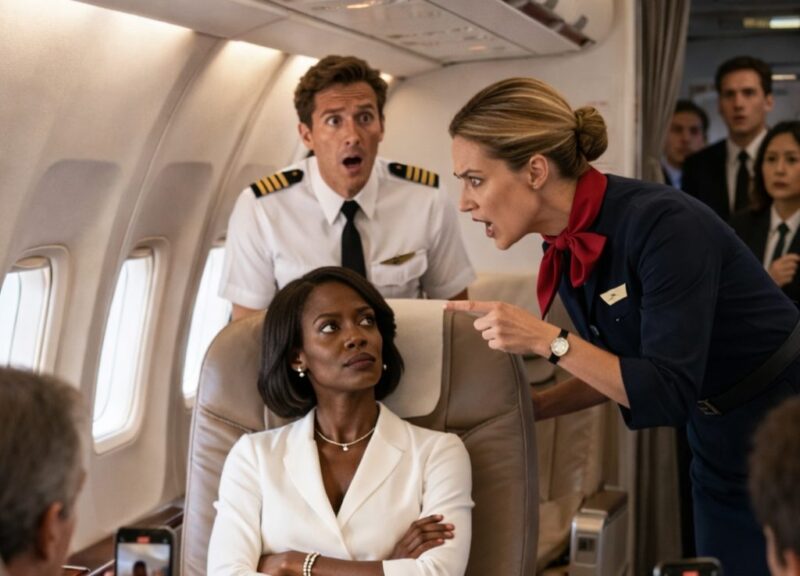
She sat upright—calm, steady, unshaken.
The red handbag on her lap stood out against the tension filling the space. Around her, whispers spread quickly—assumptions forming, judgments hardening, quiet prejudice dressed up as certainty.
“Please recheck my ticket,” she said, her voice even.
But the decision had already been made. The attendant’s tone grew sharper, her confidence unwavering. Soon, a security officer arrived, reinforcing the demand. What began as suspicion turned into open accusation—fraud, deceit… “people like you.”
The phrase hung in the air.
Amara didn’t argue. She didn’t raise her voice. Instead, she calmly picked up her phone.
“Activate protocol seven,” she said.
At first, nothing changed. Passengers shifted in their seats, unsure what they were witnessing. But then, almost imperceptibly, the mood began to shift.
The intercom clicked on.
Ground control requested immediate verification for her seat.
The crew stiffened.
Seconds later, confirmation came through: her ticket was valid—fully authorized.
Then everything changed.
Amara stood.
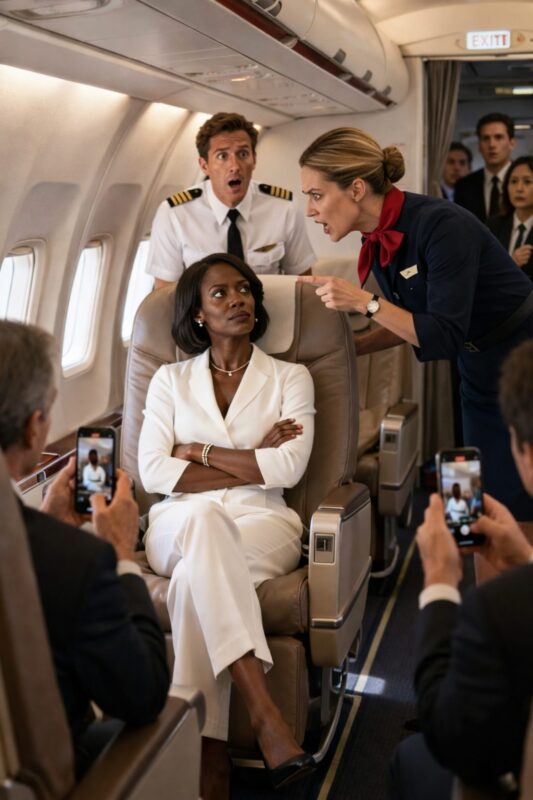
“I am the CEO of Aerolux Holdings.”
Shock rippled through the cabin. Phones lowered. Expressions shifted. The balance of power had quietly, completely reversed.
Yet she showed no triumph.
“You didn’t need to know who I was,” she said, her tone measured. “You only needed to know how to treat someone.”
Within moments, the flight was halted—not because of weather or mechanical failure, but because of something far more serious: accountability.
Investigators boarded. The certainty that once filled the crew dissolved into uncertainty. Positions meant nothing now. Only actions remained.
Amara revealed the truth: this was a covert audit—a test designed to measure integrity under pressure.
And it had failed.
What had begun as her humiliation became a reflection for everyone onboard. Not only for those who acted, but for those who watched and said nothing.
A young trainee finally spoke, admitting she had seen the correct information but chose silence out of fear.
Amara acknowledged her courage.
“It’s never too late to choose what’s right.”
Outside, corporate teams arrived swiftly. Inside, the cabin fell into a different kind of silence—one shaped by realization. No one protested the delay. No one questioned what was happening.
Because they understood.
This wasn’t inconvenience.
It was consequence.
Later, when addressing the public, Amara refused to call it a scandal.
She called it a mirror.
Bias, she explained, rarely appears openly. It hides in assumptions, in tone, in unchecked decisions. And if left unchallenged, it continues.
Her words spread rapidly—across news outlets, across industries, across conversations.
Not because she spoke loudly—
but because she didn’t have to.
At headquarters, executives worried about losses, image, and backlash. Her response was unwavering:
“Any company that fears accountability was never strong to begin with.”
Instead of retreating, she pushed forward—introducing mandatory training, stricter standards, and a clear principle: dignity is non-negotiable.
The results followed quickly. Trust grew. Culture shifted. And one grounded flight became something far greater—a moment of change.
Not just for the company,
but for everyone who witnessed it.
Because this wasn’t just about one passenger.
It was about what happens when power stays controlled, when silence is finally broken, and when respect is defended without compromise.
Amara never saw it as control.
She saw it as duty.
And as she later put it:
“When bias rises, justice must come down first.”