A relentless downpour swept across the southern districts of Atlanta while evening commuters crept through gridlocked streets. Inside Harbor Street Café, the comforting scent of roasted coffee drifted through the dining room as dishes rattled in the kitchen. At the sink stood seventeen-year-old Ethan Carter, finishing another shift after school with his sleeves rolled up and his hands buried in soapy water.
Money had always been scarce. Since his father’s fatal construction accident four years earlier, Ethan and his mother had survived on determination and careful budgeting. She worked exhausting night shifts as a nursing assistant, while Ethan’s wages helped pay for rent, medicine, utilities, and groceries. By that rainy evening, only eighteen dollars remained in his pocket.
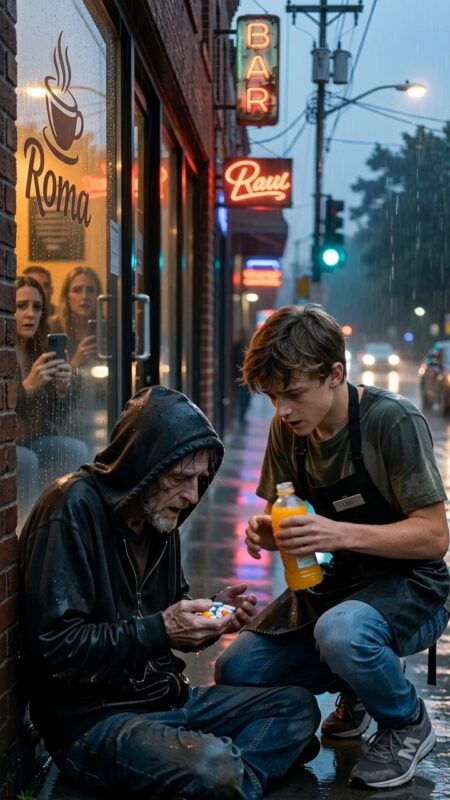
As he glanced through the front window, something caught his attention. An elderly man, drenched by the storm, staggered along the sidewalk. He grabbed a nearby streetlight for support, then suddenly collapsed onto the wet concrete.
Several customers looked over in surprise.
A few lifted their phones.
No one stepped outside.
Ethan immediately headed for the door, but the café manager stopped him.
“You’re on the clock. Stay where you are.”
“Someone needs help,” Ethan replied.
“That’s not our responsibility. If you want, call an ambulance—but you’re not leaving this building.”
For a brief moment, Ethan hesitated. Then he remembered the lesson his father had repeated throughout his childhood: *Your character is measured by what you do when helping someone costs you something.*
Ignoring the order, Ethan pushed through the door and ran into the rain.
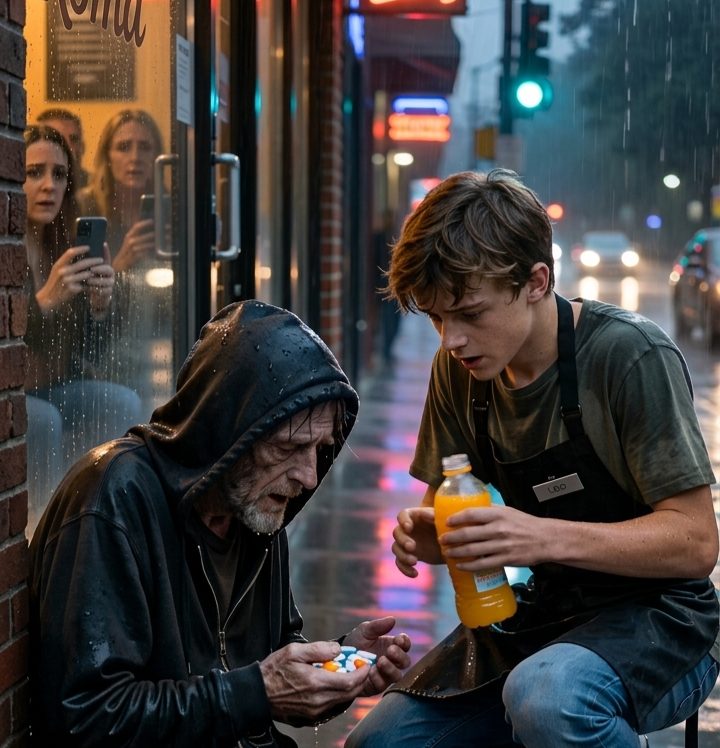
The elderly man’s skin looked pale, his hands trembled violently, and his breathing was weak. Having heard countless stories from his mother’s work with diabetic patients, Ethan suspected severe hypoglycemia. Without wasting a second, he hurried to the nearest convenience store and spent his final eighteen dollars on orange juice and glucose tablets.
After several anxious minutes, color slowly returned to the man’s face. His eyes opened.
“You’ve saved me,” he murmured.
Before Ethan could answer, the manager stormed outside.
“You’re finished here. Don’t bother coming back.”
Ethan simply nodded. His paycheck was gone, and so was every dollar he had.
The elderly man calmly reached into his soaked hoodie, removed an expensive smartphone, and placed a short call.
“Bring everyone… including the regional director.”
Less than fifteen minutes later, three black luxury SUVs pulled up outside the café. Several professionally dressed executives stepped out. One walked directly to the older man and greeted him with obvious respect.
“Mr. Hayes, we’re very sorry for the delay.”
The manager froze.
The frail stranger was actually Victor Hayes—the founder of Hayes Medical Holdings, chairman of the Hayes Foundation, and the businessman responsible for helping establish more than one hundred twenty community hospitals across America.
Victor explained that he occasionally dressed as a homeless man to observe how strangers treated someone who appeared to have nothing.
“Many people noticed me,” he said, surveying the room. “Only one chose compassion over convenience.”
The manager rushed to justify his actions.
Victor stopped him with a raised hand.
“You dismissed a young man because he tried to save a life?”
The manager could not answer.
“A business that values profit above humanity has already lost what matters most,” Victor said quietly.
He then turned to his executives.
“Begin negotiations to purchase this café. If the owners agree, every employee remains—except the manager. If they refuse, we’ll build a new café across the street where kindness is part of the business model.”
The room fell silent as Victor revealed the reason for his unusual experiment.
Twenty years earlier, his wife had suffered a diabetic emergency outside another café. People assumed she was intoxicated and ignored her. Help arrived too late.
“That tragedy inspired me to build hospitals,” Victor said. “But it also taught me that compassion can’t be created with wealth. It already exists—or it doesn’t.”
Looking directly at Ethan, he smiled.
“You offered everything you had to help a complete stranger. That’s the kind of integrity no résumé can prove.”
Victor awarded Ethan a full university scholarship, paid housing, textbooks, and a flexible part-time position with the Hayes Foundation. Overcome with emotion, Ethan accepted, knowing his mother’s years of sacrifice had finally opened the door to a brighter future.
A few moments later, the former manager quietly approached him.
“I made the wrong decision,” he admitted. “I’m sorry.”
“I hope you remember this day whenever someone needs help,” Ethan answered.
Within a week, the café officially joined the Hayes Foundation. Every employee kept working, completed certified first-aid training, and learned how to recognize diabetic emergencies. Beside the entrance stood a refrigerator stocked with free emergency glucose supplies beneath a bronze plaque that read:
Never walk past someone who needs help. One compassionate moment can change a lifetime.
Months later, Ethan started college while coordinating volunteer projects for seniors and families facing hardship. One rainy afternoon, Victor sat unnoticed in the corner, watching Ethan greet every customer with the same quiet kindness that had first captured his attention.
“Do you know what your decision gave me that night?” Victor finally asked.
Ethan smiled.
“A second chance?”
Victor shook his head.
“It reminded me that genuine compassion still exists.”
Outside, the rain continued to fall, but neither man associated it with sorrow anymore. Instead, it marked the unforgettable evening when a teenager gave away his last eighteen dollars for a stranger—and gained a future he had never imagined.