A Rich Woman Refused to Share a $10 Turkey With a Poor Grandmother—Minutes Later, Her Father-in-Law Made Her Regret Everything
I never expected a routine grocery trip to turn my entire life upside down. But one afternoon, I witnessed a wealthy woman’s heartless behavior toward an elderly stranger—and what happened next changed the futures of all three of us.

My name is Rachel. I was thirty-eight years old and had spent more than a decade organizing weddings, corporate gatherings, and private celebrations. Recently, however, I’d reduced my workload to care for my mother after her surgery.
That afternoon, I stopped at a local supermarket to pick up a few things for her.
I was passing the frozen-food aisle when I heard a frail voice.
“Please, just one. I don’t need anything else.”
An elderly woman stood beside a refrigerated display, clutching a battered handbag. Her faded blue coat had clearly seen better days.
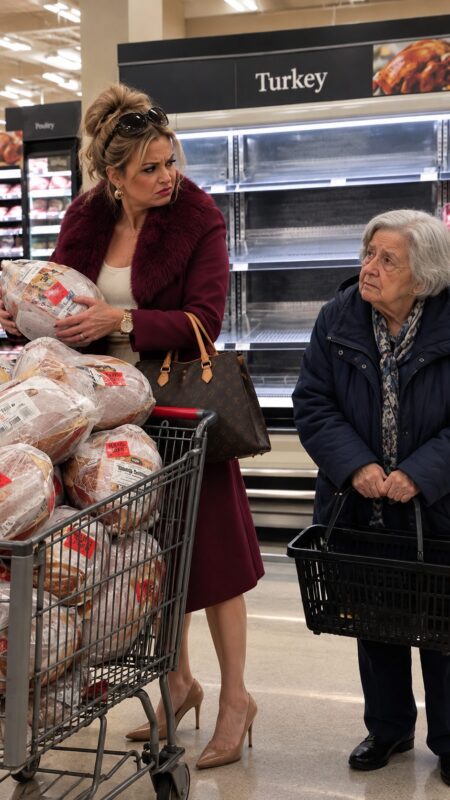
Across from her was a stylish woman wearing a luxurious fur-trimmed coat and enough jewelry to attract attention from the other end of the store.
Her shopping cart contained twelve frozen turkeys.
Every single one had been discounted to $9.99.
I recognized the elegantly dressed customer immediately.
Her name was Beatrice, and she was married into one of the most influential families in our town.
The grandmother glanced desperately at the cart.
“My grandson has been sick, and I’m the only person looking after him. I promised I’d make him a proper meal. Could you please leave just one for me?”
Beatrice didn’t even pretend to sympathize.
“Find something else to cook.”
“I’ve looked everywhere,” the older woman explained. “These are the only ones I can afford.”
“Then perhaps you should buy less expensive food.”
The grandmother’s hands trembled.
“I only have ten dollars.”
Beatrice gave a dismissive shrug.
“Then that isn’t my concern.”
As the older woman reached toward the display, Beatrice grabbed the last turkey and threw it into her cart.
I couldn’t believe what I’d just seen.
“Excuse me,” I interrupted. “You’ve taken every discounted turkey. Would it really inconvenience you to give her one?”
Beatrice slowly turned toward me.
Her gaze traveled from my simple jacket to my worn sneakers.
“And who exactly are you?”
“Someone who thinks you could show a little compassion.”
She laughed unpleasantly.
“People like you always have opinions about how others should spend their money.”
The grandmother hurriedly opened her handbag and produced a folded ten-dollar bill.
“I’m not asking for anything free,” she said. “I can pay.”
Beatrice glanced at the money.
“If your entire budget is ten dollars, maybe turkey shouldn’t be on your shopping list.”
My face grew hot with anger.
But before I could answer, the loudspeakers overhead suddenly came to life.
“Attention, customers. Would Mrs. Beatrice please remain in the frozen-food department? Someone is coming to speak with her.”
Beatrice’s expression changed instantly.
“What on earth is this about?”
A few seconds later, a silver-haired gentleman appeared at the end of the aisle, accompanied by the supermarket manager.
I immediately recognized him.
Walter was a respected businessman who owned the supermarket chain—and Beatrice’s father-in-law.
He approached without offering her a smile.
“Beatrice, I’ve just received a rather disturbing report.”
She straightened her shoulders.
“Walter, thank goodness you’re here! These people have been harassing me!”
He looked at the elderly woman, then at the turkeys piled inside Beatrice’s cart.
“Is it true that you refused to let this lady purchase even one discounted turkey?”
Beatrice rolled her eyes.
“I got here first. Since when is shopping a crime?”
“No one said it was,” Walter replied. “I’m asking why you felt the need to humiliate her.”
Several nearby customers began explaining what they had witnessed.
The store manager confirmed their accounts.
Walter listened without interrupting.
Then he turned to Beatrice.
“Last week, you asked me to recommend you as the next head of our family’s charitable foundation. You told me you wanted to dedicate yourself to helping disadvantaged people.”
Beatrice shifted uncomfortably.
“That’s completely different.”
“Is it? Because here’s someone who needs a little kindness, and you’ve treated her like she doesn’t deserve basic respect.”
For the first time, Beatrice had nothing to say.
Walter addressed the grandmother.
“May I ask your name?”
“Margaret, sir.”
“Margaret, please forgive what happened here. The store will provide everything you need for your grandson’s meals, free of charge.”
Margaret’s eyes filled with tears.
“I couldn’t possibly—”
“I insist.”
He then signaled to the manager.
“Arrange for the twelve turkeys in this cart to be delivered to our local food pantry. We’ll cover the cost.”
Beatrice nearly shouted.
“But those are mine!”
Walter turned back toward her.
“Not anymore. And while we’re discussing expenses, there’s something else you should understand.”
His voice remained calm, but every word carried weight.
“For years, I’ve paid the mortgage on your house, financed your vehicles, covered your expensive trips, and kept your restaurant afloat whenever it lost money.”
Beatrice looked around nervously.
“Walter, this isn’t the place—”
“That financial arrangement ends today.”
Her face drained of color.
“What about our holiday next month?”
“You’ll have to pay for it yourself.”
I thought the confrontation was over.
Then I noticed a promotional flyer hanging near the customer-service counter.
It advertised a glamorous charity dinner scheduled for that evening at Beatrice’s restaurant.
I looked from the flyer to Walter.
“Sir, may I suggest something?”
He turned toward me.
“Go ahead.”
“I’m a professional event planner. If tonight’s dinner is supposed to support charity, perhaps we could turn it into an event that genuinely helps people.”
Walter raised an eyebrow.
“What do you have in mind?”
“Instead of spending the evening listening to speeches about generosity, guests could help prepare meals and grocery packages for struggling families.”
He considered the suggestion.
“How many families could we reach?”
“With the right organization, perhaps two hundred by tonight.”
Walter nodded.
“I’ll pay for the supplies. Can you coordinate everything?”
“I can.”
And just like that, my ordinary grocery trip became the beginning of something extraordinary.
By six o’clock, Beatrice’s upscale restaurant looked completely different.
The crystal chandeliers were still sparkling, and the beautifully decorated tables remained in place.
But the dining area was now filled with volunteers, grocery boxes, and stations for preparing food packages.
Walter had arranged enough supplies for two hundred households.
The kitchen staff cooked hot meals while volunteers sorted vegetables, bread, canned goods, and other essentials.
I organized the workflow, assigned responsibilities, and coordinated deliveries.
Everything was running smoothly when Beatrice finally appeared.
She entered wearing a dazzling evening gown and an expression that suggested she’d already forgotten the supermarket incident.
“Rachel,” she said sharply, “I expect tonight to go perfectly. Important guests are coming, and my presentation must be flawless.”
I nodded.
“We’ve prepared something that should make the evening unforgettable.”
She smiled with satisfaction.
“Excellent.”
Minutes later, the guests gathered near the stage.
Walter stepped up to the microphone.
“Thank you all for attending. Tonight, we’ve decided to give our charity celebration a more practical purpose.”
The audience listened attentively.
“Rather than simply raising money and exchanging compliments, we’ll be providing food for two hundred families.”
Applause broke out.
“And to demonstrate her personal commitment to this mission, our hostess has agreed to take part.”
Beatrice stood up, assuming she was being invited to deliver her speech.
Instead, I approached carrying a plain white apron.
“Here you are, Beatrice. We’ve saved you a place at the packing station.”
She stared at me.
“You cannot be serious.”
“Everyone is helping tonight.”
She looked down at her shimmering gown.
“Do you have any idea what this dress cost? Four thousand dollars!”
I offered her the apron again.
“Then we’d better make sure it stays clean.”
Several guests chuckled.
Walter gave her an encouraging nod.
“Go on, Beatrice. Show everyone what leadership looks like.”
With visible reluctance, she tied the apron around her waist.
Soon she was placing groceries into cardboard boxes beside guests who had once attended her parties solely to be seen in her company.
After twenty minutes, she approached Walter with an irritated expression.
“I’ve finished six packages. Surely I’ve done enough.”
He checked the list.
“Only another 194 to complete.”
Laughter echoed around the room.
Beatrice returned to her station, muttering under her breath.
But the atmosphere changed when I introduced the evening’s special guest.
Margaret entered the room wearing the same old blue coat.
She walked slowly toward the microphone, looking overwhelmed by the elegant surroundings.
“I’ve never spoken in front of so many people,” she began nervously.
The audience fell silent.
“I’ve spent the past several years raising my grandson. He’s my whole world. When he became ill, I wanted to prepare something special for him, but money has been very tight.”
She paused.
“This morning, I walked into a supermarket with my last ten dollars. I left with more groceries than I could have imagined, but what mattered most wasn’t the food.”
Her voice trembled.
“It was discovering that strangers were willing to stand up for someone they didn’t know.”
A few guests wiped their eyes.
Margaret continued.
“Nobody should feel ashamed because they need help. Circumstances can change for anyone. What matters is how we treat people when they’re having a difficult time.”
The room erupted in applause.
I glanced toward Beatrice.
For once, she wasn’t examining her reflection or checking whether anyone was watching her.
She was listening.
I picked up one of the prepared grocery packages and carried it over.
“Beatrice, would you give this to Margaret?”
She hesitated.
Then she accepted the box and approached the older woman.
“Margaret,” she said softly, “I behaved terribly this morning. You didn’t deserve any of it.”
Margaret looked into her eyes.
“No, I didn’t.”
Beatrice swallowed.
“I’m sorry.”
After a moment, Margaret nodded.
“Thank you for saying that.”
Walter stepped back to the microphone.
“Before tonight ends, I’d like to recognize the person who helped us turn this event into something worthwhile.”
He gestured toward me.
“Rachel organized this entire operation in just a few hours. Her experience, determination, and compassion are exactly what our community needs.”
I stood there, completely unprepared for what came next.
“We’re launching a permanent food assistance initiative, and I’m offering Rachel the position of program director.”
Beatrice immediately jumped to her feet.
“What? You’re giving her an important position in our foundation? She’s practically a stranger!”
Walter remained composed.
“She has demonstrated more commitment to helping others in one afternoon than some people have shown in years.”
Beatrice sank back into her chair.
“Being part of this family doesn’t automatically qualify someone to lead its charitable work,” he added.
I was stunned.
A few days later, after discussing the offer with my mother, I accepted the position.
The following months were busier than anything I’d experienced in my event-planning career.
We recruited volunteers, developed partnerships with local suppliers, and established a reliable weekly distribution schedule.
By the end of our third month, we were providing regular food assistance to more than one hundred families.
Walter visited often and encouraged us to expand.
One afternoon, he even suggested that I might eventually oversee the entire foundation.
But the greatest surprise had nothing to do with my promotion.
It happened on a rainy Thursday.
I was checking our inventory when someone knocked on the distribution center’s office door.
I looked up.
Beatrice stood in the doorway.
At first, I barely recognized her.
Her expensive jewelry was gone. Instead of designer heels, she wore sneakers. Her clothes were simple, and she carried an ordinary canvas bag.
She seemed uncomfortable.
“Walter said I should come here and help,” she explained.
I studied her for a moment.
“Would you like to volunteer?”
She glanced around.
“I suppose that’s why I’m here.”
I handed her an apron.
She accepted it without complaining.
As we walked through the storage room, she examined the shelves stacked with groceries.
“Where does all this food go?”
“To families who are struggling financially. Some are caring for sick relatives. Others have lost jobs or are raising children alone.”
“How many families?”
“More than a hundred every week.”
Beatrice stopped walking.
“Every single week?”
I nodded.
“And we still have people waiting for assistance.”
She looked around again, this time more thoughtfully.
“I had no idea there were so many.”
For a while, neither of us spoke.
Then she put down her bag and rolled up her sleeves.
“All right,” she said. “What needs doing?”
I led her toward a table covered with supplies.
“We’re preparing packages for tomorrow’s deliveries.”
She picked up an empty cardboard box.
“What should I put inside?”
I gestured toward the refrigerated storage area.
“Actually, we’ve just received a shipment. Let’s begin with the turkeys.”
Beatrice glanced at me.
For a second, I wondered whether she’d be offended.
Instead, she gave a small, embarrassed laugh.
“Fair enough.”
Then she opened the box and began working.
I watched her quietly.
Months earlier, she’d treated a ten-dollar turkey as something more important than another person’s dignity.
Now she was spending her afternoon helping strangers she would probably never meet.
I didn’t know whether her change would last, but it was a beginning.
And sometimes, a beginning is enough.
That experience taught me something I’ll never forget: wealth can purchase comfort, luxury, and admiration, but it cannot buy compassion. True generosity begins when we recognize that another person’s needs matter just as much as our own.