A wealthy man humiliated a struggling boy, telling him to “earn” the money for his mother’s medicine—but when the child raised a flute and began to play, a secret long buried rose to the surface.
At first, it seemed like nothing more than a display of quiet cruelty. In front of a garden full of elegantly dressed guests, the man delivered his challenge with casual indifference. Yet everything shifted the moment the boy pressed the flute to his lips. The melody that followed didn’t just quiet the gathering—it reached into a past the man had spent years avoiding.
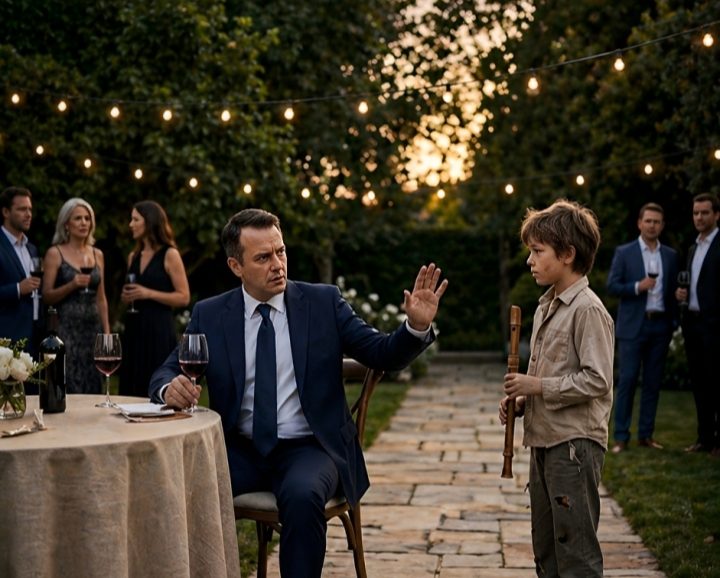
The garden was flawless, arranged with deliberate precision. White linens stretched across polished tables, silverware shimmered under the soft glow of evening light, and conversations flowed effortlessly among people untouched by hardship.
Then the boy stepped in.
He moved carefully between the tables, his clothes worn and dusty, his presence sharply out of place. His hands trembled, betraying his fear, while he clutched a small wooden flute, its surface smoothed by years of use.
At first, the guests continued speaking—but slowly, their voices faded. One by one, attention shifted toward him.
The man at the head of the table noticed last. When he finally looked up, irritation flickered across his face.
“Get him out of here,” he said sharply, dismissing the boy with a wave.
No one responded.
The boy didn’t leave. He swallowed his fear and stood his ground.
“Please,” he said, his voice quiet but steady. “I need help. My mother is sick.”
Some guests shifted uneasily, avoiding his eyes, pretending not to hear.
The man leaned back, a faint, cold smile forming.
“Then earn it,” he replied. “Impress us, and I might give you something.”
The expectation was simple: a brief distraction, perhaps something embarrassing—nothing that would matter.
But when the boy began to play, everything changed.
The sound was soft, almost fragile, yet it carried through the garden with quiet strength. It slipped into the spaces between conversations until silence took hold. Forks paused midair, glasses hovered near lips, and even the breeze seemed to hesitate as the melody unfolded.
It was gentle.
Melancholic.
Unforgettable.
The man reacted first—not because the music was beautiful, but because it was familiar.
His fingers tightened against the table. His breath slowed. The world around him seemed to fade.
He was somewhere else.
Years before.
Standing in the rain, watching the woman he loved walk away. Tears blended with the storm as she held her stomach, trying to tell him something he never heard.
He had written that melody for her—
a lullaby meant only for her.
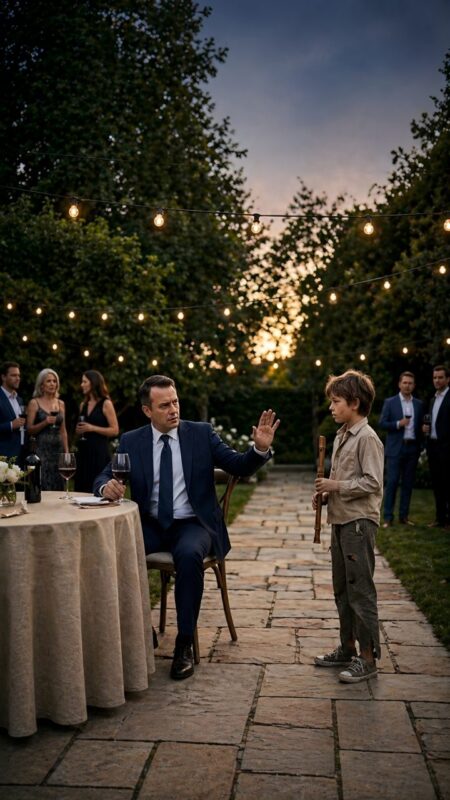
The music ended.
The boy lowered the flute, his hands now shaking for a different reason. Then he reached into his pocket and pulled out an old photograph, its edges worn with time.
He held it out.
The man took it—and froze.
In the image, a younger version of himself stood beside a woman. They were smiling with a certainty that only exists before life changes everything.
On the back, written in faded ink, were seven words:
“If he insults our son, show him.”
The garden fell silent, as if the world itself had stopped.
PART 2
The man’s hand began to tremble before anyone understood why. He stared at the photograph as though it had resurfaced from another life, gripping it tightly as if it might disappear again. Around him, guests exchanged uncertain glances, sensing something had shifted.
Only the boy remained still, holding the flute so tightly his knuckles turned pale.
“Where did you get this?” the man asked, his voice low, stripped of its earlier authority.
“My mother kept it,” the boy said. “She told me if you ever treated me like I didn’t matter… I should give it to you.”
The words were quiet, yet they carried a weight no one could ignore.
The man looked at the boy again—truly looked this time. Past the dirt, past the worn clothes, he saw the shape of the boy’s face, the tension in his jaw, the familiar lift of his chin.
It wasn’t resemblance.
It was recognition.
“Your mother’s name,” he said, his voice unsteady despite his effort to control it. “Tell me.”
The boy hesitated, then answered:
“Marina.”
The name struck him like a sudden, undeniable truth.
For years, he had carried a carefully constructed lie—that she had abandoned him, chosen someone else, built a life without him. It was the version his family gave him, and eventually, he stopped questioning it. Believing it was easier than searching for a truth no one wanted him to uncover.
But the boy slowly shook his head.
“She didn’t leave,” he said gently. “She got sick. She said your family made sure your letters never reached her.”
The man’s chair scraped violently across the stone as he stood, the sound tearing through the quiet garden.
The boy slipped a hand into his pocket and pulled out a folded piece of paper, worn thin at the creases from being opened again and again. He held it out.
A hospital document.
Marina’s name was printed at the top.
Below it, in cold, clinical terms: *Urgent surgery required.*
And under “Emergency Contact,” written in unsteady handwriting that seemed shaped by pain, there was only one line:
*The man with the summer song.*
The man’s vision faltered.
He dropped to his knees in front of the boy, no longer aware of the guests, the setting, or the image he had spent years protecting.
None of it mattered now.
Not the wealth.
Not the reputation.
Not the life he had built on something untrue.
He opened his mouth to speak—to finally ask the question that had been buried for years—but before he could, something shattered.
A glass hit the ground.
The sharp sound cut through the air.
Both of them turned.
And in that instant, a cold realization settled deep inside him.
Because the woman standing there—frozen, pale, staring at the document as if it had revealed something she could no longer hide—
was his mother.
And for the first time in years, everything became clear.
He finally understood who had destroyed his life.
If the truth about your past stood right in front of you… would you face it, or walk away before it tears everything apart?