A week after I quietly paid four dollars for a struggling young mother at a gas station, something unexpected arrived at my workplace—an envelope with my name written neatly across the front.
There was no sender, no note on the outside. Just a simple white envelope that would completely change the way I think about kindness.

My name is Ross. I’m forty-nine years old, married to Lydia, and we’re raising two kids who seem to outgrow everything faster than we can replace it. We also have a mortgage that often feels heavier than our small house deserves—but it’s ours, and that matters.
A few years ago, the factory where I had worked for more than twenty years shut down without warning. One morning we showed up as usual; by the afternoon, the gates were locked and a bankruptcy notice hung on the fence. Just like that, everything I had built my routine around was gone.
After a long, frustrating job search, I ended up working nights at a gas station off the highway. It’s not glamorous—buzzing lights, the smell of overheated food—but it keeps us afloat. Most shifts are quiet and predictable.
That night followed the same pattern—until she came in.
It was close to 11:30 p.m. She stepped inside carrying a small boy asleep against her shoulder, moving carefully so she wouldn’t wake him. She looked completely drained—her hair untidy, her clothes worn, her eyes heavy with exhaustion.
Without speaking, she walked through the aisles and picked up just a few essentials: diapers, bread, and milk.
At the counter, she shifted the child slightly and began counting her money with shaky fingers.
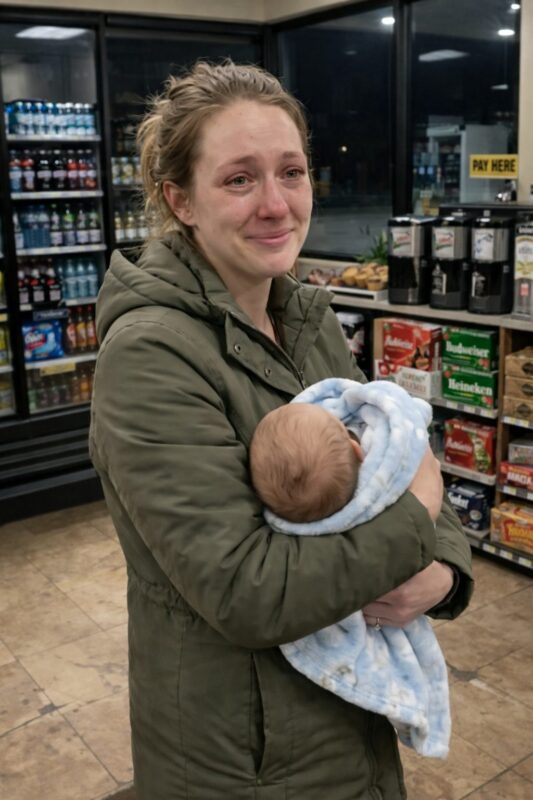
“I’m four dollars short,” she said softly. “Should I put the diapers back?”
I didn’t even think about it. “No, it’s fine. I’ll cover it.”
She froze, as if she wasn’t sure she’d heard me correctly. I took the extra cash from my own wallet, added it to the register, and said quietly, “Just make sure you get home safe.”
For a moment, it looked like she might cry. Instead, she nodded quickly, grabbed her bag, and hurried out into the night, holding her child close.
I assumed that was the end of it.
But a week later, my manager handed me that mysterious envelope. Inside was a short letter—and a check for five thousand dollars.
I read the amount several times, convinced I had misunderstood.
The letter explained everything. The woman I had helped, Emily, had just escaped a difficult and controlling marriage. That night, she had been on her way to her parents’ home with almost nothing—no safety net, no plan, just hope. When she realized she couldn’t afford even the basics, it nearly broke her.
That small moment at the register, they said, gave her enough strength to keep going.
Her parents invited me to visit them that Sunday.
I drove to their house feeling out of place the entire way. It was in a quiet, well-kept neighborhood—far from anything I was used to. They greeted me warmly, as though they had known me for years.
Over lunch, they told me their story—how their daughter had finally found the courage to leave, how she had been kept away from them, and how frightened she had been that night.
“You didn’t just help her pay,” her mother said gently. “You reminded her she mattered.”
I tried to decline the money, but they wouldn’t hear it. “Kindness like that deserves to be recognized,” they insisted.
When I returned home, Lydia listened carefully, then pulled me into a hug. “I’m proud of you,” she said. “You helped someone when they needed it most, without expecting anything back.”
We used the money wisely—fixing the car, catching up on bills, buying things we had been putting off for months. But what stayed with me wasn’t the financial relief.
It was something much deeper.
That night, I thought I was the one offering help.
In reality, I was the one who received something meaningful in return.
I still work those same night shifts at the gas station. The routine hasn’t changed much. But now, when someone walks in looking overwhelmed or worn down, I notice.
Because sometimes, a small gesture—a few dollars and a kind word—can mean far more than we ever imagine.