Chihuahua, Winter 1887
Elena Valdés entered the council chamber of San Jerónimo with seven children gathered around her and immediately understood why she had been called there.
No one intended to offer assistance.
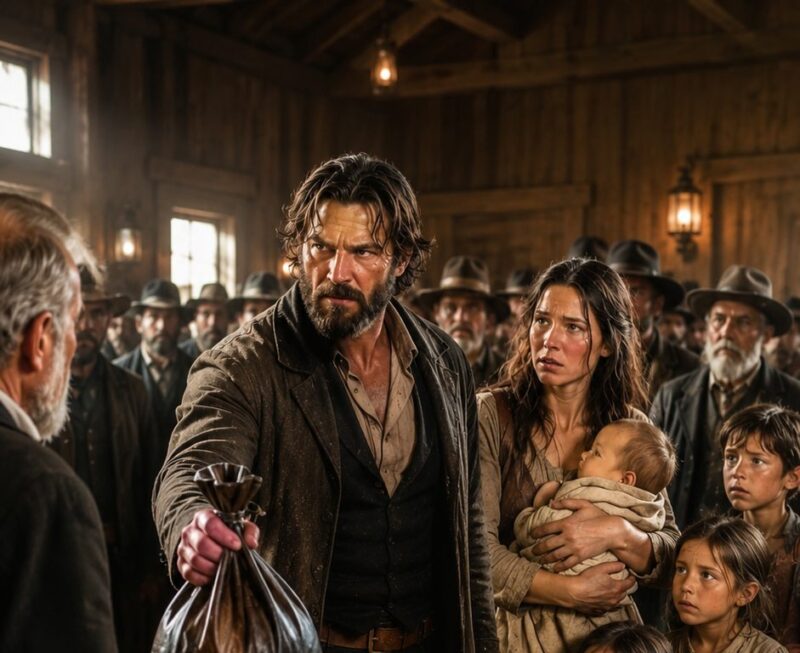
They intended to dismantle her family.
Mateo, her husband, had been buried only six weeks earlier. His death had left Elena with a crumbling adobe house, an almost empty pantry, seven children depending entirely on her, and a debt of sixty pesos she had no realistic way to repay.
Now the coldest part of winter was approaching.
The council had already decided what should happen.
Each child would be placed with a different household until Elena could supposedly support them again.
“The Mendoza family is willing to take Tomás,” Don Leandro said, consulting a sheet of paper. “The Aguilars have offered to take one of the girls. They could use another pair of hands in the house—”
“Stop.”
Elena’s single word silenced him.
Fourteen-month-old Clara rested beneath her mother’s coat, still exhausted after days of fever. Elena tightened her arms around the little girl.
“You speak about my children as though you’re dividing livestock after a sale.”
Don Leandro’s face hardened.
“We are trying to keep them alive.”
“They are seven brothers and sisters,” Elena replied. “Keeping them alive means keeping them together.”
Several councilmen exchanged uncomfortable glances.
Then the chamber door opened.
Cold wind swept into the room.
The man standing in the doorway needed no introduction.
Gabriel Lobo.
He lived several hours away in the Sierra Madre, in a cabin far above the village. He appeared in San Jerónimo only when he needed salt, ammunition, tools, or supplies.
Most villagers avoided him.
Some because of the scar running along his face.
Others because people tend to fear men who prefer mountains to company.
Gabriel stepped forward and examined the children one by one.
Finally, he said, “Send them with me.”
Don Leandro blinked.
“Which child?”
“Every one of them.”
No one moved.
Then Gabriel nodded toward Elena.
“She comes too.”
A murmur spread through the chamber.
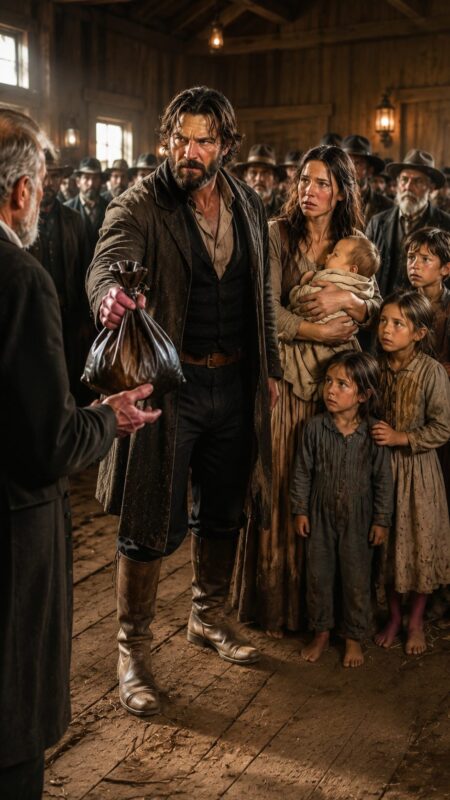
Gabriel explained that his cabin was small but solid. He had plenty of firewood, several months’ worth of supplies, and enough room if everyone accepted a little discomfort.
Elena stared at the stranger.
“You don’t even know us.”
“No.”
“Then why would you take responsibility for eight people?”
Gabriel glanced at the children.
“Because losing their father is enough. They shouldn’t have to lose one another as well.”
It was not trust that made Elena agree.
It was necessity.
But when she looked at the councilmen who had already assigned her children to separate homes, she realized the feared mountain recluse might be the safest choice she had.
So the following morning, eight members of the Valdés family climbed toward Gabriel Lobo’s cabin.
Silence disappeared from Gabriel’s life almost immediately.
His cabin had been designed for one man who required little more than a bed, a table, a stove, and a place to store provisions.
Now nine people lived beneath its roof.
Wet boots crowded the doorway. Blankets appeared everywhere. Someone was always hungry. Someone else needed the stove. Clara frequently woke before sunrise, and seven-year-old Jacinto seemed determined to ask every question that had ever occurred to a human being.
Gabriel complained about none of it.
Instead, he adapted.
He taught the older children how to split logs properly and showed the younger ones which tracks belonged to rabbits, deer, coyotes, and mountain cats.
He taught them to judge the weather by the wind and clouds.
He showed them where ice was safest and where snow could conceal dangerous ground.
Tomás remained the hardest to win over.
At thirteen, he believed it was his responsibility to protect his mother and siblings now that Mateo was gone.
For weeks, he watched Gabriel closely.
But suspicion gradually became curiosity.
Curiosity eventually became respect.
And Elena began noticing something else.
Her children were laughing again.
Then Clara’s fever returned.
One night, while wind rattled against the cabin walls, Gabriel prepared willow bark and several dried herbs.
“You know a great deal about remedies,” Elena observed.
“Not as much as Margarita did.”
Elena looked at him.
“Margarita?”
“My wife.”
Gabriel rarely spoke about himself, so Elena waited.
“She died eight years ago.”
“I’m sorry.”
Gabriel continued working.
“She became sick. Don Leandro brought medicine from town.”
Elena suddenly became very still.
“Don Leandro?”
Gabriel looked up.
“Yes.”
Elena stared at the fire.
“Mateo was given medicine by him too. A few days before he died.”
Neither said anything for several moments.
Gabriel’s expression changed.
It was subtle, but Elena noticed.
The conversation ended there.
The question it had created did not.
By the middle of January, the shelves in Gabriel’s cabin were nearly empty.
Someone had to find food.
Gabriel saddled his horse and told Elena he would hunt farther into the mountains.
“Three days,” he promised.
On the second night, the weather changed.
Snow began falling before sunset.
By midnight, the mountains had disappeared behind a wall of white.
The storm continued through the next day.
Three days passed.
Then four.
Gabriel did not return.
Elena could wait no longer.
She left the younger children inside the cabin and took Tomás with her.
Together they followed the route Gabriel had described.
Hours later, Tomás spotted tracks near the edge of a ravine.
Then they saw the horse.
Gabriel lay below, pinned beneath the animal and badly injured.
Elena and Tomás managed to reach him.
While searching for shelter from the returning wind, they noticed a dark opening in the mountainside.
An abandoned mine.
Inside, they expected darkness and empty tunnels.
Instead, they found food.
Mountains of it.
Sacks of corn were stacked beside flour, beans, and salt.
Elena examined one of the bags.
Government markings were stamped across the cloth.
These were relief provisions.
Supplies intended for villages suffering through the winter.
Supplies San Jerónimo had supposedly never received.
Gabriel had found more than food.
Hidden nearby was a ledger containing shipment records, property transactions, names, dates, and payments.
It told a devastating story.
Don Leandro had intercepted relief shipments and hidden them in the abandoned mine.
Then he had created the illusion of a catastrophic shortage.
Hungry families borrowed money.
Debts accumulated.
When they could no longer repay what they owed, Don Leandro offered to purchase their farms and homes for a fraction of their true value.
The village had not simply been suffering from hunger.
Someone had engineered it.
Then Gabriel turned several pages.
He stopped at one name.
Mateo Valdés.
Elena felt the air leave her lungs.
Mateo had apparently discovered the hidden supplies shortly before becoming ill.
Gabriel pointed to another record.
It concerned medicine obtained through Don Leandro.
Suddenly, Margarita’s death eight years earlier no longer seemed unrelated.
Gabriel believed both deaths had been connected to the same secret.
Before they could decide what to do, footsteps sounded near the mine entrance.
Don Leandro appeared with two armed men.
His gaze immediately fell on the ledger.
“You’ve found something that doesn’t belong to you.”
Gabriel struggled to his feet.
“It belongs to everyone you stole from.”
Don Leandro extended his hand.
“Give it to me.”
“No.”
For several tense moments, no one moved.
Then the worsening storm gave Elena, Tomás, and Gabriel their opportunity.
They retreated farther into the maze of tunnels, carrying the ledger with them.
Don Leandro’s men could not safely follow without risking becoming lost underground.
Elena and the others remained hidden until the storm weakened.
By morning, they had a plan.
Two wagons rolled into San Jerónimo carrying the evidence Don Leandro had hoped would never be found.
The first held government provisions.
The second carried more.
Villagers poured into the streets.
Elena climbed down from the wagon holding the ledger.
The truth spread quickly.
The missing relief shipments.
The secret storage site.
The suspicious property purchases.
The records connected to Mateo.
Everything pointed back to Don Leandro.
Authorities arrested him, and the hidden supplies were distributed among the families for whom they had originally been intended.
For the first time that winter, San Jerónimo had enough food.
Weeks later, Elena returned to the council chamber.
The atmosphere was very different.
One of the councilmen stood.
“Señora Valdés, what we attempted to do to your family was wrong.”
Another lowered his head.
“We thought separating the children was the only practical solution.”
Elena looked at the men who had once discussed her children as though she were not standing in front of them.
“You keep calling it a mistake,” she said.
“It wasn’t.”
They looked at her.
“It was a decision. You decided that a poor family was easier to separate than to help.”
No one answered.
Elena continued.
“You can’t undo that decision. But you can make a different one next time.”
The village did exactly that.
A communal storehouse was established, with several families sharing responsibility for its supplies and records. No single person would ever again have complete control over San Jerónimo’s food.
Neighbors also repaired the Valdés home.
By early spring, the roof no longer leaked, the walls had been strengthened, and the house was ready for Elena and her children.
She should have been relieved.
Instead, returning home suddenly felt strangely like leaving one.
—
One evening, Elena found Gabriel sitting outside his cabin.
Snow still clung to the highest peaks, but wild grass was beginning to emerge from the thawing earth.
“The house is finished,” Elena said.
Gabriel nodded.
“I know.”
“We can move back tomorrow.”
Another nod.
“I promised to keep all of you safe through the winter.”
Elena waited.
Gabriel looked toward the mountains.
“Winter is over.”
From inside the cabin came an explosion of laughter, followed immediately by Jacinto loudly blaming someone else for whatever had happened.
Elena smiled.
Then she looked at Gabriel.
“What if I’m not asking you for another winter?”
He turned toward her.
“What are you asking?”
“The truth.”
Gabriel was silent for a long moment.
Finally, he gave it to her.
Years earlier, before Elena had ever known his name, Gabriel had been caught in a mine fire.
Other men had escaped.
Mateo had realized Gabriel was still underground.
He went back.
Mateo carried him out.
“You owed him your life,” Elena whispered.
“Yes.”
“So taking us in was repayment?”
Gabriel looked toward the cabin.
“At the beginning.”
“And now?”
The voices of seven children filled the house behind them.
Gabriel’s expression softened.
“I spent years believing solitude was easier.”
He looked at Elena.
“Then eight people arrived and destroyed every bit of peace I had.”
Elena raised an eyebrow.
“Is that supposed to persuade me?”
“Let me finish.”
She smiled.
Gabriel continued.
“I thought that cabin was my home because I had built it. I was wrong.”
His eyes moved toward the doorway where Clara had just appeared, followed by two of her siblings.
“It became a home when all of you arrived.”
Then his gaze returned to Elena.
“I cannot promise wealth. I cannot give you an easy life. And I have never been good at beautiful speeches.”
He took her hands.
“But I can promise honesty. Work. Respect. A place beside me for as long as you want it.”
He paused.
“And every winter I have left.”
Elena looked down at their hands.
“You understand that there are eight of us?”
“I survived one winter. I’m aware.”
“The children are extremely loud.”
“I have noticed.”
“Jacinto might never stop asking questions.”
Gabriel sighed deeply.
“That is the one danger I have not learned how to survive.”
Elena laughed.
“All right.”
Gabriel blinked.
“All right?”
“We’ll stay.”
They married that summer among the wildflowers of the Sierra Madre.
As the years passed, Gabriel enlarged the cabin room by room until it became a sprawling mountain home.
Later, he and Elena built a small school nearby so that children from isolated families would not have to grow up without an education.
Whenever newcomers asked how Gabriel Lobo had ended up with a wife and seven children, Jacinto never allowed anyone else to tell the story.
“The council wanted to give us away,” he would announce. “Then Gabriel walked through the door and said he’d take all seven.”
Tomás always interrupted at exactly the same moment.
“Eight.”
Jacinto would groan.
“You know what I mean.”
“No,” Tomás would reply with a grin. “You always forget Mother.”
And perhaps that was the most important part of the story.
The council had seen seven hungry children and a widow who could no longer provide for them.
They saw a problem that could be solved by separating its pieces.
Gabriel saw something else.
Eight people who had already lost enough.
Eight people who needed shelter without surrendering one another.
He did not rescue seven children.
He protected what everyone else had been willing to break apart.
Their family.