“Fix that engine, and my position is yours.”
Esteban Morales tossed the challenge out with a sharp, mocking laugh that echoed through the workshop. It wasn’t genuine amusement—it was meant to humiliate. The other mechanics forced small, uneasy smiles, careful not to oppose the man in charge.
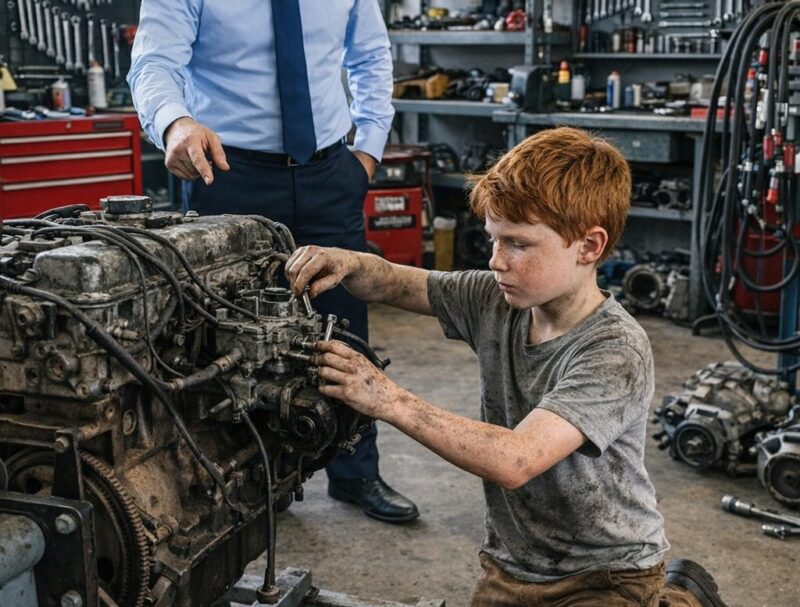
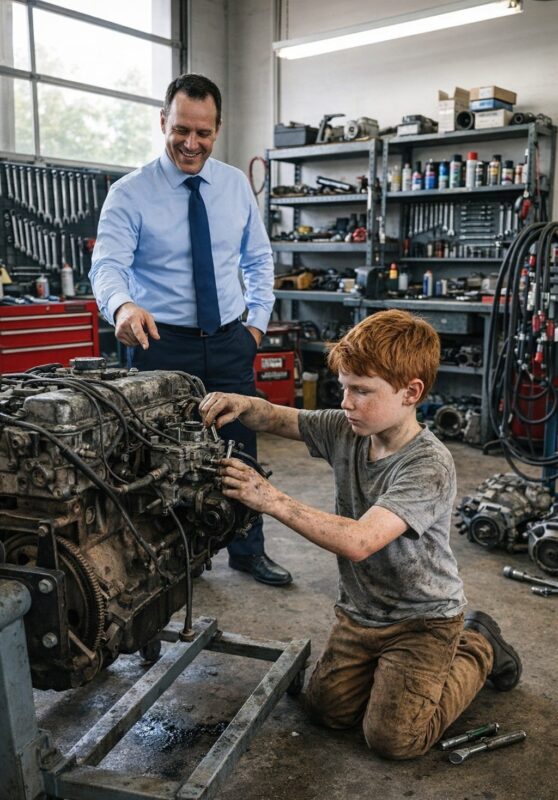
Miguel stood in front of him—fourteen, thin, dressed in worn clothes marked with oil and time. For weeks, he had hovered around the garage, asking for any kind of work, only to be dismissed again and again.
But today felt different.
The engine on the workbench was no ordinary machine. It belonged to a high-end European car, one that had already defeated the shop’s most experienced mechanic. After days of failure, even he had walked away.
“You mean it?” Miguel asked quietly.
Esteban’s lips curled. “You’ve got one week. Succeed, and you take everything—my office, my title, my salary. Fail, and you’re gone for good.”
The room fell still. Miguel turned his gaze to the engine. Where others saw a hopeless pile of parts, he saw something else entirely.
“Alright,” he said. “I accept.”
That first night, he didn’t reach for a single tool. Instead, he studied. He circled the engine slowly, examining every detail, as though it were speaking in a language only he was trying to understand. What others called damage, he recognized as misalignment—an intentional deviation from the norm.
On the third day, hunger nearly broke his focus—until Guadalupe, the secretary, quietly handed him a sandwich.
“You won’t get far on an empty stomach,” she murmured. “And ignore Esteban. You’ve got something he never will.”
Those words fueled him as much as the food.
Later, while cleaning one of the components, Miguel noticed something unusual: a faint engraving.
RM – Future Project 2009
The initials struck him instantly. Ricardo Morales—a visionary engineer whose innovations had changed the field before his untimely death.
Why would his mark be here?
Whispers spread through the shop. What had started as a joke was turning into something serious.
Then came another surprise.
Beatriz Castillo, part-owner of the business and widow of Ricardo Morales, stepped into the garage. The moment she saw Miguel working, she stopped in place.
“There’s something familiar about him…” she said softly.
After a brief conversation, she returned the next day carrying a polished wooden case filled with her late husband’s tools.
“He always believed tools carried a part of the craftsman,” she told Miguel. “Use them well.”
With those instruments in his hands, everything changed. Miguel no longer struggled—he connected. The engine wasn’t faulty. It was advanced—far ahead of its time. Others had tried to force it into a standard system, not realizing it followed a completely different logic.
It didn’t need fixing.
It needed understanding.
The night before the deadline, Esteban panicked. Afraid of losing, he secretly shut off the power to the entire workshop.
Miguel arrived to complete darkness.
He could have walked away.
Instead, he asked for candles.
Soon, the room glowed with flickering light. Shadows danced along the walls as Miguel continued working, calm and focused. The moment felt almost timeless—like something greater was guiding his hands.
By morning, the workshop was packed.
“It’s ready,” Miguel said, his voice hoarse.
He turned the key.
For a heartbeat, nothing happened.
Then the engine awakened—not with noise, but with smooth, controlled power. Perfect.
The system readings flashed: exceptional efficiency, near-zero emissions.
“…That’s impossible,” Esteban muttered.
Miguel shook his head. “No. Just misunderstood.”
Alejandro Castillo, the owner, stepped forward, visibly shaken.
“This design… I’ve only seen one mind capable of it.”
Beatriz pointed to the engraving.
“Look closely.”
The truth unfolded quickly.
Years ago, Ricardo Morales had a son—one he never found. This engine had been more than a project. It was a message left behind, a piece of hope.
A DNA test confirmed what everyone now suspected.
Miguel was that son.
Alejandro turned to Esteban. “You’re finished here. Not because of a bet—but because you lack the qualities this place deserves.”
Then he faced Miguel.
“You have a future beyond anything you can imagine. Tell me what you want.”
Miguel paused, looking around—the workshop, the people who had supported him, and the boys outside watching through the gates.
“I don’t want power,” he said. “I want opportunity—for others like me.”
The room fell silent.
He didn’t want to rise above everyone else.
He wanted to lift others up.
And that vision became reality.
The workshop was transformed into a training center, a place where young people could learn without needing money—only determination. Doña Patricia made sure no one went hungry. Guadalupe guided them. Beatriz supported them.
Years passed, and Miguel grew into a remarkable engineer—but he never left.
Whenever a new student struggled, he would hand them a tool and say:
“There’s nothing impossible here. You just haven’t figured it out yet.”
Even Esteban eventually returned—no longer arrogant, but willing to start over.
Miguel gave him that chance.
Because machines can be repaired.
And sometimes, so can people.
And Miguel showed that success isn’t about standing at the top alone—
It’s about reaching back and helping others climb.