For three weeks, my daughter Rachel didn’t respond to a single call or message. At first, I convinced myself it was grief. She had told me her husband, James, had died, and I assumed she needed time alone. I kept my messages simple—quiet reminders that I loved her and was there whenever she was ready.
But silence like that doesn’t sit right forever.
Then her neighbor, Mrs. Chen, called. She spoke carefully, almost hesitantly, but what she described unsettled me. Unknown cars had been showing up late at night, parking away from the house as if trying not to draw attention. Rachel’s SUV had disappeared days earlier. What I had been calling concern suddenly felt like fear.

That same afternoon, I drove to her house using the spare key she had once given me “just in case.” The moment I arrived, something felt off. The yard was unkempt, mail overflowed from the box, and inside, the house felt lifeless. The air was stale, and food in the refrigerator had spoiled weeks ago. It looked as if everything had stopped mid-motion.
Then I heard it.
A soft, dragging scratch.
It was coming from below—from the basement.
When I reached the door, my breath caught. A thick padlock had been fastened on the outside, newly installed. The scratching came again, slow and intentional. Then a faint, broken voice:
“Please.”
My hands shook as I called emergency services. I tried to break the lock myself, but it held firm. The sound grew weaker, and every second stretched painfully long.
When the police arrived, they cut the lock within moments and opened the door.
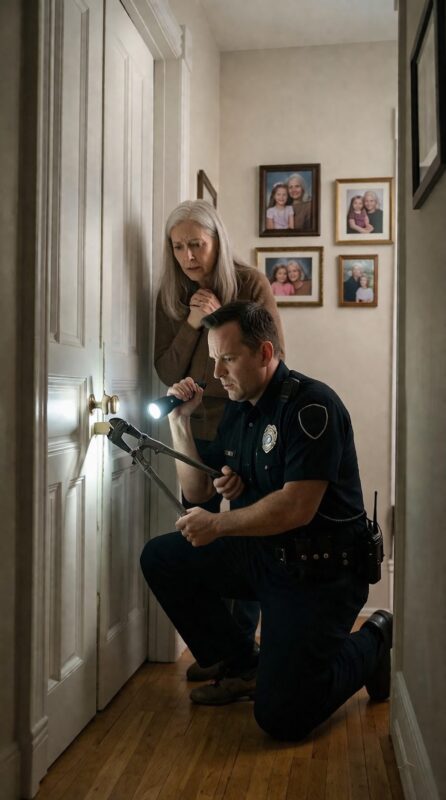
The smell hit first—stale air mixed with something worse. Then the flashlight revealed the truth I couldn’t comprehend.
James was alive.
He was chained to a beam, frail and barely conscious. His wrists were damaged from the restraints. A thin mattress and a bucket were all that surrounded him. He had been held there for weeks.
And yet, we had mourned him.
Rachel had told us he was gone.
But he had been alive beneath that house the entire time.
At the hospital, the reality came into focus. None of it had been real. Rachel had fabricated everything—the death, the documents, even the funeral. Her goal was simple and horrifying: collect the life insurance. James had been drugged, confined, and pressured into signing papers while she prepared to leave.
Investigators later uncovered a carefully constructed plan. There were forged records, payments to people willing to look the other way, and insurance claims ready to be filed. She had already begun building a new life with someone else.
She didn’t run far.
Within days, she was arrested.
In court, the evidence dismantled any doubt. The restraints, the lock, the falsified paperwork—every detail pointed to premeditation. James’s testimony filled in the rest. He survived by conserving strength, waiting, and believing someone might come.
He scratched at the door, hoping someone would hear.
And somehow, I did.
Rachel was found guilty on multiple counts, including attempted murder and fraud, and received a lengthy prison sentence. Others involved faced consequences as well.
But there was no relief.
Only a heavy, quiet understanding.
The person I had raised was capable of something I could never have imagined.
James slowly rebuilt his life. Recovery took time—his body healed faster than his mind—but he kept moving forward. He came to live with me, began therapy, and gradually found a way to feel safe again.
Little by little, life returned.
Years later, he remarried in a small, peaceful ceremony. Watching him choose happiness again, after everything he endured, felt like a rare kind of closure.
Some truths stay with you.
Not all danger looks like danger. Sometimes it hides behind familiarity. Sometimes it wears grief as a disguise. And sometimes, it seals itself behind a locked door, trusting no one will question it.
I don’t make that mistake anymore.