He hadn’t planned to arrive early that day. It was a rare break from his rigid schedule—one he usually controlled down to the minute. But what he witnessed outside the school would alter far more than his routine.
A glossy black sedan rolled to a quiet stop in front of an exclusive private academy.
Inside sat Daniel Harrison, a billionaire investor known for his discipline and emotional reserve. He glanced at his watch. Ahead of time—again.
Since his wife’s death two years earlier, he had clung to structure, believing that if he could manage time, he could manage everything else.
Through the darkened window, he observed the usual scene: parents chatting in small groups, others scrolling through their phones, chauffeurs waiting with engines idling.
Then something unusual caught his attention.
He leaned forward.
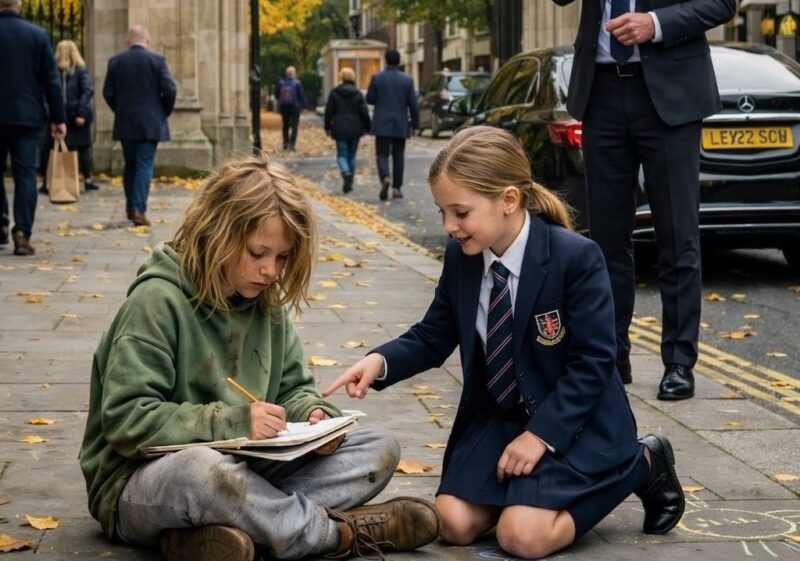
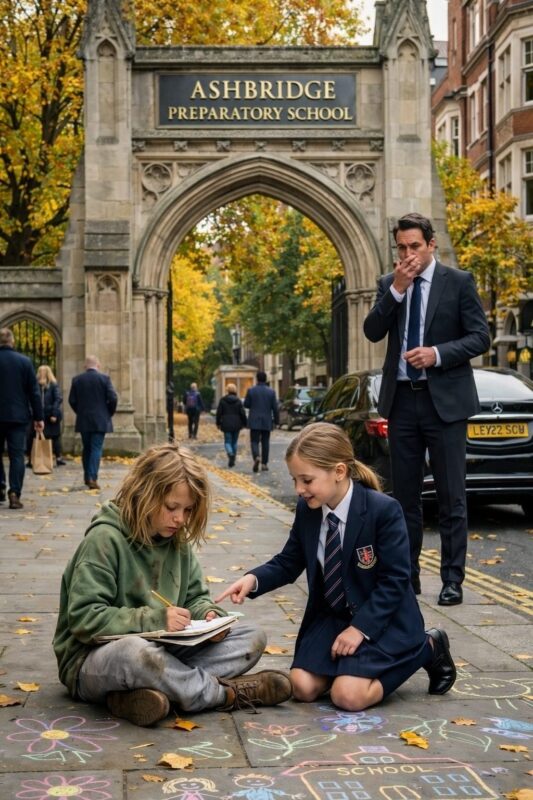
His eight-year-old daughter, Sophie, was sitting on the curb.
And she wasn’t alone.
Beside her sat a teenage girl dressed in worn, ill-fitting clothes. Her backpack was held together with strips of tape, her sneakers too large, her jacket thin and inadequate. Her hair was messy, her appearance unmistakable.
Daniel recognized it immediately—she was homeless.
But that wasn’t what held his gaze.
She was teaching.
Sophie sat with a notebook on her lap, watching closely as the girl drew numbers and shapes on the pavement with a small stick, explaining each step with surprising clarity.
Then Sophie laughed.
The sound hit Daniel unexpectedly.
He hadn’t heard that laughter in a long time.
“Stop the car,” he said quietly.
The driver hesitated. “Sir?”
“Now.”
Daniel stepped out, unnoticed.
“…if you move this number here,” the girl was saying, tapping the ground, “the result changes. Math is like solving a puzzle—you just need to spot the pattern.”
Sophie leaned in, eyes bright. “That’s why I kept getting it wrong!”
Daniel froze.
This wasn’t small talk.
This was real instruction.
At that moment, Sophie looked up and saw him.
“Dad!”
She jumped to her feet.
The girl quickly stood as well, stepping back instinctively, as though preparing to leave.
“Sophie,” Daniel said calmly, though his heart was racing, “who is she?”
The girl lowered her eyes. “I’m sorry, sir. I didn’t mean to intrude.”
“This is Maya,” Sophie said quickly. “She helps me with my homework. She’s really smart.”
Daniel studied her more closely.
“Where did you meet her?”
“At the library,” Sophie replied. “She’s always there reading. When I couldn’t understand fractions, she explained them way better than my tutor.”
Something shifted within him.
He had spent a fortune on education.
Yet here, on the sidewalk, his daughter had truly learned.
“Maya,” he said, “how old are you?”
“Sixteen.”
“And why aren’t you in school?”
She hesitated before answering.
“My mom died last year. We lost our apartment. I try to stay in shelters, but they’re often full. I study whenever I can. I want to become a teacher someday.”
The word stayed with him.
Sophie gently tugged at his sleeve. “Dad, she’s not bad. She just… doesn’t have a home.”
Daniel looked at his daughter.
For the first time in months, he saw warmth and curiosity in her eyes—the very qualities he feared she was losing.
Then he looked back at Maya.
“Come with us,” he said.
Her eyes widened. “I… I can’t.”
“You’re not in trouble,” he assured her. “I just want to talk.”
That afternoon, the staff were stunned when Daniel entered his mansion with the girl beside him.
At the kitchen table, over tea, Maya spoke openly—about her studies, her hopes, the nights she spent riding buses just to stay warm, and the children she helped at the library in exchange for food.
Daniel listened.
Really listened.
That night, he couldn’t sleep.
By morning, he had made his decision.
Maya would stay in the guesthouse—not as charity, but as a chance.
He enrolled her in a private academic program to complete her education, arranged legal support to help stabilize her situation, and—most unexpectedly—hired her as Sophie’s tutor.
At first, people questioned his choice.
A billionaire opening his home to a homeless girl?
But over time, the results spoke for themselves.
Sophie changed.
She became more engaged, asked thoughtful questions, worked on projects at home—and laughed again.
Daniel noticed something else.
He had started to change too.
Months later, during a school open house, Sophie stood at the front of her class, confidently explaining a complex math problem.
Her teacher smiled. “Who helped you understand this so well?”
Sophie turned and pointed toward the back.
“My friend Maya.”
The room fell silent as Daniel stood beside the girl so many had once overlooked.
Later, a reporter approached him.
“Why did you help her?”
Daniel looked across the courtyard, where Sophie and Maya were laughing together.
“Because my daughter learned something invaluable from someone who had almost nothing,” he said quietly. “And sometimes, those who seem to have the least… have the most to give.”
Years later, Maya became a qualified teacher.
But whenever she was asked about that day, she always answered the same way:
“I wasn’t rescued.
I was finally seen.”
And that changed everything.