He Stood Between Them and the Last Friend He Had
When twenty-three-year-old Artyom arrived at the correctional facility, nobody asked questions about his past. Whatever had brought him there remained his secret. He preferred it that way. He kept conversations to a minimum, avoided trouble, and spent most of his time alone. Once his daily shift in the prison workshop ended, he always walked to the same place—to an aging service dog named Grey.

Grey had once been one of the institution’s working dogs, but age had caught up with him. An old injury left him with a noticeable limp, his hearing had faded, and his muzzle had turned almost completely gray. Yet every time Artyom appeared, the old shepherd greeted him with a wagging tail and gentle eyes.
The officers soon realized that the quiet inmate had an unusual connection with animals. Since Grey required constant attention, they allowed Artyom to care for him. He brushed the dog’s coat, filled his water bowl, prepared his meals, and sat beside him for hours in comfortable silence.
To everyone else, Grey was simply a retired prison dog.
To Artyom, he was family.
The faithful animal never cared about criminal records or mistakes. He never demanded explanations or passed judgment. He simply rested beside the young man, placing his tired head across Artyom’s knees as though nothing else mattered.
Unfortunately, not everyone respected that bond.
Several notorious inmates controlled one section of the prison. They enjoyed humiliating quieter prisoners, especially those who refused to fight back.
“Look who’s babysitting his pet again,” one of them mocked.
“I guess that’s the only friend he’s got,” another sneered.
Artyom ignored every insult.
He calmly placed Grey’s metal bowl on the concrete and watched as the hungry dog began eating.
A large inmate stepped forward with a cruel grin.
“You think anybody cares about this old mutt?”
Before anyone could react, he swung his boot into the bowl.
Metal scraped loudly across the yard.
Dry food scattered over the ground in every direction.
Grey startled, stumbled backward, and let out a frightened whine.
Silence settled across the yard.
Artyom rose to his feet.
He never looked at the spilled food.
He never looked at the bowl.
His gaze remained fixed on the trembling old dog.
Only then did he face the men responsible.
His expression revealed nothing except calm resolve.
“You shouldn’t have done that,” he said quietly.
The group burst into laughter.
One of them stepped forward, reaching out to shove him.
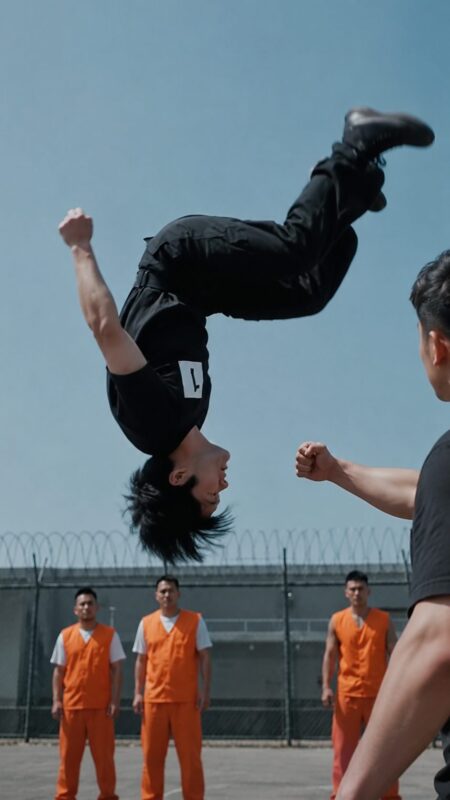
Artyom shifted sideways at the last possible moment. With a smooth movement, he redirected the man’s own momentum, sending him crashing harmlessly onto the concrete before the inmate even understood what had happened.
Another rushed in, grabbing for his shoulder.
Artyom intercepted the arm, rotated his opponent off balance, and gently but decisively pinned him to the ground until the struggle stopped.
The third attacker charged recklessly.
Again, Artyom simply stepped aside.
Using nothing but timing and leverage, he redirected the man’s movement, leaving him seated awkwardly on the pavement, rubbing his aching shoulder in disbelief.
The entire confrontation lasted only seconds.
There were no wild punches.
No unnecessary violence.
Every movement was measured, disciplined, and ended the instant the threat disappeared.
Anyone watching could tell that Artyom had spent years studying martial arts.
The remaining inmates exchanged uncertain glances.
They had expected an easy victim.
Instead, they had confronted someone who possessed both skill and restraint.
For several moments, nobody spoke.
Finally, the first inmate climbed back to his feet, dusted off his clothes, and let out a long breath.
“…We crossed the line.”
The others quietly agreed.
The mocking smiles had vanished.
Without another word, they turned around and walked away.
Artyom paid them no attention.
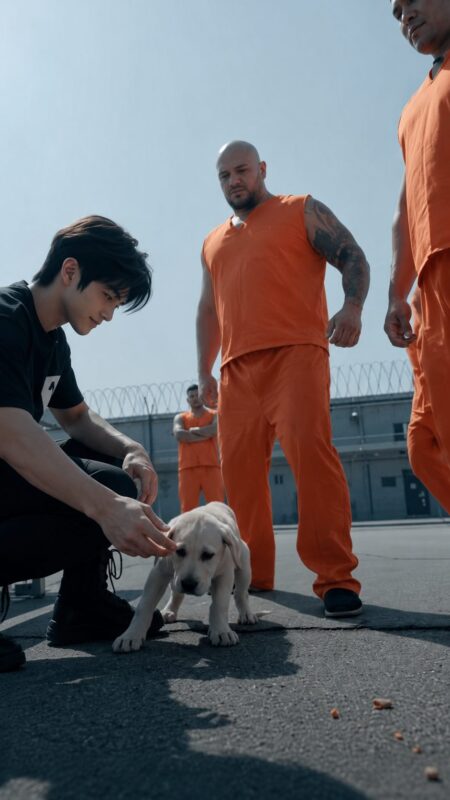
He immediately knelt beside Grey.
The old shepherd was still shaking.
“It’s over,” Artyom whispered gently. “You’re safe.”
He stroked Grey’s neck before scratching behind the ears exactly the way the old dog loved.
Slowly, Grey relaxed.
After a moment, he lifted his muzzle and gently licked Artyom’s face.
For the first time in many months, the young inmate smiled.
He collected the scattered food, brought over a clean bowl, poured fresh water, and made sure Grey could finish his meal in peace.
Throughout the afternoon, the old dog kept glancing up at him with quiet trust.
The correctional officers who had witnessed everything noticed something remarkable.
Artyom never boasted about what had happened.
He didn’t demand recognition.
He showed no anger toward the men who had provoked him.
His only concern was whether Grey had been frightened.
From that day forward, the other prisoners stopped seeing him as a withdrawn loner.
Instead, they recognized someone whose greatest strength wasn’t his fighting ability, but his compassion.
Later that evening, one of the same inmates who had mocked Grey quietly approached the kennel.
Without saying a single word, he placed a heavy sack of dog food beside the fence.
He met Artyom’s eyes for only a second before giving a small apologetic nod.
Artyom acknowledged it with a nod of his own.
No speeches were needed.
Sometimes respect is earned not by intimidation, but by protecting someone weaker than yourself when nobody else will.
As night settled over the prison, Grey curled beside Artyom and rested his tired head on the young man’s lap once more.
Behind steel bars and locked gates, the old dog reminded everyone who witnessed their friendship that kindness survives even in the darkest places—and that true loyalty is measured by the willingness to stand between danger and those who cannot defend themselves.