I heard the laughter before I understood what had happened.
Then I saw my mother.
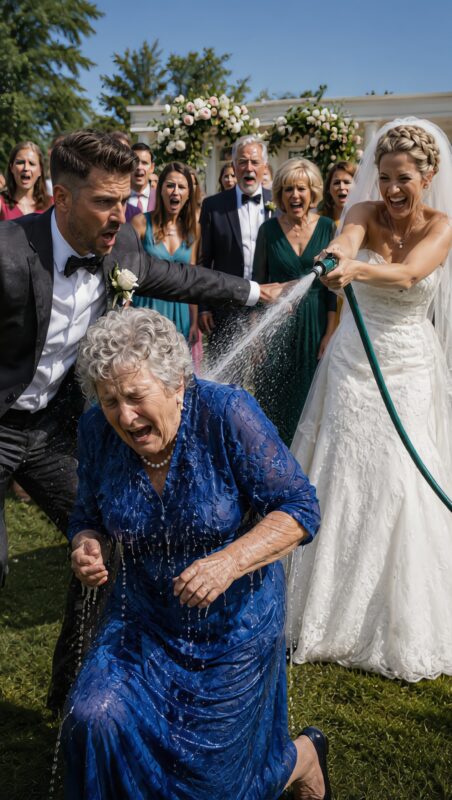
Eleanor stood in the middle of the garden, trembling beneath a stream of ice-cold water. Her elegant gray dress clung to her body, and her silver-white hair was soaked against her cheeks.
A few yards away, my fiancée held the garden hose.
Vanessa was laughing.
So was almost everyone else.
Her father, Charles Whitmore, leaned against the terrace railing with a glass in his hand.
“Someone get that woman a bus ticket!” he shouted. “She clearly took a wrong turn on her way to the shelter.”
Another wave of laughter rolled through the crowd.
Vanessa grinned at me.
“Daniel, don’t look so serious. I’m just rinsing off a little poverty.”
She aimed the hose at Mom again.
I moved before I had time to think.
The freezing water struck me instead.
“Turn it off, Vanessa.”
Her smile disappeared.
“Oh, come on. Can’t anyone take a joke anymore?”
Behind me, Mom gently touched my shoulder.
“Danny, let it go. Please. This is supposed to be your wedding day.”
I turned to look at her.
She was cold. Embarrassed. Surrounded by nearly two hundred strangers who had just laughed at her humiliation.
And she was worried about me.
Something inside me became perfectly calm.
I slipped the ring from my finger.
“There won’t be a wedding.”
The garden fell quiet.
Charles gave a dismissive laugh.
“Don’t be ridiculous.”
I looked directly at him.
“By tomorrow morning, Charles, losing this wedding will be the least of your family’s problems.”
He nearly choked on his drink from laughing.
“You’re threatening me? You’re a middle-level consultant who drives an old sedan.”
I said nothing.
For two years, the Whitmores had believed exactly what I wanted them to believe.
To them, I was Daniel Hale, an unremarkable corporate adviser who had somehow convinced Vanessa Whitmore to marry beneath her social class.
They had never asked many questions about my family.
They had certainly never questioned why their struggling hotel empire kept receiving extensions, refinancing agreements, and emergency capital whenever it approached collapse.
All of that money had come through Northbridge Capital.
Charles knew the firm’s name.
What he didn’t know was who truly stood behind it.
The soaked woman beside me had built Northbridge from nothing.
And I now controlled it.
I wrapped my jacket around Mom’s shoulders and pulled out my phone.
Rebecca answered immediately.
“It’s time,” I told her. “Send the files.”
Mom looked at me.
“Danny—”
“No more chances, Mom.”
She didn’t argue.
Twenty-seven years earlier, my father had died unexpectedly, leaving my mother with bills, responsibilities, and a young son to raise.
She started Northbridge in a rented room barely large enough for two desks.
Over the next two decades, she turned it into a financial powerhouse.
When she finally retired, she entrusted the firm to me.
One of Northbridge’s largest problem investments was Whitmore Hospitality.
We had rescued Charles’s company more than once.
What Charles didn’t realize was that every rescue had given us greater access to his financial records.
Eight months earlier, I had noticed something that didn’t make sense.
Renovation money was disappearing.
Hotel occupancy figures didn’t match independent reports.
Property valuations seemed impossibly high.
So I started digging.
The deeper I looked, the worse it became.
At 6:14 p.m., Rebecca called me back.
“The board members have the documents,” she said. “Emergency session is scheduled for midnight. Three lenders have suspended the company’s credit facilities.”
“Good.”
“Daniel, there’s more. They’re requesting a formal investigation.”
“Give them everything.”
Charles had redirected millions through companies linked to his brother. Financial statements had been manipulated. Property values had been artificially inflated. Even employee pension assets had been exposed to cover corporate obligations.
And Vanessa had benefited too.
Almost nine hundred thousand dollars had reached her through consulting contracts for work that apparently never existed.
Ironically, Charles himself had handed me the final pieces of evidence.
Months earlier, he’d asked me to quietly fix what he called “a few accounting inconsistencies.”
I hadn’t fixed anything.
I had copied everything.
At 7:03 p.m., Vanessa called.
Her voice was irritated rather than apologetic.
“Daniel, this has gone far enough. Come back to the estate.”
“No.”
“Dad says your mother can use the employees’ changing room to get cleaned up.”
For a moment, I couldn’t speak.
“You publicly humiliated my mother, and that’s your solution?”
“Stop exaggerating. It was harmless.”
“She was shaking from the cold.”
“Oh, please. Without my family, you’d still be nobody.”
I almost smiled.
“Open your email, Vanessa.”
A few seconds passed.
Her breathing changed.
“What did you do?”
“Nothing you and your father didn’t make possible.”
“This says Whitmore Hospitality is in default.”
“Yes.”
“Northbridge can’t do this!”
“They already did.”
“You don’t speak for Northbridge!”
I looked across the garden at my mother.
“Yes, Vanessa. I do.”
I ended the call.
By ten that night, the Whitmores’ perfect world was unraveling.
Footage of the garden incident had spread online.
Board members were distancing themselves from Charles.
Lenders were demanding immediate access to financial records.
Journalists had gathered outside the estate.
But the real reckoning came at midnight.
Mom, Rebecca, and I entered the Whitmore Hospitality boardroom together.
Charles was already seated at the far end of the table.
When he recognized my mother, his expression changed.
Rebecca placed several folders before the directors.
“For anyone who hasn’t been properly introduced,” she said, “this is Eleanor Hale, founder of Northbridge Capital.”
Charles stared at Mom.
His mouth opened, but no words came out.
Rebecca continued.
“Due to today’s default and the enforcement provisions contained in Whitmore Hospitality’s secured financing agreements, Northbridge has assumed control of fifty-two percent of the company’s secured voting rights.”
Charles finally found his voice.
“You?”
Mom met his eyes.
“The woman who looked as though she’d wandered in from a bus station.”
Nobody in the room smiled.
Then the evidence began appearing on the screen.
Suspicious transfers.
Shell corporations.
Fabricated occupancy numbers.
Manipulated valuations.
Pension documents.
Internal emails.
Instructions to alter financial records.
Finally, I played one last video.
The wedding.
Charles looked away.
Mom didn’t.
When the video ended, she stood.
“My son convinced me this company was worth saving because thousands of ordinary people depended on it for their livelihoods,” she said quietly. “We gave you opportunity after opportunity to correct your mistakes.”
She paused.
“You interpreted our patience as weakness.”
At 12:26 a.m., the board removed Charles Whitmore as chief executive.
Every contract connected to Vanessa was terminated.
Northbridge immediately took steps to secure the employee pension fund and stabilize the company’s legitimate operations.
Investigators arrived shortly afterward.
As Charles was escorted away for questioning, Vanessa rushed toward me.
“Daniel, wait.”
I stopped.
“We were supposed to be married today.”
“You should have remembered that before you turned my mother into entertainment.”
Her eyes filled with panic.
“It was just a stupid joke.”
“No, Vanessa. It was a revelation.”
She stared at me.
“You showed me who you really are.”
By sunrise, the Whitmore family no longer controlled the company bearing its name.
Charles was eventually convicted of multiple financial crimes and sentenced to eleven years in federal prison.
Vanessa escaped a prison sentence, but investigations into fraudulent payments and tax violations stripped away much of the wealth she had taken for granted.
Six months later, Northbridge acquired the Whitmore estate in a court-supervised sale.
We could have sold it to another wealthy family.
Mom had a better idea.
The estate became the headquarters of a charitable foundation providing temporary housing, financial guidance, and practical support to older women rebuilding their lives after financial hardship.
On the morning workers removed the Whitmore crest from the front gates, Mom stood beside me.
“You brought down an empire,” she said.
I shook my head.
“I didn’t bring down anything.”
She raised an eyebrow.
“They built their empire on lies, Mom. Eventually, I just stopped holding it up.”
A year passed.
On the anniversary of the wedding that never happened, I stood beneath an old oak tree in my mother’s garden.
This time, there were no chandeliers.
No reporters.
No luxury cars lining the driveway.
No two hundred guests waiting to judge who belonged and who didn’t.
There were twenty people.
People we loved.
Rebecca stood at the other end of the garden.
Mom came over and carefully straightened my tie.
“Last chance to run,” she whispered.
I laughed.
“Not this time.”
Her expression softened.
“Are you happy, Danny?”
I looked at Rebecca.
For once, the answer required no thought.
“More than I ever expected to be.”
Later that afternoon, laughter echoed across the garden again.
But this laughter sounded different.
It wasn’t cruel.
It wasn’t aimed at someone considered weaker.
It wasn’t meant to humiliate anyone.
Everyone was laughing because, when the music began, my mother stepped directly in front of Rebecca, grabbed my hand, and announced that the bride would have to wait.
Eleanor Hale had decided the first dance belonged to her.
And honestly?
After everything she’d been through, nobody dared argue.