My family had spent years treating my brother Ryan like a hero and me like a disappointment.
At his Navy SEAL Trident ceremony, nothing changed.
At least, not at first.
I arrived alone and quietly took the seat listed on my invitation. Within minutes, my mother was already explaining my presence to anyone who would listen.
“She’s Ryan’s older sister,” she told a security officer. Then, lowering her voice just enough to pretend she wasn’t being cruel, she added, “She’s always been the difficult one.”
Dad chuckled.
I said nothing.
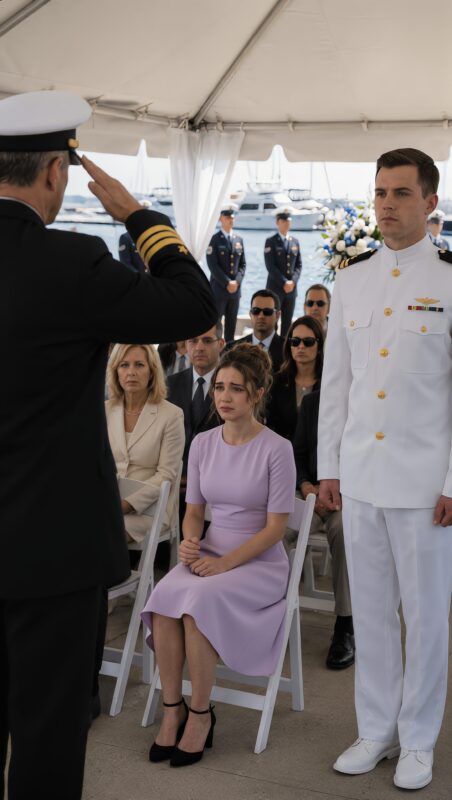
Twenty feet away, Ryan stood beneath the bright California sky in his dress whites. The Trident he had worked so hard to earn gleamed on his uniform.
I was genuinely proud of him.
When he noticed me, however, he didn’t smile.
Instead, he walked over and spoke quietly.
“Emily, can we please have one day without drama?”
I looked at him.
“I came to watch my brother receive his Trident.”
“That’s all?”
“That’s all.”
He studied me suspiciously before returning to the other SEALs.
My family had never understood my silence.
When I was younger, I argued with them.
Eventually, I realized there was little point in defending myself to people who had already decided who I was.
So I stopped explaining.
Mom looked over my plain black dress and whispered to Aunt Patricia.
“Of all the things she could have worn…”
Aunt Patricia gave me a disapproving glance.
I ignored them.
In the Carter family, Ryan had always been easy to celebrate.
He was athletic, popular, confident, and ambitious.
Football captain.
Prom king.
Then the military.
Then the SEALs.
My father loved talking about him.
“My son serves his country,” he would proudly tell strangers.
If someone asked about me, his tone changed.
“Emily? She’s still finding her way.”
That was the story my family had chosen.
They knew I had left college.
They knew my work required frequent travel.
They knew I sometimes disappeared for months and rarely discussed what I did.
They didn’t know much more because they had stopped asking serious questions years ago.
And I had stopped volunteering answers.
That morning, the security officer at the entrance examined my credentials carefully.
His posture changed slightly.
Mom noticed him looking at me and immediately intervened.
“There must be some confusion. She’s only here as Ryan’s sister.”
The officer glanced at her, then back at me.
“Ma’am?”
“It’s fine,” I said.
Inside my purse was an official invitation containing information my family had never bothered to learn.
My full title.
My rank.
The reason I had been specifically requested to attend.
I could have taken it out.
Instead, I left it where it was.
People reveal a great deal about themselves when they believe there will be no consequences for their behavior.
A few minutes later, my cousin Madison turned around.
“Aren’t you in the wrong section?”
“No.”
“These seats are supposed to be for close family.”
“I’m his sister.”
She laughed softly.
“I meant family who actually supported him.”
Several people heard her.
So did Ryan.
He looked in our direction but remained silent.
That hurt more than Madison’s comment.
Dad leaned toward me.
“You probably shouldn’t come to the reception afterward.”
“Why?”
“There’ll be officers and important people there. Someone might ask what you’ve accomplished.”
Mom touched his arm as if he had gone too far, but then she added, “Your father only means that today should remain focused on Ryan.”
I almost laughed.
Then Ryan returned.
He had apparently heard enough of the conversation to misunderstand everything.
“Why did you even come, Emily?”
“Because you’re my brother.”
“You disappear for years and suddenly show up here, sitting in the front section.”
“This is the seat I was assigned.”
He shook his head.
“You always find some way to make people wonder about you.”
For a second, I considered showing him the invitation.
Instead, I said, “Enjoy your ceremony, Ryan. You earned it.”
Then I turned toward the stage.
A few minutes later, Commander Nathaniel Hayes was speaking when he suddenly stopped.
His attention shifted away from his notes.
He scanned the audience.
Then his eyes found mine.
His expression changed.
He stepped away from the podium.
Senior officers nearby immediately noticed.
Ryan noticed too.
Commander Hayes began walking toward our section.
My mother straightened in her chair.
She smiled proudly, apparently assuming he was approaching Ryan’s family to congratulate them.
He passed Aunt Patricia.
Then Dad.
Then Mom.
He stopped directly in front of me.
The surrounding conversations disappeared.
Hundreds of eyes followed him.
I rose from my chair.
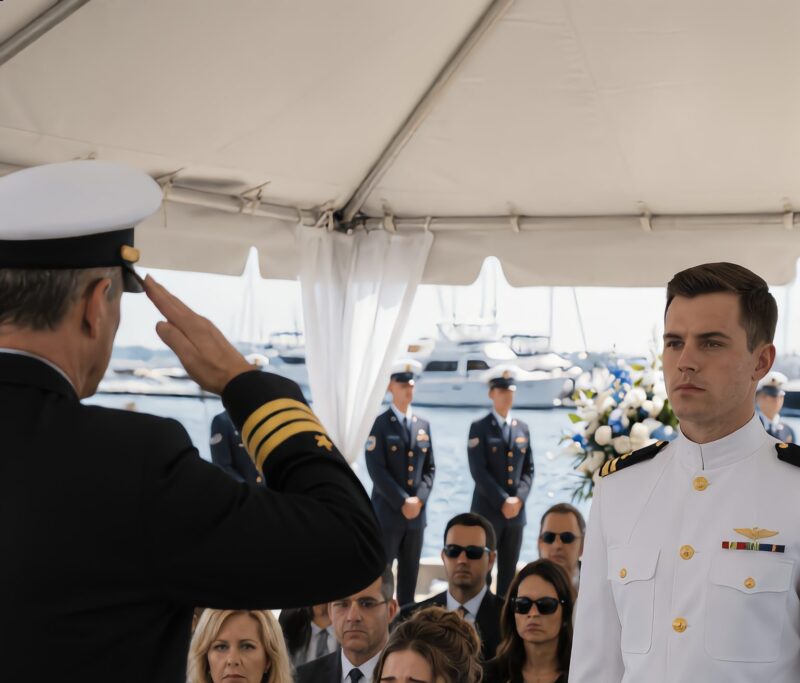
Commander Hayes snapped to attention.
Then he saluted me.
“Ma’am,” he said, his voice carrying through the tent, “we were hoping you’d make it.”
Behind me, someone gasped.
Hayes lowered his salute and faced the audience.
“I realize many of you may not know our guest.”
He gestured toward me.
“Lieutenant Commander Emily Carter.”
I didn’t need to turn around to know what my family looked like.
“For nearly ten years,” Hayes continued, “Lieutenant Commander Carter has served in assignments where discretion matters more than recognition. Much of her work cannot be discussed publicly, which means the people benefiting from it rarely know her name.”
The silence deepened.
Then Hayes said something even Ryan hadn’t expected.
“Several years ago, Lieutenant Commander Carter provided critical support during an overseas operation involving members of my unit. Because of decisions she made under extraordinary circumstances, people who might not otherwise have returned home are standing with us today.”
He turned toward me.
“Having you here means more to this command than I can properly express. Thank you, ma’am.”
I returned his salute.
Applause began somewhere behind the stage.
Then another section joined.
Within moments, the entire tent was applauding.
I didn’t feel triumphant.
I didn’t turn around to enjoy my family’s embarrassment.
Instead, I looked at Ryan.
His face told me everything.
For the first time in our adult lives, my brother realized that the version of me he had accepted without question had never been real.
After the ceremony, I walked toward the shoreline.
I had barely reached the water when I heard Ryan behind me.
“Emily.”
I turned.
He was holding his cap at his side.
For a moment, he seemed unable to find the right words.
Finally, he asked, “Why didn’t you tell me?”
“Tell you what?”
“Any of it.”
I studied his face.
“If you had known my rank before breakfast, would Madison’s comment suddenly have been unacceptable?”
Ryan looked away.
“Would Dad’s jokes have bothered you?”
He said nothing.
“Would you have defended me?”
His shoulders dropped.
“I don’t know.”
“At least that’s honest.”
He stared toward the ocean.
“I spent years thinking you didn’t care about anything.”
“I know.”
“And you just let us believe that?”
“I stopped believing it was my responsibility to convince you otherwise.”
He swallowed.
“I thought I was doing something important.”
“You are.”
He looked at me.
“I mean it, Ryan. What you accomplished today matters. I’m proud of you.”
His eyes became wet.
“How can you say that after the way I treated you?”
“Because your achievement and your behavior are two different things. I can celebrate one without pretending the other didn’t hurt.”
He nodded slowly.
“I’m sorry.”
I stepped closer and adjusted his collar.
It was something I had done countless times when we were children.
Ryan suddenly laughed through his tears.
“You still do that.”
“You still wear your collar crooked.”
He hugged me.
Our parents stood several yards away.
Mom looked as though she wanted to approach but didn’t know whether she should.
For once, I didn’t solve the problem for her.
If my parents wanted a relationship with me, they could begin by walking those few yards themselves.
I had spent too much of my life trying to earn respect from people who believed respect had to be justified by accomplishments.
That ceremony finally taught me something I should have understood years earlier.
The uniform didn’t make me valuable.
My rank didn’t make me worthy.
Commander Hayes’s salute didn’t create my dignity.
And the applause of hundreds of people didn’t transform me into someone my family should suddenly love.
I had deserved basic respect when they thought I was unsuccessful too.
The salute had only exposed how differently they behaved once they discovered I had status.
Ryan and I started walking toward the reception.
After a few steps, he stopped.
“Emily?”
I turned.
He hesitated before saying quietly, “I’ve spent my whole life wanting Mom and Dad to say they were proud of me.”
He looked directly at me.
“I never realized you probably wanted the same thing.”
“Once.”
“And now?”
I smiled faintly.
“Now I know I don’t need it.”
Ryan nodded.
Then he said, “Well, for whatever it’s worth, I’m proud you’re my sister.”
This time, I didn’t need the words.
But I was glad to hear them.
“I’m proud you’re my brother.”
We continued toward the reception together.
Not as the decorated son and the disappointing daughter.
Not as the golden child and the family mystery.
Just Emily and Ryan.
Brother and sister.
And for the first time in years, that was enough.