My Parents Took My Sister on Luxury Vacations and Left Me on Grandpa’s Farm—Eleven Summers Later, I Discovered Why He Kept a Secret
The first time my parents abandoned me at my grandfather’s farm, I was seven years old.
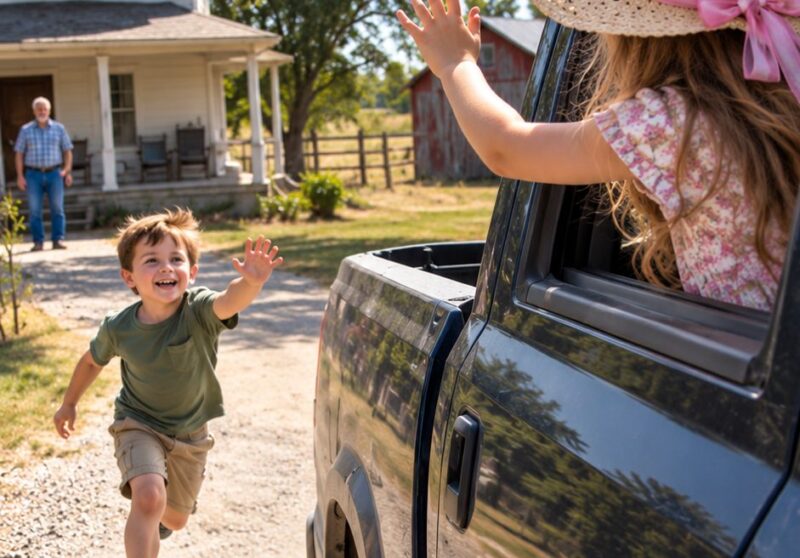
Dad unloaded my belongings from the trunk. Everything I owned for the summer had been crammed into a faded pillowcase.
Meanwhile, my younger sister, Paige, sat in the back seat, excitedly talking about the amusement parks they would visit in Orlando.
“Can I come with you?” I asked.
Mom barely looked at me.
“Grandpa Walt could use an extra pair of hands. Besides, you love the countryside.”
I wanted to tell her that I loved vacations too.
But the car was already pulling away.
That summer, while my family enjoyed hotels, restaurants, and swimming pools, I learned what it meant to work from dawn until dusk.
Grandpa owned a large cattle farm in Kansas. Every morning began before sunrise. There were animals to feed, fences to repair, and endless chores waiting to be finished.
He wasn’t particularly talkative or affectionate.
Yet whenever a job became too difficult, he was there beside me.
He never made me feel useless.
At the end of August, just before my parents arrived, Grandpa handed me a small brass washer engraved with a number.
“Keep it safe, Cal,” he said. “And don’t let your mother see it.”
I slipped it into my pocket, confused.
I had no idea that little piece of metal would someday change my entire life.
The next summer, my parents traveled again.
Paige went with them.
I went to Kansas.
The pattern continued year after year.
My sister collected souvenirs from beaches and foreign cities. I collected calluses, practical skills, and memories of early mornings with Grandpa.
He showed me how to repair engines, handle stubborn livestock, manage equipment, and solve problems without giving up.
Every August, we visited the county courthouse.
Grandpa would place several documents in front of me and explain that they concerned the farm. When I was old enough to sign legally, I signed the documents myself; before then, the necessary paperwork was handled by my legal representative.
After each visit, he gave me another numbered washer.
I stored them in an old red coffee tin beneath my bed.
After eleven summers, I had eleven washers.
The final one carried no number.
Instead, a single word had been engraved on its surface.
HOME.
I assumed it was Grandpa’s way of telling me that his farm would always be a place where I belonged.
I had no idea how literally he meant it.
Years passed.
At my high school graduation, my parents left before my name was called. Grandpa remained until the ceremony ended, cheering when I walked across the stage.
Not long afterward, I discovered that my college savings account had been emptied.
Forty-four thousand dollars—money supposedly reserved for my education—had been spent on family expenses and Paige’s dance training.
Mom offered no apology.
“You’re good at figuring things out,” she said. “You’ll be fine.”
Grandpa helped me cover my immediate expenses, and I worked my way through college, eventually graduating with a degree in agriculture.
My parents missed that ceremony too.
By twenty-three, I had built a steady career. Whenever possible, I returned to Kansas to help Grandpa manage the farm.
Then one ordinary morning turned everything upside down.
Grandpa slipped in the barn and broke his hip.
When I reached the hospital, I found Mom standing outside his room with a folder full of legal documents.
“He can’t keep running that place,” she announced. “It’s time to sell.”
She claimed an old power of attorney gave her authority to negotiate a deal with a solar-energy company.
Hundreds of acres would be sold, supposedly to pay for Grandpa’s medical care.
Something about her urgency bothered me.
My suspicions grew when I learned that my parents had already started arranging the purchase of an expensive lakefront property.
They were counting on money from a sale Grandpa hadn’t even approved.
A few days later, Mom arrived at the farmhouse in a fury.
She slammed a county property report onto the kitchen table.
“Cal, explain why your name is all over this!”
I examined the paperwork.
Grandpa’s farm had originally covered 640 acres.
But the records showed that he now owned only 200.
The other 440 acres, including the house, barns, and valuable northern fields, belonged to me.
I could barely believe what I was reading.
Then a memory flashed through my mind.
The red coffee tin.
I hurried to my old bedroom, found it in the closet, and carried it downstairs.
One by one, I arranged the brass washers beside the property map.
The engraved numbers matched the identification numbers of individual parcels.
And the washer marked HOME corresponded to the farmhouse.
The truth finally became clear.
Grandpa hadn’t been giving me childhood keepsakes. He had spent eleven summers gradually placing his land in my name.
My mother stared at the table, speechless.
Then her disbelief turned into anger.
She accused me of taking advantage of Grandpa and filed a court petition attempting to gain control over his affairs.
But Grandpa had prepared for that possibility long before his accident.
His attorney arrived with a thick folder containing legally recorded deeds and supporting documents.
Every transfer had been completed through the appropriate legal process.
Some dated back to my childhood, when they had been arranged on my behalf. The later transfers carried my own signature.
Then the attorney revealed another document.
Six years earlier, Grandpa had officially revoked Mom’s power of attorney.
She had received the notification by certified mail.
Her signature was clearly visible on the delivery receipt.
When the hearing finally took place, Grandpa appeared in a wheelchair.
The judge asked him whether he understood that most of his property had been transferred to his grandson.
“Of course I do,” Grandpa answered. “I planned every bit of it.”
Then he turned toward my mother.
And what he said next shocked everyone.
“Your mother worked this farm when she was young, Cal. She worked harder than anyone I’ve ever known.”
He paused.
“But I was too stubborn to tell her how proud I was. I demanded perfection and offered almost nothing in return.”
Mom lowered her eyes.
“I thought being strict would make her strong,” Grandpa continued. “Instead, I taught her that love had to be earned.”
His voice became quieter.
“When she started leaving you with me every summer, I saw the same loneliness in you that I’d once caused in her.”
He looked directly at me.
“I couldn’t undo my mistakes with my daughter. But I could make sure my grandson never believed he was worthless.”
The room fell silent.
For the first time, I understood why Grandpa had insisted on teaching me everything he knew.
He wasn’t simply preparing me to work the farm.
He was preparing me to own it.
The judge rejected Mom’s petition, confirmed the validity of the property transfers, and determined that the revoked power of attorney provided no authority for the proposed sale.
The solar-energy agreement collapsed.
So did my parents’ plans for their lake house.
Soon afterward, they returned the entire $44,000 they had taken from my education fund.
But money wasn’t what stayed with me.
It was the telephone call I received from Paige.
“Cal,” she whispered, “I need to tell you something.”
I waited.
“All those years, Mom said you begged to spend your summers with Grandpa. She told me you hated traveling.”
I closed my eyes.
For eleven years, my sister had believed I was choosing farm work over family vacations.
She had never known I was being left behind.
“I’m sorry,” she said.
It was the first apology anyone in my immediate family had offered me.
Several weeks later, Grandpa finally came home from the hospital.
Paige accompanied us.
Before going inside, he asked us to take him to his workshop.
He opened a drawer, searched beneath a stack of old tools, and removed a small brass washer.
This one was blank.
He held it out toward Paige.
“Breakfast is at five-thirty,” he said. “First chores start at six. Think you can manage?”
My sister accepted the washer.
“I’d like to try.”
Grandpa glanced at me.
“What do you think, Cal?”
I looked at Paige and answered, “She’ll learn. You taught me.”
For a moment, Grandpa said nothing.
Then he smiled.
It wasn’t a grand gesture. There were no speeches or celebrations.
Just three people standing in a dusty workshop, finally beginning to understand one another.
As a child, I had spent every summer wondering why my parents kept choosing adventures with Paige over time with me.
For years, I believed those departures meant I was less important.
But Grandpa had seen something in me that my parents had overlooked.
He’d given me knowledge, confidence, responsibility, and eventually a future of my own.
My parents had sent me to Kansas because they didn’t want to take me along. Grandpa had spent eleven summers making sure I’d always have somewhere to belong.