She was just another passenger in seat 8A, finally surrendering to sleep.
Then the captain’s voice tore through the quiet cabin.
“If anyone on board has combat pilot experience, please identify yourself immediately.”
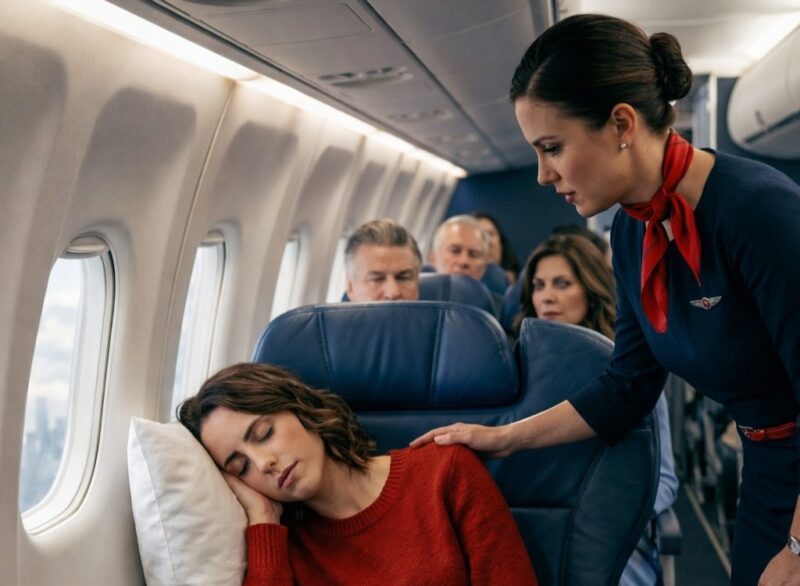
The effect was instant.
Three hundred people fell silent. Conversations stopped mid-word. Even the low drone of the engines seemed to fade beneath the weight of that request.
The woman in the green sweater slowly opened her eyes.
No one around her knew who she really was.
The flight from New York to London had been uneventful—dim lighting, tired passengers, the soft glow of screens in the darkness. It was meant to be routine. Forgettable.
Until now.
Something in the captain’s tone had shifted. It wasn’t calm. It wasn’t reassuring.
It was controlled fear.
Uneasy whispers spread through the cabin. A combat pilot? On a commercial flight? Whatever was happening, it wasn’t normal.
In seat 8A, Mara Dalton blinked, still caught between sleep and awareness. For a moment, she thought she was dreaming—that the words belonged to a life she had already left behind.
To everyone else, she was invisible.
To the man beside her, she was just another exhausted traveler. To the crew, she was the quiet passenger who had refused dinner and asked only for water and a blanket. That anonymity had been deliberate.
She had chosen this.
For weeks, she had tried to step out of her past.
No rank. No missions. No pressure.
Just Mara.
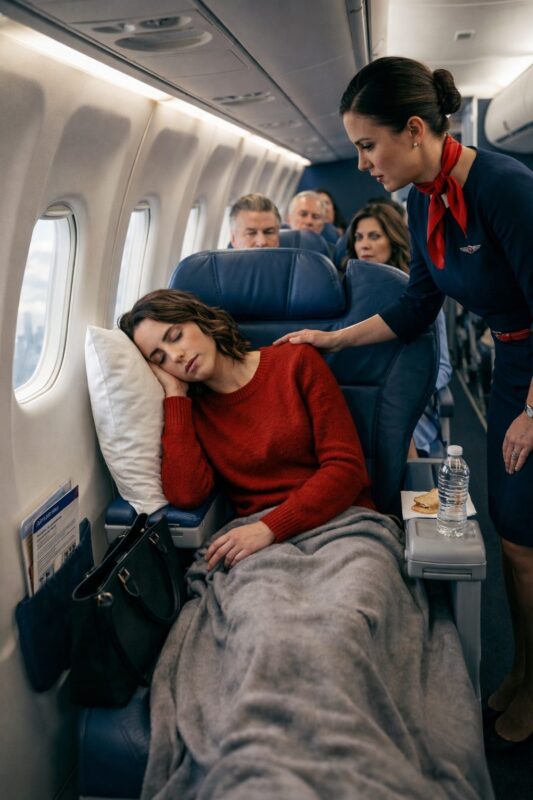
The sweater she wore still carried the faint scent of home—a fragile attempt to feel ordinary again. She had convinced herself she was done with that life, done carrying the burden of decisions that could cost lives.
But when she looked around, she saw it—
Fear.
A mother clutching her baby too tightly. An elderly couple holding hands as if afraid to let go. A young man staring forward, trying to hide his panic.
She knew that look.
A flight attendant moved quickly down the aisle, scanning faces with rising urgency.
“Ma’am,” she said gently, stopping beside Mara. “Do you know if anyone here has military flight experience?”
Mara hesitated.
This wasn’t her responsibility anymore.
She could stay quiet. Keep her head down. Let someone else take that weight—if there even was someone else.
She closed her eyes for a second.
Then opened them.
“I’m a pilot,” she said softly.
The attendant leaned closer. “I’m sorry?”
Mara sat up straighter. Something in her expression shifted—calm, focused, unmistakable.
“I’m a combat pilot. United States Air Force. I flew F-16s.”
The reaction was immediate. Murmurs spread. People turned to look at her. The man beside her stared as if seeing her for the first time.
Relief washed over the attendant’s face.
“Please,” she said quickly. “We need you.”
Mara unfastened her seatbelt and stood.
As she walked forward, the illusion she had built around herself began to fall away. The quiet passenger disappeared with every step.
She wasn’t just Mara anymore.
She was Captain Dalton.
The cockpit door opened, and the moment she stepped inside, she understood the urgency.
The captain’s hands were locked tight on the controls. The first officer looked pale, sweat gathering at his temples. Warning lights flickered across the panel in chaotic patterns.
“You’re the combat pilot?” the captain asked.
“Yes, sir. Captain Mara Dalton. Retired.”
She moved closer, her focus sharpening instantly.
“What’s the situation?”
The captain exhaled sharply. “We’ve lost part of our flight systems. Autopilot failed—we’re flying manually. But that’s not the worst of it.”
He pointed to the radar.
Mara’s chest tightened.
Another aircraft.
Too close.
It wasn’t moving like a civilian plane. It was holding position with precision—tracking them.
“How long has it been there?” she asked.
“About fifteen minutes. No transponder, no communication. Every time we adjust course, it mirrors us.”
Mara studied the screen, her instincts snapping back into place.
This wasn’t random.
“Have you contacted air traffic control?”
“They don’t see it. They think it’s a malfunction.”
Mara shook her head slightly.
“It isn’t.”
Where others saw confusion, she saw intent.
A controlled approach.
A situation escalating fast.
And in that moment, the truth became impossible to ignore:
She could walk away from the uniform.
But not from who she was.
She looked at the captain, her voice steady.
“Alright,” she said. “Here’s what we’re going to do.”