The first person to realize Madison had left her chair was her mother.
By then, the seven-year-old was already halfway across the chapel.
“Madison?”
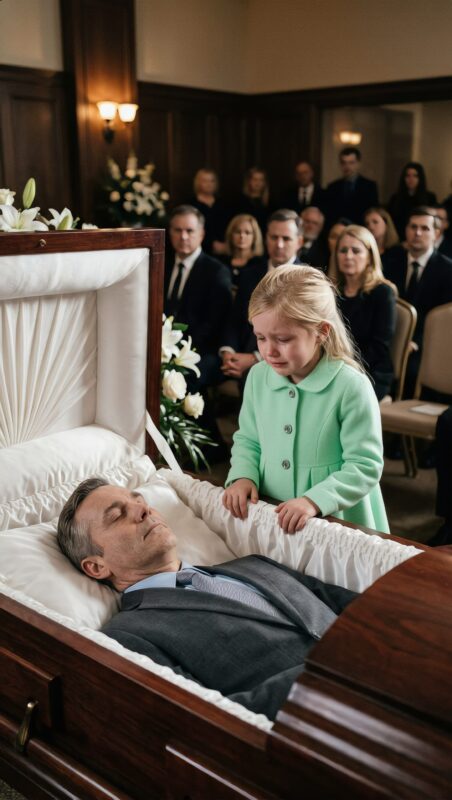
She didn’t turn around.
Her small black shoes made soft tapping sounds against the polished floor as she walked toward the front of the room.
Every chair was occupied. White flowers surrounded the altar, and the air carried the uncomfortable silence of people trying not to cry in front of one another.
Madison stopped beside her father.
For a moment, she simply stood there.
Then she reached toward him.
Her mother rose immediately.
“Sweetheart, come back to me.”
Madison shook her head.
Her navy dress wrinkled as she climbed closer and rested against her father, clutching his jacket with both hands.
The room became completely still.
Her mother hurried forward.
“Madison, honey, please.”
But the little girl held on tighter.
“I need one more minute.”
Those five words stopped her mother.
She stood beside them, fighting tears.
Madison pressed her cheek against her father.
“Everybody keeps saying goodbye,” she whispered. “I don’t want to.”
No one knew what to say.
Then Madison added something that made her mother look at her sharply.
“Daddy wouldn’t want me scared.”
Her mother swallowed.
“How do you know?”
Madison didn’t answer.
She simply stayed where she was.
Several seconds passed.
Then a woman in the front row gasped.
“Did anyone see that?”
Madison’s mother turned.
“See what?”
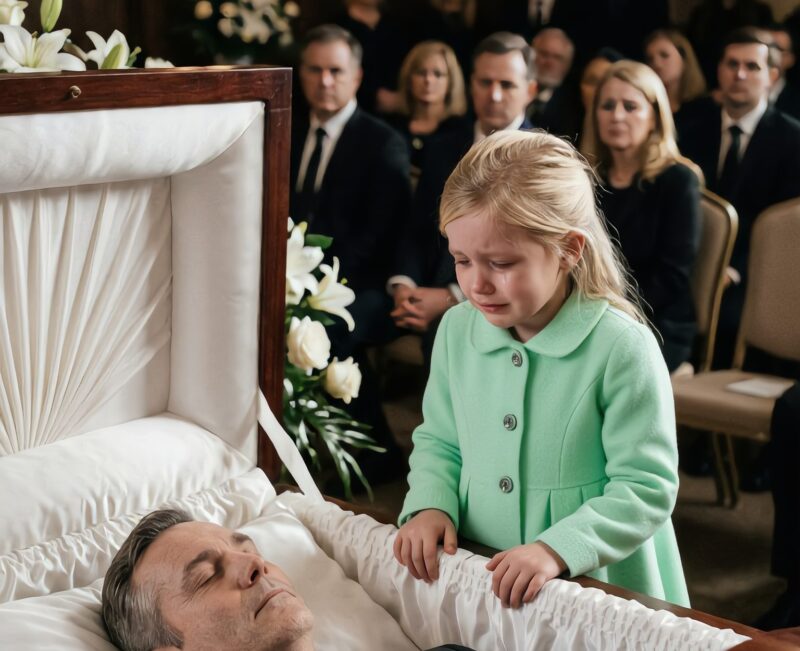
Nobody answered immediately.
Their attention had shifted toward Madison’s father.
One of his fingers appeared to move.
His wife stared at his hand.
Nothing happened.
Perhaps they had imagined it.
Then his fingers shifted again.
This time, several people saw it.
“Call someone,” Madison’s mother said.
Her voice was barely audible.
Madison lifted her head.
“Daddy?”
Another small movement.
Then his hand slowly shifted toward her.
Madison froze as his fingertips touched her hair.
Her eyes widened.
“Mom?”
Her mother was already crying.
Medical help was called immediately, but Madison barely seemed to notice the commotion around her.
She was watching her father.
His eyelids moved.
Then, gradually, they opened.
For one long second, father and daughter simply stared at each other.
Madison’s mouth fell open.
“Daddy?”
His gaze found her.
She threw her arms around him.
“You came back!”
People around them began crying, talking, and calling for help all at once.
Madison’s mother reached for her husband’s hand.
“Can you hear us?”
His mouth moved.
No sound came at first.
Then, with enormous effort, he whispered one name.
“Madison.”
She buried her face against him and cried.
Only minutes earlier, she had believed she was holding him for the final time.
Now he was holding her back.
Medical personnel arrived quickly and transported him to the hospital.
Doctors later explained that the severe medical crisis he had suffered had created an extraordinarily unusual situation. The signs that he was still alive had been so faint that they had gone undetected.
His recovery was uncertain.
The family spent several anxious days waiting.
Madison carried the navy ribbon she had worn to the chapel everywhere she went.
Then one morning, her mother finally smiled at her.
“Someone wants to see you.”
Madison rushed down the hospital corridor.
When the door opened, she stopped.
Her father was sitting up.
He looked tired and much weaker than she remembered.
But when he saw her, he smiled.
That was enough.
Madison ran toward him.
“Careful,” her mother warned gently.
Madison slowed at the last second and climbed beside him.
Her father wrapped his arms around her.
She rested her head against his chest and became completely quiet.
He looked down.
“What are you doing?”
“Listening.”
“To what?”
Madison smiled.
“You.”
Beneath her ear was the steady rhythm she had been desperate to hear again.
His heartbeat.
She closed her eyes.
“I thought I lost you.”
Her father held her a little tighter.
“I’m here.”
“I was scared.”
“I know.”
Madison looked at him.
“At the chapel, I thought you were telling me not to be afraid.”
He frowned gently.
“I don’t remember being able to tell you anything.”
“Maybe I just knew.”
Her father smiled through tears.
“Maybe you did.”
Recovery took months.
Some days were easy.
Others weren’t.
But eventually, her father came home.
Ordinary moments became celebrations without anyone needing to call them that.
Breakfast together mattered.
School drop-offs mattered.
Movie nights mattered.
Even hearing him complain about dishes left in the sink made Madison smile.
Several months later, the family returned to the chapel.
Madison hesitated outside.
Her father noticed.
“You okay?”
She looked up at him.
“The last time we came here, I thought you were leaving forever.”
He held out his hand.
“Then maybe we should make a better memory.”
Madison took it.
Together, they walked inside.
Family and friends were waiting—not dressed for mourning, but gathered to celebrate his recovery.
When they reached the front, Madison stopped at the exact place where everything had changed.
Her father knelt beside her.
“You know something?” he said.
“What?”
“You gave me one more hug when you thought there wouldn’t be another.”
Madison wrapped her arms around his neck.
“So?”
“So now I owe you a lot of hugs.”
She laughed.
“How many?”
“I haven’t counted.”
“Good.”
“Why?”
“Because I’m going to need a lot.”
He hugged her tighter.
Some people called what happened an extraordinary medical event.
Others called it impossible luck.
And plenty simply called it a miracle.
Madison never tried to decide who was right.
To her, the explanation was much simpler.
She had walked across that chapel because she wasn’t ready to let her father go.
She thought she was giving him one last hug.
Instead, she felt his hand move.
Months later, she left the same chapel holding that hand.
And this time, nobody was saying goodbye.