The Hidden Secret That Saved the Orlov Museum
An uneasy silence hung over the central hall of the old Moscow museum that afternoon. Wealthy patrons, journalists, lawyers, and members of the board had all gathered for what many believed would be the final transfer of power. After the death of the famous collector and benefactor Mikhail Orlov, everyone expected the museum to fall completely under the control of his second wife, Irina Orlova.
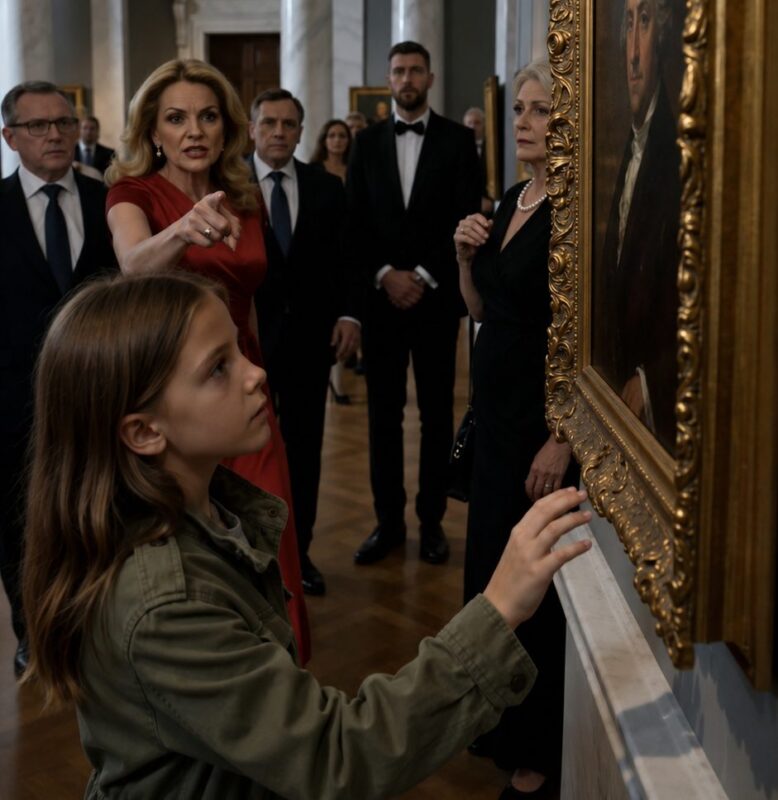
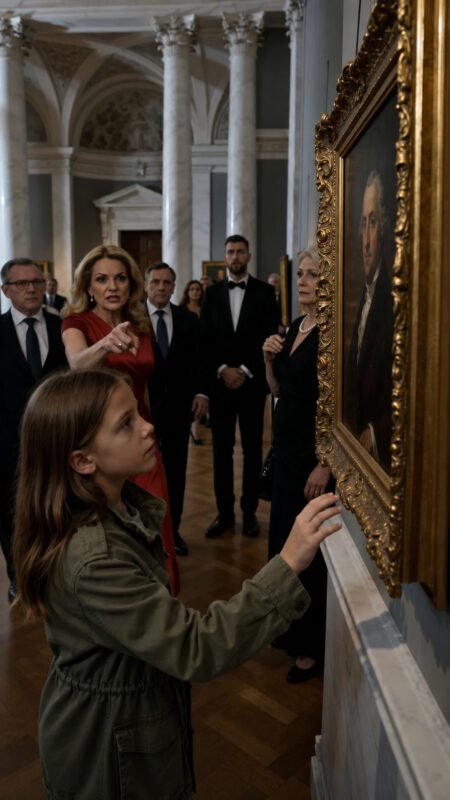
Irina carried herself with the confidence of someone who already considered the victory hers. Her elegant crimson dress, glittering jewelry, and calm, commanding smile made it clear she enjoyed being the center of attention. She often repeated that art belonged to those strong enough to govern it. So when a small girl in a faded green jacket wandered into one of the exhibition halls, irritation flashed across her face immediately.
“Don’t touch that,” Irina snapped coldly. “You could never afford anything here.”
But the child refused to step away.
Her name was Varya. She was only eight years old, yet she had come to the museum with a purpose.
Three days before his death, her father, Andrei Orlov, had whispered something strange to her:
“If anything happens to me, go to your great-grandfather’s portrait. I hid the truth where only someone I trust could ever find it.”
Andrei had been Mikhail Orlov’s only son from his first marriage. For years, he had openly accused Irina of forging the collector’s final will in order to gain ownership of the museum, the priceless collection, and the family fortune. He had tried to expose her, but before he could prove anything, he died in a suspicious car crash.
After his death, only Varya remained — and the memory of his final words.
The girl approached the large portrait in silence. Her fingers slid along the golden frame until she found a tiny carved symbol hidden in the ornamentation.
“Dad told me where to search,” she said softly.
The room seemed to freeze.
A faint click echoed through the hall. The portrait shifted forward like a concealed door, revealing a hidden compartment behind the canvas. Inside lay an aged parchment sealed with the personal wax emblem of Mikhail Orlov.
Varya carefully lifted the document.
At that exact moment, Irina’s confident smile disappeared.
The elderly attorney standing beside her, a respected lawyer named Gromov, took the parchment with trembling hands. As he unfolded it, the color drained from his face.
It was the original will.
Older than every other version that had ever been presented.
And authenticated with Mikhail Orlov’s official seal.
The document made everything unmistakably clear:
The museum was never meant to belong to Irina Orlova.
Neither the family foundation nor the main art collection were to fall under her authority.
All rights were reserved exclusively for the direct blood descendants of the Orlov family.
After Andrei Orlov’s death, the inheritance was to pass to his daughter, Varvara.
Shock swept through the hall in an instant. Quiet whispers spread among the guests.
Irina immediately called the document fake and insisted the child had no idea what she was holding. But Gromov had already discovered something else hidden with the will — a handwritten letter from Mikhail Orlov himself.
Its message destroyed any remaining doubt.
In the letter, Mikhail explained that the museum had to be protected from people who valued influence more than memory and legacy.
The letter read:
“If these words are being read, then I was unable to protect the museum from those who seek power above all else. Let its future belong not to the loudest voice, but to the one who preserves our blood, our conscience, and our truth.”
Irina stepped backward as though the words had physically struck her.
An official investigation began that very same day. It did not take long for investigators to uncover the truth: the so-called “official” final will had been forged, and several members of Irina’s inner circle had known about it for years. Soon afterward, the board of trustees removed her from every position of authority connected to the museum.
Yet the most unforgettable moment came later, after the shouting and confusion had finally faded.
Varya quietly returned to the portrait and stood before it alone.
The painting showed her great-grandfather — the founder of the museum. But in the reflection of the glass, she imagined she could also see her father beside him, as though he had guided her there himself.
Months later, the museum reopened under a newly appointed board.
Near the entrance, visitors noticed a modest plaque:
“The Orlov Museum. Preserved according to the will of the family and entrusted to Varvara Orlova.”
And inside the new children’s gallery, created at Varya’s request, another inscription appeared:
“Art does not belong to the richest people. It belongs to those who know how to protect the truth.”
Sometimes the courage of a single little girl in an old worn jacket can accomplish what adults fear to do for years.
Not for money.
Not for power.
But for the truth.
And because of that, the story of the museum ended not in deception and greed, but in the return of memory, family legacy, and justice.