The laughter began the moment my mother-in-law opened the velvet box.
Inside was a black pet collar with a tiny gold bell.
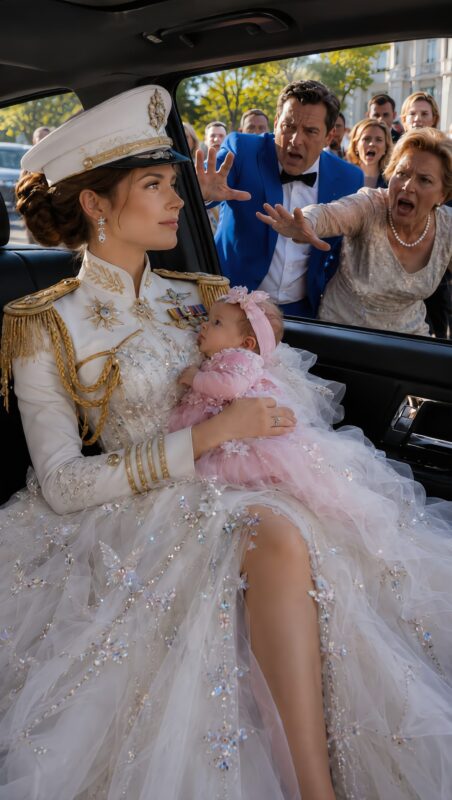
Margaret Pembroke lifted it delicately between two fingers and smiled at the sixty guests gathered beneath the crystal chandeliers.
“For little June,” she announced. “It’s never too early for a girl to understand her place.”
The room erupted.
I stood in the center of the elegant sunroom with my five-week-old daughter asleep against my chest.
Nobody came to my defense.
Not the relatives sipping sparkling water.
Not the family friends pretending this was harmless entertainment.
Not even my husband.
To them, I was simply Nora—the ordinary woman Wesley Pembroke had married despite coming from the wrong side of society.
They knew almost nothing about my real life.
And that was exactly how I preferred it.
What none of them realized was that I was a senior officer in the United States Army.
They also didn’t know that my father, Colonel Thomas Ellis, had spent more than thirty years teaching me how to recognize the difference between an insult and a threat.
The bell on the collar jingled softly as Margaret waved it in my direction.
Around us, the Pembroke estate displayed every sign of old money. White roses stood in gleaming silver vases. Uniformed servers circulated with trays of pastries. Through the tall windows, I could see luxury cars parked along the curved driveway of the Myers Park property.
Everything looked beautiful.
Except the people laughing at my child.
June stirred beneath her pale pink wrap.
I lowered my eyes to her peaceful face.
She smelled of warm milk and baby lotion.
Five weeks old.
That was all.
Yet a room full of adults had already decided she deserved to be reminded that she wasn’t one of them.
Margaret stepped closer.
“Don’t look so offended, Nora. It’s a gift.”
“A collar isn’t a gift for a baby.”
Her smile widened.
“Oh, please. Learn to take a joke.”
The Pembrokes had been making similar “jokes” since the day Wesley introduced me.
They knew I had grown up in a working-class household near Dayton, Ohio. Margaret never missed an opportunity to remind everyone of it.
One Christmas, while her daughters received diamond earrings and designer handbags, Margaret gave me a box filled with household cleaning products.
The following year, my present was an apron.
Across the front, in decorative stitching, were three words:
Know Your Rank.
Everyone laughed.
Wesley later apologized privately.
“That’s just Mom,” he told me. “She’s complicated.”
For years, I accepted that explanation.
My father would have called it something else.
He had served in the Army for more than three decades before retiring as Colonel Thomas Ellis.
Growing up, I learned chess before most children my age understood strategy. Dad taught me discipline, patience, and the importance of knowing when not to react.
“Silence can be a choice,” he once told me. “Surrender is when you let someone else make that choice for you.”
I entered military service at eighteen.
Over the years, I completed command training, served overseas, and eventually took responsibility for personnel involved in sensitive national security operations.
My position required discretion.
I didn’t discuss my work at dinner parties, and I certainly didn’t use my rank to impress my husband’s relatives.
So the Pembrokes invented their own explanation.
Margaret told people I had a minor government job.
I never corrected her.
Until June was born, their opinion of me had seemed irrelevant.
But motherhood changed the equation.
I could tolerate being insulted.
What I could not tolerate was allowing my daughter to grow up believing humiliation was the price of belonging.
Margaret moved even closer.
“Come on, Nora. Let me put it on her. Everyone wants a picture.”
My body reacted before I had time to think.
I stepped backward.
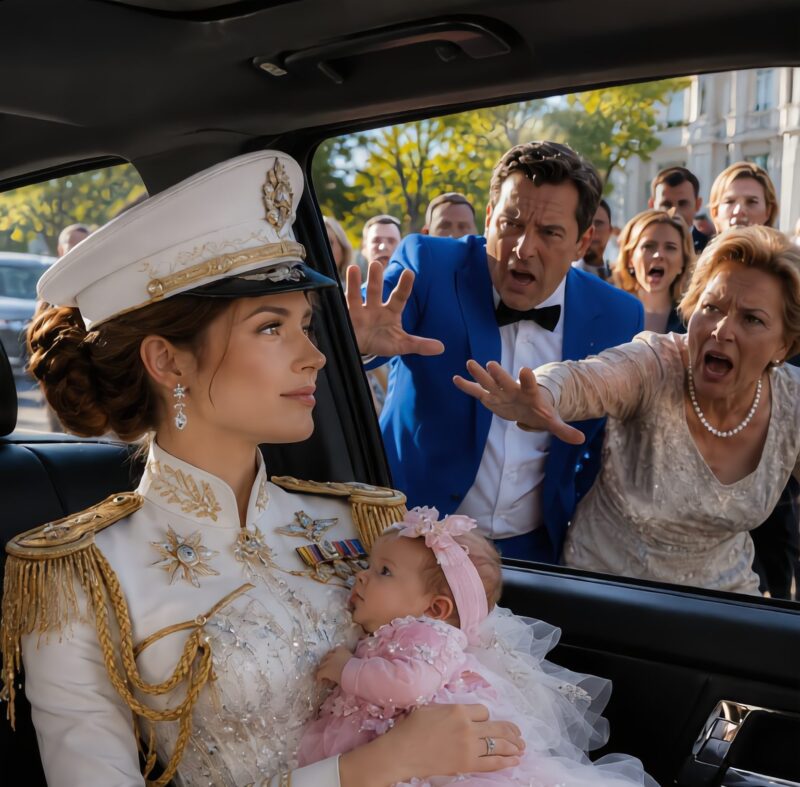
June woke and immediately began crying.
Margaret rolled her eyes.
“Now look what you’ve done. Give her to me.”
She extended her arms.
I tightened mine around my daughter.
“No.”
The laughter stopped.
Someone set down a glass.
For the first time that afternoon, the room became completely silent.
Margaret blinked.
“Excuse me?”
“You heard me.”
I looked across the room at Wesley.
He avoided my eyes.
“Wesley?”
My voice forced him to look at me.
His face showed embarrassment, but I couldn’t tell whether he was embarrassed by his mother’s behavior or mine.
“Mom,” he finally said, “maybe you should put the collar away.”
Margaret turned on him.
“Don’t be ridiculous. Your wife is making a scene over nothing.”
That was when something inside me shifted.
I didn’t become angry.
I became calm.
The kind of calm my father had taught me to trust.
With one hand supporting June, I reached for my phone.
I started recording.
Margaret noticed.
“What are you doing?”
“Nothing important,” I replied.
She continued talking.
That was her mistake.
She repeated the joke.
She defended the collar.
She complained about my background.
Behind her, several guests laughed again.
I recorded every second.
Then I slipped my phone into my bag and picked up June’s diaper bag.
Wesley hurried toward me.
“Where are you going?”
“I’m taking our daughter home.”
“Nora, don’t do this. We can talk after the party.”
I turned to face him.
“Your mother brought a pet collar to celebrate the birth of our daughter.”
“It was stupid,” he whispered.
“And you watched.”
His expression changed.
“Nora—”
“You watched her humiliate your wife and your child because standing up to your mother was uncomfortable.”
“It was only a joke.”
I shook my head.
“No, Wesley. It was an experiment.”
Margaret gave a short, humorless laugh.
“An experiment?”
I looked directly at her.
“You wanted to know how much disrespect I would accept before I finally said no.”
Nobody answered.
“Now you know.”
I walked out of the estate without raising my voice.
By the time I reached my car, June had stopped crying.
My hands hadn’t.
I sat behind the steering wheel for several minutes, staring at the recording on my phone.
Then I sent the entire unedited video to one person.
My father.
He called almost immediately.
“Nora.”
His voice was calm.
“Are you safe?”
“Yes.”
“Is June safe?”
I looked at my sleeping daughter.
“Yes.”
There was a brief silence.
“Good,” Dad said. “Send me anything else you have. And don’t speak to Margaret tonight.”
The next morning, Wesley arrived home looking as though he hadn’t slept.
He stood in the doorway for several seconds before speaking.
“My father called.”
I waited.
“He wants everyone at the estate at noon.”
“Why?”
“He wouldn’t tell me.”
Wesley rubbed his face.
“He just said the entire family had to be there.”
Then he looked at me.
“Your father is coming.”
I said nothing.
Wesley hesitated.
“He’s bringing several people with him.”
At noon, I returned to the Pembroke estate.
June slept against my chest as I entered the same sunroom where everyone had laughed the previous afternoon.
Nobody was laughing now.
My father stood beside the fireplace in his full dress uniform.
He didn’t need to raise his voice.
He didn’t need to make threats.
Colonel Thomas Ellis simply looked across the room at Margaret Pembroke.
“My daughter has never required your family’s permission to have dignity,” he said.
Margaret’s face tightened.
Dad continued.
“But my granddaughter will not grow up believing that cruelty is something she must tolerate in exchange for acceptance.”
Silence filled the room.
Wesley stepped toward me.
His eyes were red.
“I failed you,” he said quietly. “Both of you.”
For once, I didn’t immediately answer.
I looked down at June.
She had no idea what had happened.
She didn’t know about the collar.
She hadn’t heard the laughter.
And if I had anything to say about it, she would never grow up thinking she deserved either.
My father had spent years teaching me that strength wasn’t measured by how loudly you fought.
Sometimes strength was quieter.
It was walking away when others expected you to stay.
It was saying no when everyone else demanded silence.
It was drawing a boundary that the next generation would never have to draw for themselves.
I bent my head and kissed my daughter’s forehead.
The Pembrokes could keep their wealth, their mansion, and their ideas about rank.
June would inherit something better.
She would inherit the certainty that her dignity was never negotiable.
I held her closer.
“What happened to me ends here.”