The Untold Story of the Anderson Estate: How One Woman Restored a Family
For months, whispers circled the city about the Anderson estate—a striking glass mansion overlooking everything below. But its tension had nothing to do with money or scandal. The real mystery lived inside: three four-year-old children no one could manage.

The triplets of tech billionaire Jonathan Anderson had earned a reputation as unmanageable. Caregivers came and left almost immediately—some in tears, others visibly shaken. One woman even ran out, convinced something was deeply wrong with the children.
Jonathan, buried in work and constant pressure, was running out of options. His children—Oliver, fearless and impulsive; Sophia, thoughtful and observant; and Benjamin, restless and unpredictable—had pushed every nanny away. What he needed was not just help, but someone who could truly understand them.
That someone arrived quietly.
Evelyn.
She carried herself with calm assurance, her presence gentle yet steady. While others doubted her chances, she asked for nothing extravagant—only the opportunity to meet the children.
The following morning unfolded as expected: noise, movement, toys scattered everywhere. But Evelyn did not raise her voice or attempt to control the situation. Instead, she sat down, closed her eyes, and began humming a soft melody.
Something changed.
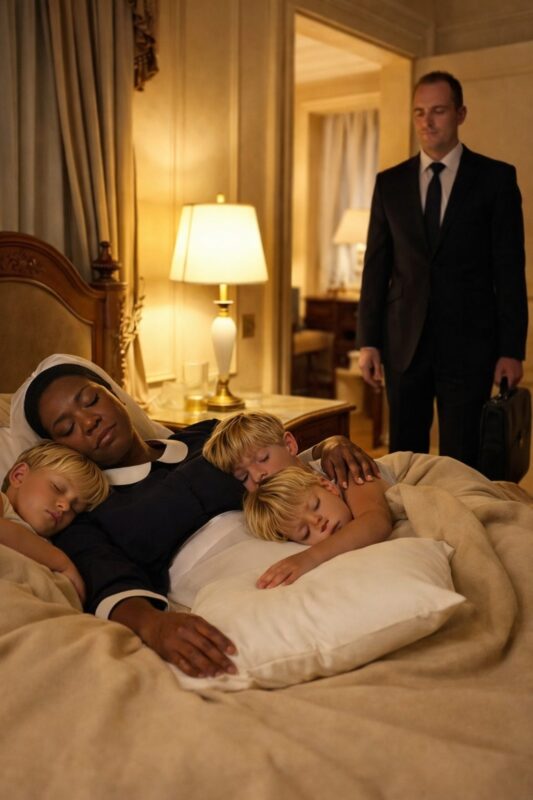
The children paused. Then, slowly, they came closer—curious, cautious, drawn in. For the first time, they listened. And in that silence, Evelyn recognized what no one else had seen. Their behavior was not defiance—it was a cry for something missing.
Days turned into weeks, and Evelyn stayed. The energy of the house began to shift. The chaos did not vanish, but it softened. Laughter appeared where tension once lived.
She saw the truth clearly: these children were not difficult—they were alone.
Their mother, Catherine, had died in a tragic accident before they were born. Their father, overwhelmed by grief, had buried himself in work, creating distance where love should have been. Surrounded by staff, the children still grew up without connection.
Evelyn gave them what they had been silently asking for—attention, patience, and warmth. She listened to them, comforted them, and made them feel visible. When Oliver admitted he acted out just to be noticed, it revealed everything.
But the real barrier was not the children—it was Jonathan.
One afternoon, Evelyn spoke honestly. The children did not need stricter rules, she said—they needed their father. His presence mattered more than any structure.
Her words lingered. That night, Jonathan began to confront what he had long avoided.
The turning point came in the attic. Among forgotten вещи, they discovered a worn wooden rocking horse and photographs of Catherine, smiling as she awaited the birth of her children.
Everything returned at once—the grief, the loss, the silence he had built around it.
The children had been reaching for that connection all along.
For the first time, Jonathan allowed himself to break down in front of them. And in that moment, the distance between them began to dissolve.
From then on, his actions changed. He became present—sharing stories, spending time, rebuilding trust. Slowly, the house transformed from a place of tension into a true home.
The children did not become perfect—but they became understood. Their chaos turned into connection.
Evelyn remained, not simply as a caretaker, but as the person who helped restore what had been lost.
What once was a story about “impossible children” became something deeper—a reminder that wealth cannot replace presence, and that healing begins the moment we face the truth we have been avoiding.