When a Crying Baby Brought Two Worlds Together
Andrew Caldwell, a powerful tech entrepreneur, sat in first class on a flight to London, completely drained. His six-month-old daughter, Lily, had been crying without pause for hours. He had tried everything—feeding her, walking up and down the aisle, changing her diaper, even playing calming sounds—but nothing eased her distress. Around him, the atmosphere grew tense, and the disapproving looks from other passengers only deepened his frustration.
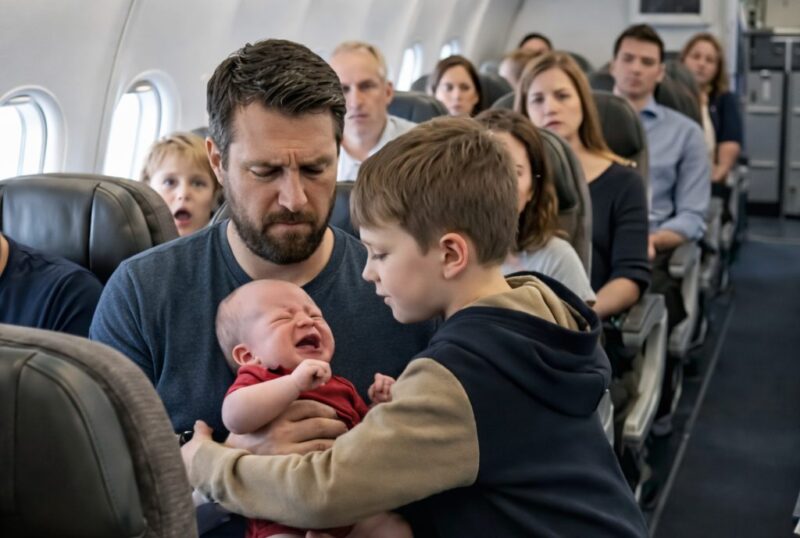
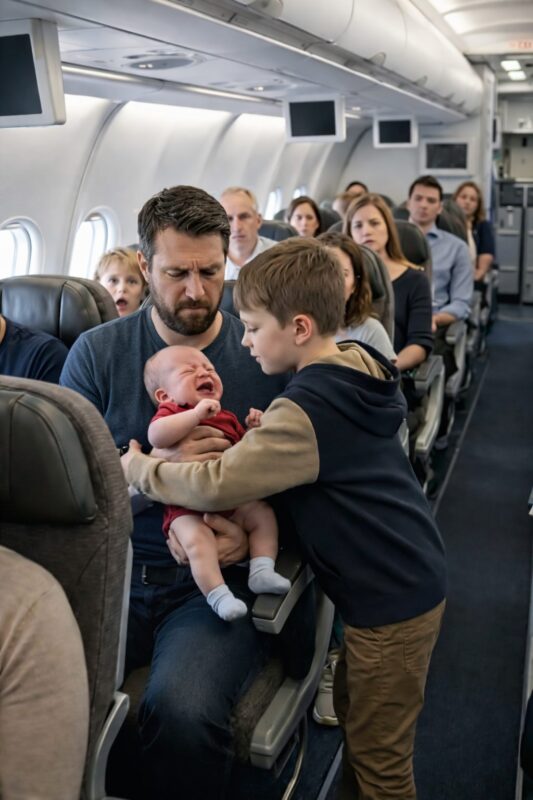
Then, out of nowhere, a teenager from economy class stepped forward.
The boy’s appearance was simple—slightly worn clothes and scuffed sneakers—but his calm presence stood out. Politely and without hesitation, he asked if he could try to help. Too exhausted to argue, Andrew passed Lily into his arms.
Within moments, the cries began to soften.
The boy, Noah Bennett, held her securely, using gentle, rhythmic movements along her back while humming a quiet tune. Gradually, Lily relaxed—and then fell asleep. The sudden silence across the cabin was almost surreal.
Curious, Andrew asked how he had managed it. Noah explained that his younger sister had suffered from severe colic, and he had spent months learning how to comfort her properly.
But Noah was more than just compassionate.
Andrew noticed a notebook filled with advanced mathematical formulas and soon learned that Noah, only sixteen, was on his way to an international math competition in London. Coming from a tough neighborhood in Chicago, he had relied on community support to afford the trip. With limited resources, he had educated himself far beyond his school’s offerings through sheer dedication.
Impressed by both his intellect and maturity, Andrew invited Noah to sit beside him. As they talked, it became clear that Noah had a rare combination of qualities—sharp intelligence, emotional awareness, and quiet confidence.
By the time the plane landed, Andrew had made a decision. He offered Noah a temporary job: help care for Lily during his stay in London, with flexible hours around the competition—and excellent pay. Beyond that, he also proposed supporting Noah’s future education through his foundation.
Though cautious, Noah agreed.
In London, Noah split his time between the competition and helping with Lily. He quickly distinguished himself among the participants—not only for his mathematical ability but for his ability to connect theory with real-life challenges.
In the final round, he presented an innovative model on how diseases spread in crowded urban areas, combining technical knowledge with real-world insight. The judges were deeply impressed.
When the results were announced, Noah stood at the top.
He had won the entire competition—and secured a full scholarship to MIT.
Later, back at the hotel, the celebration was simple but meaningful. What began as a stressful flight had turned into a turning point for both of them.
On the journey home, Andrew and Noah reflected on how easily that moment could have been missed. Noah could have stayed in his seat, and Andrew could have refused his help.
Instead, one chose to act, and the other chose to trust.
That single decision changed everything.
Andrew realized that true success is not only measured by wealth or knowledge, but by the ability to recognize potential in others. Noah understood that even a small act of courage can open doors to life-changing opportunities.
What started with a crying baby became the beginning of a powerful connection—one built on respect, opportunity, and the belief that talent, when given the chance, can shape a new future.