A Millionaire Saw a Waitress Ask His Disabled Son for a Dance—What Happened Next Silenced the Entire Ballroom
The ballroom sparkled like a treasure chest opened for the night.
Crystal chandeliers cast warm golden light across the marble floor. Silk gowns moved like quiet waves between dark tuxedos. Laughter rose and faded in polished rhythms. It was the annual Whitmore Foundation gala—an evening where elegance, wealth, and charity shared the same stage.
Charles Whitmore stood slightly apart from the crowd, holding a glass of mineral water he had not touched. At fifty-two, he had built a vast business empire through discipline and strategy. Yet none of his achievements had prepared him for the quiet weight he felt in his chest that evening.
His attention never left his son.
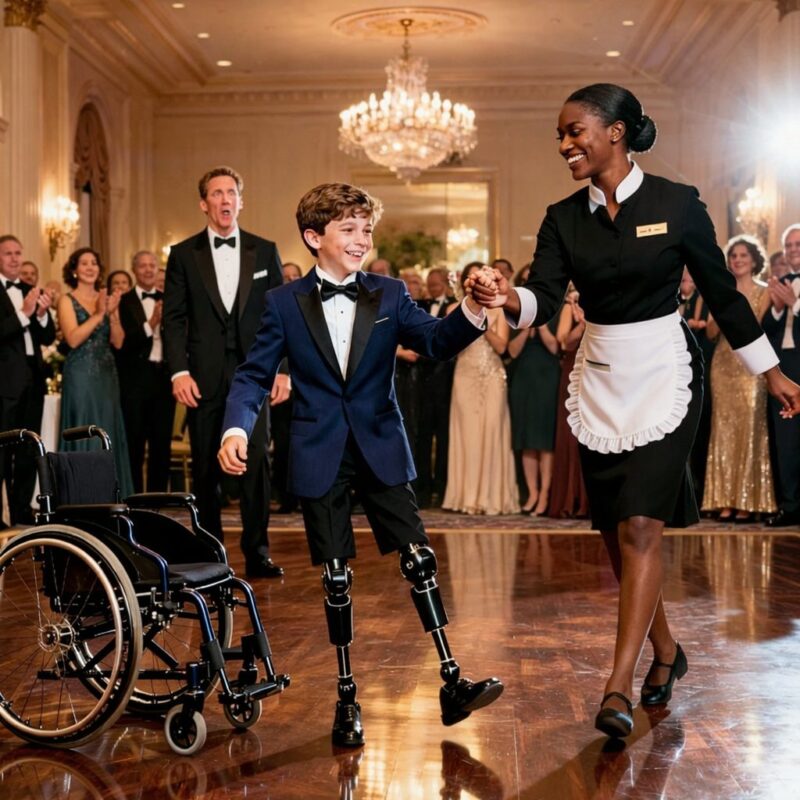
Evan sat beside the dance floor, posture straight, hands resting neatly in his lap. His wheelchair stood just behind him—modern, expensive, almost graceful in its design. Beneath the tailored legs of his tuxedo were prosthetic limbs: sleek, black, and carefully engineered. Evan wore a polite smile, the kind people learn when they know others are always watching.
Charles had convinced himself the gala would help his son. A night of celebration. A reminder that life continued after tragedy. Proof that Evan still belonged in places filled with music and elegance.
But the truth was more complicated. Charles had arranged every detail—ramps, transport, seating—yet there was one thing he could never provide for his son.
The courage to dance again.
Evan had loved dancing as a child. But after the accident, after the surgeries, after the long months of rehabilitation, that joy had quietly disappeared.
The orchestra began a new piece. Couples stepped gracefully onto the floor. Evan watched them, trying to hide the distance in his eyes.
Then she arrived.
A young server moved between the guests carrying a polished silver tray. Her uniform was simple: a black dress, a clean white apron, her hair tied neatly back. A small name tag reflected the chandelier light.
AMARA.
At first, Charles hardly noticed her. Staff at events like this were part of the scenery—efficient and nearly invisible.
Until she stopped beside Evan.
Amara didn’t approach him like a server offering a drink. She approached him like someone who had truly seen another person. She leaned closer and spoke quietly.
Evan looked up, surprised.
Charles felt a small spark of concern. Galas like this had unspoken rules: guests enjoyed themselves while staff remained in the background.
Evan said something.
Amara smiled.
Then she did something completely unexpected.
She placed her tray on a nearby table.
A ripple passed through the room. Conversations slowed. Even the violin hesitated for a moment.
Amara held out her hand.
“Would you like to dance?” she asked.
The entire ballroom seemed to pause.
Charles instinctively took a step forward. This was unusual. Risky. Evan had experienced enough uncomfortable attention in public.
He was about to interrupt—
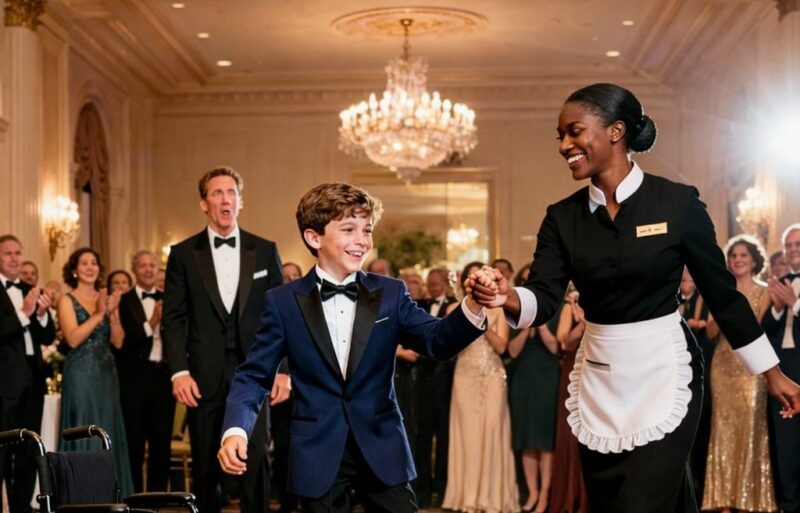
When Evan laughed.
Not the careful smile he usually showed in public, but a real laugh—light and surprised. He glanced at his wheelchair, then at his prosthetic legs, and finally back at her.
“I haven’t danced in years,” he admitted.
“That’s okay,” Amara replied warmly. “We can figure it out together.”
She focused only on him, as if the rest of the ballroom had vanished.
Slowly, Evan pressed against the armrests of his chair.
He stood.
The silence in the room deepened. Even the faint hum of the lights seemed louder.
Evan took a careful step.
Then another.
The prosthetic legs moved smoothly, steady and controlled. Amara adjusted her pace naturally—never pulling him, never rushing him. She simply moved beside him.
The orchestra seemed to understand the moment.
The music grew fuller, richer. Evan stepped onto the dance floor. Amara guided him into the simplest rhythm possible. No dramatic movements. No complicated choreography.
Just movement.
Together.
Applause began softly at the back of the room.
Then more people joined.
Within seconds, the ballroom filled with thunderous clapping.
Charles felt emotion tighten his throat.
He remembered Evan as a little boy, dancing barefoot across the kitchen tiles. He remembered the early morning phone call about the accident. The bright hospital lights. The long nights when he promised his son that life would still be beautiful.
Even when he wasn’t sure it was true.
On the dance floor, Evan laughed again. He stumbled once but quickly recovered. Amara didn’t rush him or correct him.
She simply celebrated the moment.
When the music ended, the entire room erupted in applause.
Evan bowed awkwardly, smiling widely. The applause only grew louder.
Amara quietly picked up her tray, nodded to him like a partner finishing a shared moment, and disappeared back into the crowd.
As if nothing remarkable had happened.
But everything had changed.
Later, Charles found her near the service corridor polishing a glass.
“That was my son,” he said softly. “You didn’t ask my permission.”
Amara nodded calmly.
“I asked him.”
For a moment, neither of them spoke.
“I hope I didn’t cross a line,” she added. “He looked like he wanted to dance.”
Charles took a slow breath.
“He did.”
For the first time, he truly looked at her—the calm confidence in her eyes, the absence of hesitation.
“What made you do it?” he asked.
She smiled gently.
“My brother lost his leg when we were children,” she explained. “He always said the hardest part wasn’t learning to walk again. It was waiting for people to stop being afraid of him.”
Something inside Charles shifted.
“My son stopped dancing because everyone told him to be careful,” Charles said quietly. “Tonight you reminded him to live.”
Amara shrugged softly.
“Sometimes those two things are the same.”
Later that evening, Charles watched Evan surrounded by guests, standing proudly with bright eyes.
For the first time, the empire Charles had built seemed small compared to that moment.
When Evan rolled beside him, glowing with happiness, he whispered,
“Dad… I danced.”
Charles placed a hand on his shoulder and smiled through tears.
“Yes, son,” he said. “You did.”
And in that moment Charles understood something important.
The night hadn’t changed because of wealth, influence, or prestige.
It changed because one woman saw a young man—not a wheelchair, not prosthetic legs, not limitations—and simply asked him to dance.