THE TWELVE-HOUR WATCH
Nobody expected Elias “Sarge” Ransom to become the person bed seven needed most.
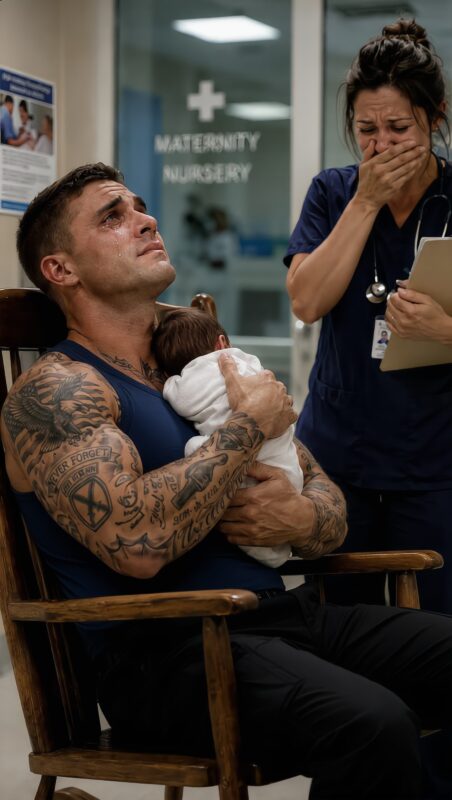
When he first arrived at Willow Creek Medical Center’s neonatal unit, he looked strangely out of place among the quiet machines and tiny incubators.
Sarge was fifty-two, unusually tall, and still carried himself like a soldier despite the limp in his left leg. Old scars marked his arms. His fingers shook whenever he tried to keep them still.
He had applied to become a volunteer in the hospital’s newborn comfort program. His references were excellent, his screening was complete, and every required check had been approved.
Even so, I had doubts.
Those doubts lasted until bed seven began alarming.
The little girl inside had arrived fourteen weeks early. Her chart identified her only as Baby Reed. Her mother, Tessa, had left soon after the birth, overwhelmed by circumstances no newborn could understand.
That evening, the baby had been unusually restless.
Sarge stood several feet away, watching the nurses work.
“Does somebody normally sit with her?” he asked.
“When we can.”
He glanced at the rocking chair.
“May I?”
I looked at his hands.
He noticed.
“They shake,” he said. “They don’t stop me from being careful.”
There was something reassuring in the way he said it.
Under supervision, we let him try.
Once the infant was safely positioned against him, Sarge became completely still.
He didn’t sing.
He didn’t rock.
Instead, he began taking slow, deliberate breaths.
Four counts in.
A pause.
Four counts out.
Another pause.
The rhythm continued.
Little by little, Baby Reed settled.
The frantic movements eased. The numbers on the monitor improved. Within minutes, she was sleeping peacefully.
Then I noticed Sarge’s fingers.
For the first time since he’d arrived, they were still.
Two hours passed.
His volunteer period ended.
“Ready for a break?” I asked.
“Not yet.”
Four hours passed.
Then six.
Every time we suggested moving the baby, Sarge gave the same answer.
“She’s comfortable. I’ll leave when she doesn’t need me.”
By the ninth hour, Martin Sterling from hospital administration appeared.
Sterling believed rules existed for good reasons, and occasionally seemed to believe people existed mainly to follow them.
He stared at Sarge.
“How long has he been there?”
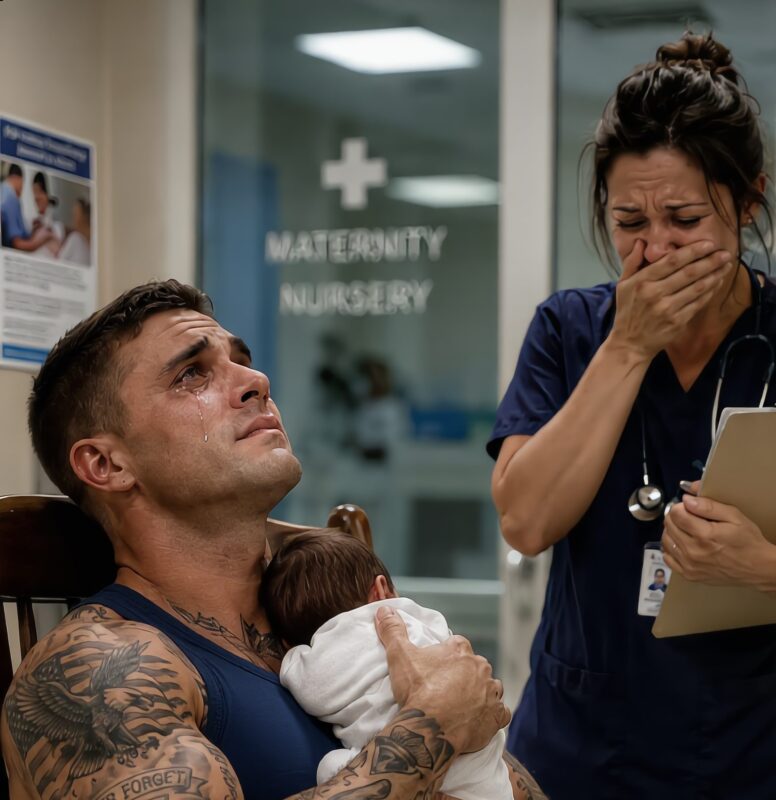
“Nine hours.”
“Absolutely not.”
Sterling approached the chair.
“Mr. Ransom, your volunteer assignment ended hours ago.”
“I know.”
“Then give the infant to the nurse.”
Sarge looked down.
“She’s finally resting.”
“This isn’t optional.”
A physician came over to help transfer Baby Reed.
The moment she was moved, her condition became less settled and the team immediately focused on stabilizing her.
Sarge remained nearby.
When the doctor decided it was appropriate, the baby was returned to the position in which she had been comfortable.
Sarge resumed his breathing rhythm.
Slowly, the room became quieter again.
Sterling watched the monitors.
The physician turned toward him.
“For now, he’s staying.”
Sterling didn’t argue.
After he left, Sarge leaned back.
A thin chain slipped outside his shirt.
Something metallic hung from it.
I assumed it was his identification tag from his years in the military.
Then I saw the engraving.
**NORA RANSOM**
“Your wife?” I asked quietly.
Sarge’s hand closed around the tag.
“My daughter.”
I waited.
Eventually, he told me.
More than two decades earlier, Sarge had been serving overseas when his wife experienced an unexpected premature delivery.
There had been no quick way to contact him.
No video call.
No final conversation.
By the time the message reached him, everything was already over.
His daughter Nora had lived for twelve hours.
He never held her.
“Everyone tells you not to live in the past,” Sarge said. “But nobody explains what you’re supposed to do with the parts of the past that never got finished.”
He looked down at Baby Reed.
“Nora was alone when I should’ve been there.”
I checked the time.
Eleven hours and thirty-eight minutes.
Suddenly his refusal to leave made sense.
“You’re counting the hours,” I said.
He nodded.
“Twelve.”
“For Nora?”
His eyes remained on the infant.
“For both of them.”
Twenty-two minutes later, the clock reached five in the morning.
Twelve hours.
Sarge released a long breath.
He gently looked down at Baby Reed.
“That’s it, kiddo,” he whispered. “Your night watch is finished.”
I thought the story had ended there.
It hadn’t.
Voices erupted beyond the secured doors.
Seconds later, a frightened young woman entered with hospital staff and security nearby.
Tessa Reed had returned.
“Where is she?”
Then she saw Sarge.
Her expression hardened.
“Who are you?”
Sarge immediately allowed the nurse to place the infant back in her bed.
Tessa hurried toward the incubator.
“Why was that man holding my daughter?”
Sarge didn’t defend himself.
He simply stepped away.
“Because she needed somebody.”
“You don’t know anything about her.”
“No,” he said. “But I know what it means to wish you’d stayed.”
That stopped her.
Sarge pointed gently toward the incubator.
“Look at her.”
Tessa did.
Her daughter was sleeping.
“She spent the whole night working hard to stay strong,” Sarge said. “Whatever happened yesterday doesn’t have to decide what you do today.”
Tessa pressed one hand against the incubator.
Her face crumpled.
“I don’t know how to do this.”
“Then don’t pretend you do.”
Sarge’s voice softened.
“Ask for help. Learn. Come back tomorrow. Then come back the day after that.”
Tessa looked at him.
“Why do you care?”
His fingers found the metal tag around his neck.
“Because once there was a baby I would’ve given anything to come back to.”
He said nothing more.
He didn’t need to.
Tessa agreed to meet with the hospital’s support team.
Before leaving the unit, she returned to her daughter’s bedside and remained there for several quiet minutes.
Sarge watched from across the room.
His hands had begun trembling again.
“You should go home,” I told him.
“Probably.”
He removed his volunteer gown.
At the doorway, he glanced toward bed seven one final time.
“She’ll have someone tomorrow?”
“Yes.”
He nodded.
Then I asked, “Does that someone include you?”
A tired smile appeared.
“If you’ll have me.”
“We’ll have a chair ready.”
Sarge walked into the hallway.
The limp was still there.
So were the shaking hands and the memories he had carried for twenty-two years.
But something was different.
For decades, he’d measured one terrible day by what he had failed to reach in time.
Twelve hours.
Twelve hours his daughter had lived without him.
Twelve hours he could never recover.
Bed seven hadn’t given those hours back.
Nothing could.
Instead, it gave them somewhere new to go.
Sarge couldn’t return to the night Nora was born.
But he could sit beside another fragile child.
He could breathe when she was restless.
He could remain when leaving would have been easier.
And when twelve hours finally passed, he could walk away knowing that, this time, someone had stayed.