After my daughter Lily’s sixth birthday, I thought the most unsettling part of the day had already passed—a harmless-looking gift from my in-laws: a small brown teddy bear wrapped in gold paper and tied with a pink ribbon. I was wrong.
The moment Lily saw it, her face lit up.
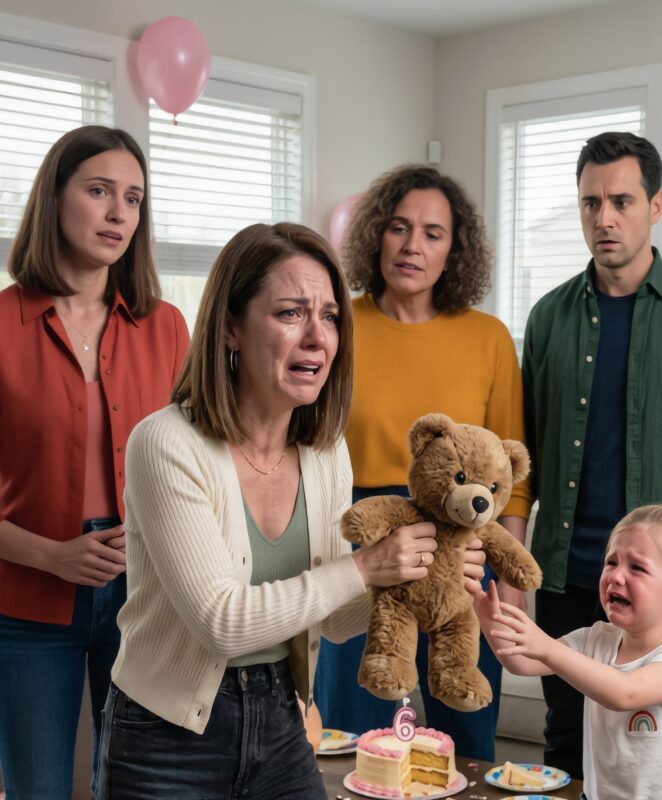
“Grandma and Grandpa remembered me!” she said, clutching it tightly.
I forced a smile. My husband Daniel hadn’t spoken to his parents in months. Their relationship had fallen apart over control and boundaries, and I didn’t want that history to cast a shadow over Lily’s birthday.
“Go on, open it,” I said gently.
She tore away the wrapping, lifted the bear into her arms, and hugged it—then suddenly froze.
Her hands dropped. Her expression changed instantly.
“Mommy… what is it?” she whispered.
At first, I thought she meant the label. Then I noticed it too—the bear’s eye. One looked ordinary. The other felt disturbingly off… too deep, too precise, like something hidden behind it.
A cold sensation swept through me.
I took the toy from her. “Go help Daddy with the cake,” I said, keeping my voice steady.
Daniel saw my face right away.
I turned the bear over and traced the seam. Something hard was embedded inside.
A camera.
My heart sank, but I didn’t react outwardly. No confrontation. No panic. I took photos, secured the toy, and called my brother Aaron, who works as a detective.
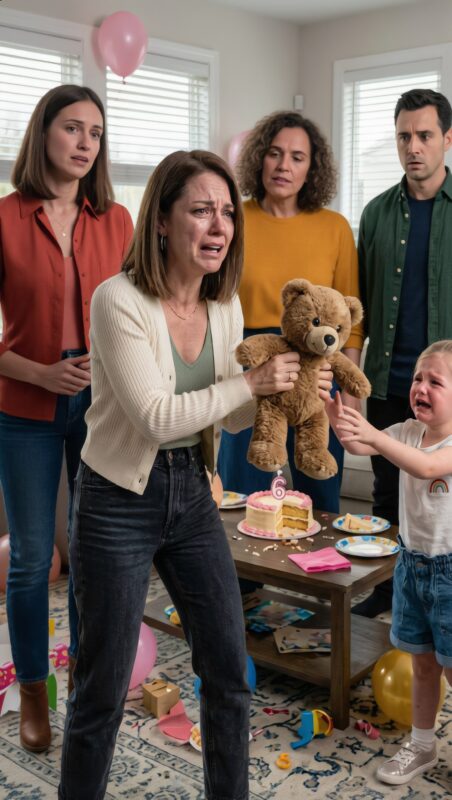
“Don’t touch anything else,” he warned. “We’ll handle this the right way.”
Three days later, police arrived at my in-laws’ house.
By then, I already knew what they would find. A technician carefully dismantled the teddy bear in front of us, exposing a hidden camera system with audio recording and storage. The lens had been concealed behind the eye.
Daniel turned pale.
“They wouldn’t do this,” he murmured.
But the recordings told another story.
We watched clips of Margaret and Richard discussing the device—how they would use it to monitor Lily, how it could help them challenge my parenting, how it might provide “proof” for a custody case.
My stomach twisted.
This wasn’t concern. It was surveillance.
The investigation widened quickly. Officers reviewed messages, devices, and financial activity. The evidence showed clear preparation. This had been planned.
It was intentional.
Soon after, a search warrant was executed at their home.
Inside, investigators discovered the original packaging, instruction manuals, and a second hidden device. On Margaret’s computer were folders labeled “Lily,” filled with recordings and screenshots.
The goal was undeniable: to build a case against me using secretly gathered evidence.
Richard tried to distance himself. Margaret insisted she was only acting out of “concern for her granddaughter.” But the facts said otherwise.
They had crossed a line that could not be repaired.
In court, the charges were straightforward: illegal surveillance, invasion of privacy, and unauthorized monitoring of a minor.
The judge didn’t hesitate.
“Concern is not a justification for hiding recording devices in a child’s toy,” she said.
A restraining order followed immediately—no contact, no communication, no exceptions.
Daniel stood quietly afterward. “They were spying on our daughter,” he said.
I didn’t answer at first. There was nothing that needed to be said.
In the weeks that followed, relatives tried to soften what had happened. They called it a misunderstanding. A mistake.
But Daniel didn’t bend.
“They put a camera in our daughter’s teddy bear,” he said. “There’s nothing left to discuss.”
For the first time, he wasn’t protecting their image—he was protecting us.
At home, Lily slowly healed. She began asking questions about safety, trust, and gifts. Each question hurt, but we answered honestly.
“We always check first,” I told her. “You’re safe.”
And little by little, her laughter returned.
On her next birthday, there were no surprises—only things she could see and understand. She opened a gift, looked up at me, and asked softly:
“Is this safe?”
I checked it carefully and nodded.
“Yes.”
She smiled and held it close.
And in that moment, I realized something simple but profound:
We hadn’t lost our family that day.
We had lost the illusion that it had ever been safe.
And now, we finally knew how to protect it for real.