After raising four wonderful daughters, I gave birth to the baby boy my husband had hoped for for nearly eight years.
Aaron’s joy lasted less than ten minutes.
One tiny mark on our newborn’s skin was enough to destroy it.
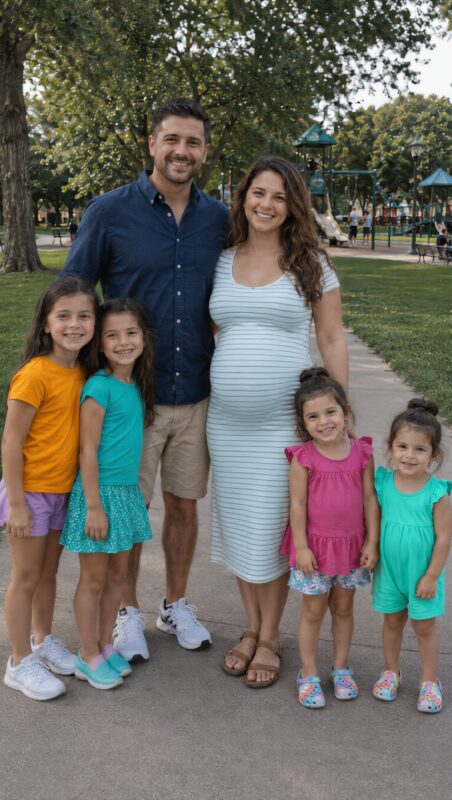
I was exhausted after twelve hours of labor when the nurse finally brought our son into the room. At home, Lily, Grace, Chloe, and Ava were impatiently waiting for pictures of their new baby brother.
Aaron couldn’t stop smiling.
“Our son,” he murmured as the nurse handed him the tiny bundle. “I can’t believe he’s finally here.”
He cradled the baby against his chest as though nothing else in the world existed.
Then the nurse loosened the onesie to check him.
Aaron suddenly went rigid.
Near the baby’s lower back was a small birthmark shaped like a crescent.
I noticed Aaron’s expression before I noticed the mark.
“What is it?”
He didn’t answer at first.
Then he said one name.
“Michael.”
I immediately understood.
Michael had been Aaron’s best friend for years. During my difficult pregnancy, he had become especially helpful. He brought groceries, collected the girls from school, drove me to medical appointments, and helped whenever Aaron’s work kept him away from home.
And Michael had a distinctive crescent-shaped birthmark in almost the same place.
Aaron stared at our newborn.
“It’s identical.”
I couldn’t believe where his mind had gone.
“Are you accusing me of having a child with Michael?”
Instead of answering the question, Aaron began demanding answers of his own.
How often had Michael been at the house?
Had we ever been alone together?
Was there something I hadn’t told him?
I was stunned.
“You asked Michael to help me,” I reminded him. “You were the one who called him whenever you couldn’t be there.”
Aaron barely seemed to hear me.
So I gave him the simplest solution.
“Get a paternity test.”
He looked away.
“Do it today,” I insisted. “If you believe I’ve betrayed you, prove it.”
But he didn’t want a test.
He wanted distance.
Before leaving the hospital, Aaron told me not to return home after I was discharged. He said I should take the baby to my sister Diana’s house until he decided what to do.
Then he left.
No goodbye.
No kiss.
He didn’t even look back at the son he’d been dreaming about for years.
Three days later, Diana’s house was overflowing with children, bags, toys, and confusion.
All five of my children were with me.
My husband wasn’t.
I called Aaron several times.
He ignored every call.
Eventually, one message arrived.
His lawyer would contact me about separating.
Something inside me became strangely calm.
I stopped pleading.
I stopped explaining.
And I ordered the DNA test he’d been unwilling to request himself.
Seven days later, the answer arrived.
PATERNITY PROBABILITY: 99.99%.
Aaron was the biological father.
I took a photograph of the report and sent it to him.
Nothing else.
Forty minutes later, there was a knock at Diana’s door.
Aaron stood outside with tears running down his face.
“I made a terrible mistake.”
I said nothing.
“Please,” he continued. “Let me see him. Let me fix this.”
But the DNA results had created another question.
If Michael wasn’t our son’s father, why did they share such a distinctive birthmark?
We contacted Michael.
His reaction surprised both of us.
He became completely silent.
Finally, he said, “Aaron, there’s something I should have told you years ago.”
He asked us to come to his house.
When we arrived, Michael was waiting at the kitchen table.
He looked directly at Aaron.
“Your father had the same mark.”
Aaron frowned.
“How would you know that?”
Michael took a long breath.
“Because he was my father too.”
Aaron stared at him.
At first, I don’t think he understood the sentence.
Then he did.
Michael wasn’t simply the childhood friend Aaron had treated like a brother.
He actually was his brother.
Their father had lived with a secret for decades.
Michael explained that he’d learned the truth at seventeen. Aaron’s father had acknowledged that Michael was his son but insisted that the truth could never come out.
Michael could remain close to Aaron.
He could visit the family.
He could grow up beside him.
But he could never tell Aaron why their connection felt deeper than an ordinary friendship.
The birthmark had traveled through their father’s family.
And now Aaron’s newborn son carried it too.
What Aaron had mistaken for evidence of infidelity was actually evidence of his own hidden family history.
Then Michael mentioned their father’s funeral.
“You remember when I disappeared outside?”
Aaron nodded.
“Everyone thought I was grieving for your father because he had always been kind to me.”
Michael’s voice broke.
“But I was grieving for my father. I just couldn’t tell anyone.”
Aaron looked devastated.
His father’s secret had changed everything he thought he knew about his family.
But it didn’t change what Aaron had done to me.
The following morning, he came back to Diana’s house.
This time, he didn’t make excuses.
“I failed you,” he said. “I’ll go to counseling. I’ll do whatever you ask. Just give me another chance.”
I looked at him and realized something surprising.
I didn’t want to go back.
“No.”
He seemed certain he’d misheard me.
“No?”
“One mark on our baby’s skin was enough for you to decide I was unfaithful.”
“I was shocked.”
“You didn’t ask me for the truth, Aaron. You decided you already knew it.”
“I made a mistake.”
“You abandoned me in a hospital hours after I’d given birth.”
His face crumpled.
“I know.”
“No, you know now—because a laboratory proved you wrong.”
He reached toward me.
I stepped away.
“My word should have mattered before the DNA results arrived.”
He lowered his hand.
“I trusted you for years,” I continued. “But when it was your turn to trust me, one coincidence mattered more than everything we’d built together.”
Our baby started crying in the next room.
As I went to pick him up, another realization came over me.
For years, I had been arranging my life around Aaron’s happiness.
I loved our four daughters completely. I hadn’t needed another child to feel that our family was complete.
Aaron did.
He desperately wanted a boy.
Eventually, I agreed to another pregnancy because I wanted to give him the family he’d imagined.
But that wasn’t the first time I’d put his wishes ahead of mine.
I had become skilled at compromising.
Too skilled.
I avoided arguments.
Changed plans.
Ignored my own frustration.
Convinced myself that keeping a marriage together sometimes meant becoming smaller inside it.
Holding my newborn son, I finally saw how wrong that had been.
Being a good mother didn’t mean teaching my daughters that a woman should accept anything to preserve her marriage.
And protecting my children didn’t require sacrificing my dignity.
Aaron stood near the doorway.
“Please don’t end our family because of one terrible mistake.”
I looked down at our son.
“This wasn’t about one mistake.”
It was about what that mistake revealed.
When Aaron was frightened, his first instinct hadn’t been to trust me.
It had been to condemn me.
When I needed him most, he had walked away.
I couldn’t pretend I hadn’t seen that.
Aaron quietly said my name.
For years, hearing disappointment in his voice would have made me reconsider everything.
Not anymore.
I carried our baby toward my daughters.
Behind me was the man whose happiness I had spent years trying to protect.
Ahead of me were five children who needed a mother who understood her own worth.
For a long time, I had believed choosing my family meant choosing Aaron.
I finally understood that those weren’t always the same thing.
And for the first time in years, I stopped asking what Aaron wanted.
I asked myself.
Then I chose accordingly.