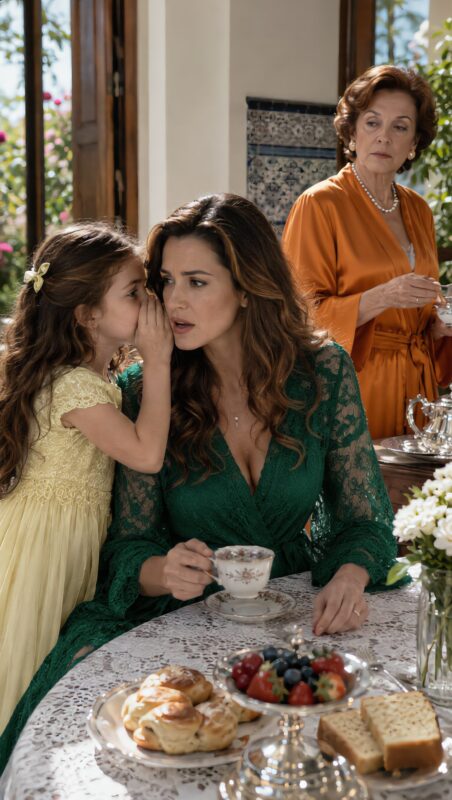
“Mom, Grandma does something strange to your tea.”
My eight-year-old daughter, Elspeth, said it so quietly that I almost didn’t hear her.
I stopped sorting the laundry.
“What kind of strange thing?”
She moved closer.
“When you’re not looking, she takes a tiny bottle from the cupboard and puts something in your mug. Then she waits until you drink everything.”
I felt a sudden chill.
“Does she do it to Dad?”
Elspeth shook her head.
“Only you.”
For nearly a decade, Mireille had been more than my mother-in-law.
After my own mother died, she’d stepped into an emptiness I hadn’t known how to fill. She lived in our home, helped care for Elspeth, cooked meals, and became woven into our everyday routine.
In return, I covered many of her expenses, including medical bills and occasional trips.
I’d trusted her completely.
Every morning, Mireille prepared a cup of chamomile tea especially for me.
“Finish it while it’s warm, Ondine,” she’d remind me. “Your stomach will thank you.”
I’d always considered the ritual an act of affection.
After Elspeth’s warning, it felt different.
I began remembering the way Mireille remained nearby while I drank.
How she sometimes asked if I was going to finish the last few sips.
How she seemed satisfied only when the cup was empty.
That afternoon, I examined the bottom of my mug.
A faint residue clung to the porcelain.
I didn’t mention it.
Instead, I started thinking about the previous several months.
I’d been constantly exhausted.
My joints often hurt for no obvious reason. My skin occasionally developed unusual irritation, and several medical tests had produced abnormal results that doctors couldn’t fully explain.
I’d seen specialists.
I’d changed my diet.
I’d altered my routine.
Nothing had provided a clear answer.
Now my daughter’s words had given those symptoms an entirely different meaning.
That evening, I noticed a small white jar pushed behind several boxes in the kitchen cupboard.
I’d never seen it before.
I reached for it.
Mireille appeared beside me almost instantly.
She positioned herself between me and the cabinet.

“What’s in there?” I asked.
“Just some herbs I use for cooking.”
Her voice remained calm.
Her eyes didn’t.
I withdrew my hand.
The following morning, I woke earlier than usual.
Instead of entering the kitchen immediately, I watched quietly from where Mireille couldn’t easily see me.
She prepared my tea exactly as she always did.
Except this time, I saw the part I’d apparently been missing.
Elspeth had been telling the truth.
My first instinct was to confront Mireille.
I wanted answers immediately.
But anger wouldn’t give me proof.
So I acted as though nothing had changed.
Later, I contacted Zora, a close friend who worked as a research chemist.
After I explained what had been happening, she became serious.
She helped me arrange professional medical testing.
When the results came back, Zora asked me to sit down.
“They found something unusual in your system,” she said.
My mouth went dry.
“What does that mean?”
“It shouldn’t be there, Ondine. And the findings suggest this wasn’t a single exposure.”
I couldn’t speak.
Months of unexplained health problems suddenly had a possible explanation.
What hurt almost as much was realizing who might be responsible.
I’d spent years trusting Mireille.
I’d welcomed her into my home.
I’d allowed her to help raise my daughter.
And every morning, I’d accepted the cup she placed in front of me without hesitation.
Zora insisted that I shouldn’t confront Mireille by myself.
We concentrated instead on preserving what I already knew and getting appropriate outside help.
Then another clue appeared.
Near the place where Mireille kept the white jar, I discovered an old pharmacy receipt.
One name was printed across it:
Malachi Braddock.
I didn’t recognize it.
Neither did Lucien, as far as I knew.
The next morning, Mireille prepared my tea again.
She placed it in front of me with her usual gentle expression.
Before I could touch it, Elspeth came running into the kitchen.
“That smells good. Mommy, can I try some?”
Mireille reacted instantly.
“NO!”
Her shout startled everyone.
Lucien lowered the newspaper he’d been reading.
“Mom?”
Mireille’s face had gone pale.
“What’s wrong?” he asked.
“The tea is too hot for her.”
Lucien reached over and touched the cup.
He frowned.
“Ondine’s tea is barely warm.”
Silence filled the kitchen.
Mireille looked at me.
For the first time since I’d known her, there was no warmth in her expression.
No reassuring smile.
No attempt to look concerned.
Just recognition.
She knew I was watching her.
And I knew she understood why.
I ended the conversation before it could become a confrontation.
My daughter was standing only a few feet away.
Whatever was happening, I didn’t want Elspeth caught in the middle of it.
During the drive to school, I gave her one simple rule.
“Until I tell you otherwise, don’t accept food or drinks from Grandma unless I’m there.”
Elspeth stared at me.
“Is Grandma doing something bad?”
I chose my words carefully.
“I’m finding out what’s happening. You don’t need to solve anything. You already helped me by telling me what you noticed.”
She reached for my hand.
“Are you going to be okay?”
“I’m doing everything I can to make sure we’re both safe.”
After leaving her at school, I backed up the records and information I’d collected.
A few hours later, my phone vibrated.
Motion detected: Kitchen.
I opened the camera feed.
Mireille entered the room.
But she wasn’t alone.
A man followed her inside.
I’d never seen him before.
What immediately frightened me was the way he moved through our home.
There was no hesitation.
He seemed to know exactly where he was going.
He walked straight toward the cupboard.
Straight toward the hidden jar.
Then he stopped.
His head tilted upward.
His eyes settled on the camera.
My stomach dropped.
He pointed.
Mireille turned and followed his finger.
The screen went black.
They’d discovered the camera.
I called Lucien immediately.
He didn’t answer.
I tried again.
Still nothing.
Then Zora called me.
There was something in her voice I’d never heard before.
Urgency.
“Ondine, go to Elspeth’s school immediately.”
“What happened?”
“Just get there.”
I grabbed my keys.
As I rushed toward the car, one thought overwhelmed everything else.
For days, I’d been focused entirely on Mireille.
But the stranger in my kitchen changed that.
This wasn’t only about her.
Someone else knew what was happening.
And whoever he was, he knew our house far too well.
By the time I reached Elspeth’s school, Zora was already there with her.
My daughter was safe.
The proper authorities had also become involved, and because I’d preserved the information I’d gathered, Mireille and the man connected to her—Malachi—could no longer rely on secrecy.
What followed was handled by professionals.
For me, the most important thing was that Elspeth was protected and the truth was finally being taken seriously.
My physical recovery took months.
Learning to trust again took even longer.
Then, one morning, I made myself a cup of tea.
I was sitting beside the window when Elspeth walked into the room.
She stopped when she saw the mug in my hands.
“Did Grandma make that?”
“No.”
“You made it?”
I nodded.
She hesitated.
“Then it’s safe?”
I placed the cup on the table.
“Yes.”
She came closer.
“And you?”
I pulled her gently into my arms.
“I’m safe too.”
Elspeth hugged me tightly.
That was when the tears finally came.
Not because I missed Mireille.
Not because I wanted the past back.
I cried because an eight-year-old girl had paid attention when everyone else had overlooked the smallest details.
She had noticed a pattern.
She had trusted her instincts.
And most importantly, she’d found the courage to speak.
I’d spent much of my life believing that love was measured by how much you sacrificed for another person.
Elspeth taught me that love can look much simpler than that.
Sometimes it’s noticing what everyone else ignores.
Sometimes it’s asking the uncomfortable question.
And sometimes the person who saves you isn’t the strongest or oldest person in the room.
Sometimes it’s the smallest one who refuses to stay silent.