At my own graduation ceremony, my father struck me across the face in front of everyone.
The crack of the slap echoed through the university courtyard so sharply that even the photographers lowered their cameras. My cap flew off and skidded across the ground beside my diploma folder. For a brief second, all I could register was the heat spreading across my cheek as hundreds of students, families, and faculty turned toward the scene.
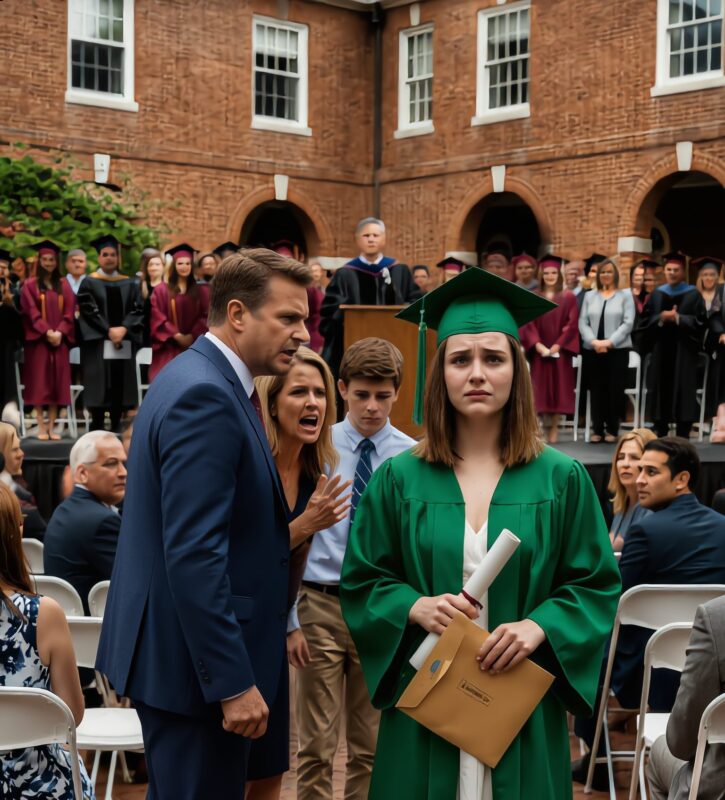
My father stood inches away, his expression twisted with anger. “You don’t deserve that degree,” he said through clenched teeth.
My mother hurried in behind him—not to separate us, but to point at me as if I were something shameful. “You’re a failure in a gown!” she snapped. “You’re embarrassing this family!”
A few people gasped. My friend Chloe leaned in and whispered, “Mia… are you okay?”
I didn’t answer. I couldn’t look away from them.
For years, they had told everyone I had quit university. The story they repeated was simple: I had failed, given up, disappeared. The truth was the opposite—I had earned a scholarship, kept going without them, and built a life they never wanted to acknowledge.
My younger brother Ethan stood just behind them, polished and composed, the “perfect child” they always held up as proof of their success. But even his expression flickered when my name was called with honors.
My father moved again, as if he intended to continue.
A security officer stepped forward, but I lifted my hand. “No,” I said. “It’s fine. Let him.”
He stopped, uncertain.
I bent down, picked up my cap, and straightened my folder. My cheek still burned, but my voice came out calm.
“You’re right,” I said quietly. “People should hear everything.”
My mother narrowed her eyes. “Mia, don’t you—”
I turned away from her and faced the stage, where the university president still held the microphone.
I opened my folder, removed the envelope I had carried all day, and stepped forward.
“Before I leave this university,” I said clearly, “I need to report financial fraud committed in my name—student loans taken out without my consent, documents forged, and my identity used without permission.”
Behind me, my father snapped, “Enough—stop talking!”
But the microphone was already active.
The entire courtyard went still.
Dr. Wallace, the university president, looked between my shaking hands and my parents’ faces. “Are you formally reporting this?”
“Yes,” I replied. “And I have documentation.”
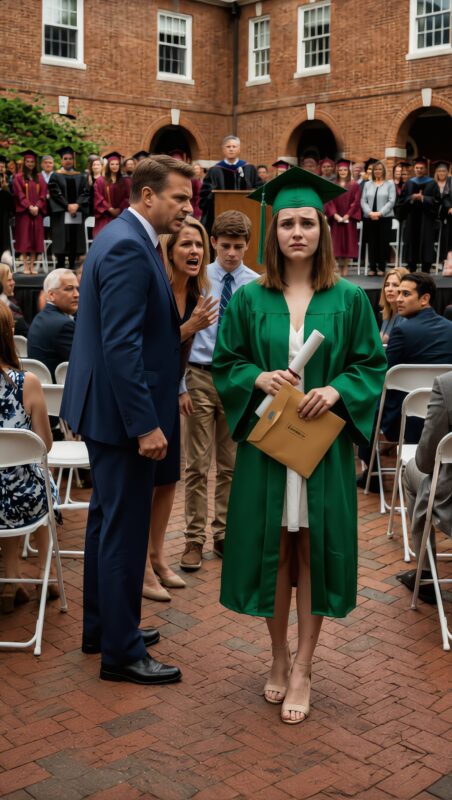
My mother gave a short, dismissive laugh. “She’s always been theatrical.”
I met her eyes. “Was it theatrical when you opened loans under my identity?”
Her expression tightened instantly.
Years earlier, I had found three separate student loans registered in my name—loans I never applied for. The funds had been redirected into accounts my parents controlled. When I confronted them, my father told me I should be grateful. My mother said no one would believe me.
So I stopped arguing. I started collecting proof.
Now I placed the envelope into Dr. Wallace’s hands. Inside were bank statements, forged signatures, loan agreements, and an independent investigator’s report.
My father stepped forward again. “This is a private family issue!”
Security stopped him immediately.
“They didn’t just steal from me,” I said into the microphone. “They built a false version of my life and told everyone I was a failure. I was working. I was surviving. Sometimes I was even sleeping in my car.”
Murmurs rippled through the crowd.
My mother’s voice turned sharp. “Ungrateful girl.”
Then my aunt pushed through the edge of the crowd, pale and shaken. “You told us she was addicted to drugs,” she whispered.
Silence dropped like a weight.
My mother didn’t answer.
The story she had built was collapsing in real time.
Police arrived soon after. The ceremony didn’t continue. There were no cheers, no applause—only stunned silence and the echo of everything that had just been revealed.
It didn’t feel like triumph.
It felt like something breaking open.
But for the first time, it wasn’t me who was being erased.