At twenty-seven, I thought the biggest problem in my life was making it to payday.
Then one evening, I opened my apartment door and found three six-month-old babies waiting for me.
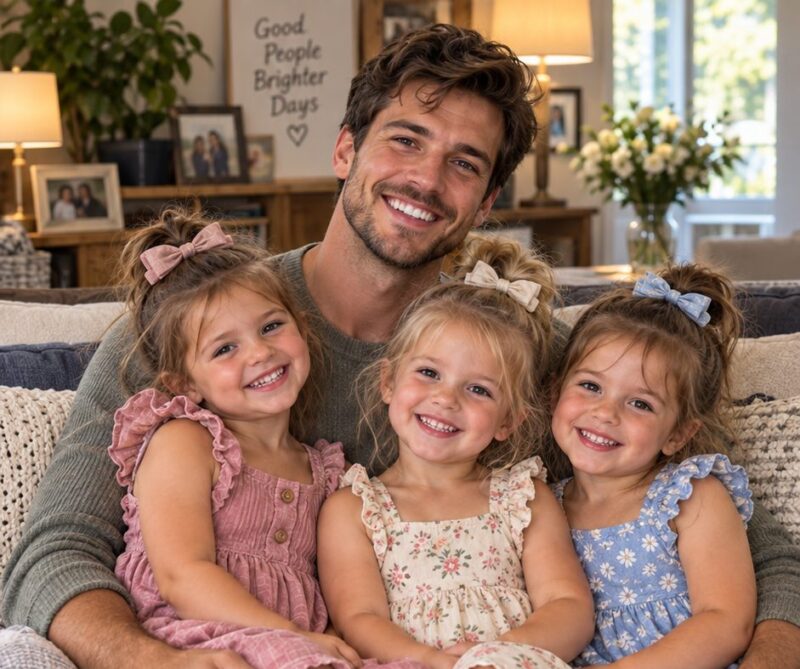
My brother’s daughters.
Three carriers sat side by side in the hallway. Next to them was an overstuffed diaper bag that looked as exhausted as I felt just looking at it.
Tucked beneath one carrier was a crumpled gas-station receipt.
My brother Elias had written a message on the back.
“Noah, I’m sorry. I can’t keep doing this. I feel like I’m drowning.”
Eleven days earlier, his wife, Sarah, had died without warning.
Elias went from being a husband and father to a grieving widower responsible for three infants almost overnight.
Apparently, eleven days had been all he could endure.
Now he was gone.
And the babies were with me.
I wasn’t prepared for any of it.
My apartment was a tiny place above a hardware store. I worked long, physically demanding shifts and had $312 in my bank account.
I didn’t own a crib.
I didn’t know how much formula a baby needed.
I couldn’t have explained the difference between most baby products if my life depended on it.
My neighbor took one look at the situation and told me the sensible thing to do.
“Call social services.”
She was right.
I picked up the phone.
My thumb hovered over the screen.
Then the smallest baby moved inside her carrier.
She reached toward me and closed her tiny fingers around one of mine.
That was it.
I lowered the phone.
I didn’t know how I was going to manage tomorrow, let alone the next twenty years.
But I knew those three girls weren’t leaving with strangers that night.
Their names were Ava, Claire, and June.
At first, I told myself I was only keeping them safe until Elias returned.
He never did.
Days became weeks.
Weeks became months.
Eventually, I stopped thinking of myself as the uncle temporarily looking after them.
They were my girls.
And I was raising them.
The following twenty-two years were messy, exhausting, expensive, and louder than anything I’d imagined.
I took every extra shift I could get.
When that wasn’t enough, I found more work.
Vacations vanished from my vocabulary.
I became an expert at making one grocery trip last longer than it should. I learned how to recognize a fever in the middle of the night, attend school meetings half-awake, and braid hair badly enough that the girls eventually learned to do it themselves.
Then came homework.
Birthday parties.
Teenage arguments.
First heartbreaks.
College applications.
Tuition bills that made me wonder whether eating was really necessary.
Somehow, we survived all of it.
And somehow, those three babies became three remarkable young women.
Ava had always lived through her heart. Happiness, sadness, anger—whatever she felt, she felt completely.
Claire was our keeper of memories. She saved photographs, cards, decorations, and tiny pieces of family history that everyone else would have thrown away.
June was the observer.
She didn’t say much unless she had something worth saying, and she could study a situation for ten minutes and notice what everyone else had missed.
There was one thing we rarely discussed.
Their biological father.
Elias became an empty space in our family history.
Until graduation day.
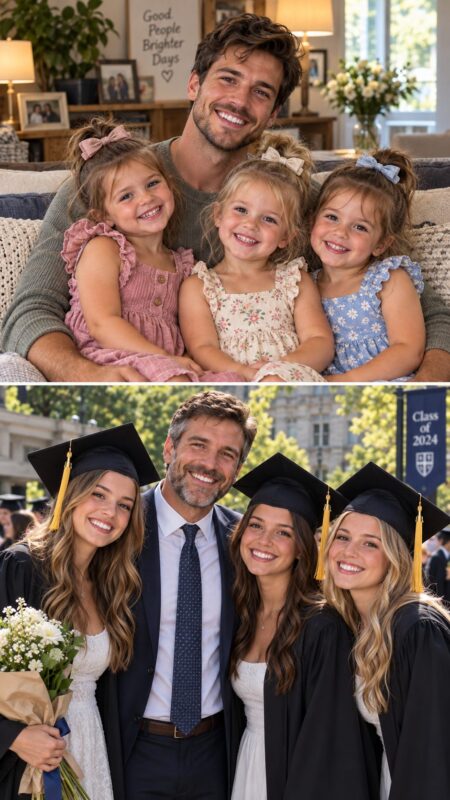
Twenty-two years after I’d found those carriers outside my apartment, I sat in a university auditorium watching my daughters receive their degrees.
My old camera rested in my hands.
My hair had gone gray years earlier, and one knee had never recovered from decades of physical labor.
None of that bothered me.
Ava walked across the stage.
Then Claire.
Then June.
Watching the third diploma being handed over, I felt a weight lift from somewhere deep inside me.
We’d done it.
All those years.
All those bills.
All those nights wondering whether I was enough.
We had made it.
Then the ceremony unexpectedly stopped.
The dean remained at the podium and asked everyone to stay seated.
My daughters walked back onto the stage.
June approached the microphone.
“There is someone missing from today’s ceremony,” she began. “Our biological father isn’t here. But recently, we found something he left behind.”
Every muscle in my body tightened.
Claire handed Ava an old sheet of paper.
Ava unfolded it carefully.
Then she read the opening words.
“My brother Noah will probably never forgive me. But there’s something I know about him: when people need him, he stays.”
I stopped breathing for a moment.
The paper was a letter from Elias.
He had written it before leaving the babies at my door.
Until that moment, I’d always believed he’d abandoned them in blind panic.
The letter told a different story.
Elias had been terrified after Sarah died. He was convinced grief had hollowed him out so completely that he would eventually ruin his daughters’ lives.
And he’d chosen me deliberately.
He knew I wouldn’t walk away.
Realizing that hurt in a way I wasn’t prepared for.
My brother hadn’t simply left.
He’d placed the responsibility on my shoulders because he knew exactly what kind of man I was.
Then June spoke again.
“That wasn’t the only thing we found.”
Recently, the girls had been sorting through boxes from their childhood when Claire came across the old diaper bag.
June examined it and noticed that the bottom seemed thicker than it should have been.
Hidden beneath the lining was a second envelope.
It had remained there for twenty-two years.
On the front was a single instruction:
For Ava, Claire, and June. Open after college graduation.
Ava unfolded that letter too.
“To my three beautiful daughters,” she read. “If this letter is finally in your hands, then you reached the day I hoped you would. But don’t thank me. Thank Noah.”
I stared at the stage through blurred eyes.
In the letter, Elias didn’t defend himself.
He called what he’d done cowardly.
He admitted that he’d run from a responsibility that should have been his.
But he also wrote that he’d trusted me with the most important thing he’d ever had.
His daughters.
Then Ava reached the final lines.
“I gave you my name and my blood. Noah will give you everything else. One day, you’ll understand which of those things makes someone a father.”
Nobody in the auditorium moved.
Then June took the microphone from her sister.
She looked directly toward row twelve.
Toward me.
“We understand now.”
Her voice trembled.
“That man sitting there didn’t inherit three children. He chose us every morning for twenty-two years.”
Ava was crying.
So was Claire.
June continued.
“He worked when he was exhausted. He gave up things we didn’t even know he wanted. And no matter how difficult life became, he never once made us feel like we were a burden.”
She wiped her face.
“We grew up calling him Uncle Noah.”
Then she smiled through her tears.
“But that’s not who he is.”
She looked straight at me.
“That’s our dad.”
The auditorium erupted.
People stood.
Applause filled the room.
I couldn’t process any of it.
Someone beside me grabbed my arm and helped me to my feet.
I started toward the stage on my bad knee.
The girls didn’t make me walk far.
They ran to me.
Three grown women wrapped themselves around me just as tightly as they’d clung to me when they were children.
Ava was the first to say it.
“We love you, Dad.”
Claire held onto me without speaking.
June leaned against my chest.
“We finally understand what staying cost you,” she whispered.
For years, I’d kept an invisible list of everything I’d given up.
Sleep.
Money.
Travel.
Relationships.
Opportunities.
A younger man’s dreams that gradually stopped making sense once three little girls depended on him.
But standing in that auditorium, I realized I’d been looking at my life backward.
Ava, Claire, and June weren’t the reason I’d missed out on living.
They were the reason my life had become something worth remembering.
I still couldn’t forgive Elias for leaving them.
Fear didn’t erase responsibility.
Grief didn’t turn abandonment into something noble.
But his absence wasn’t the end of our family.
It was the beginning of a different one.
Months after graduation, the girls left home one by one to begin their careers.
The silence afterward was almost unbearable.
After twenty-two years of footsteps, arguments, laughter, music, and doors opening and closing, my home suddenly sounded empty.
Even now, I occasionally find evidence of the life we shared.
A hair tie beneath the couch.
An old photograph behind a drawer.
A forgotten birthday card tucked inside a book.
My knee still reminds me of all those years spent working.
The mirror reminds me how much time has passed.
But I don’t look at the gray hair or aching joints and think about sacrifice anymore.
I think about proof.
Proof that when three children needed someone, I was there.
Proof that when life became difficult, I didn’t disappear.
My brother left three babies outside my door.
I opened that door thinking I was saving them.
Twenty-two years later, I finally understood something.
They had saved me too.