I should have realized something was wrong the moment Daniel told my sixteen-year-old son to set the table for two instead of three.
Noah paused with the plates in his hands.
I looked toward my husband.
“You’re not having dinner?”
Daniel shook his head casually.
“I’ve been checking the sauce all day. I’ve already eaten enough.”
It wasn’t an unusual explanation.
What happened next was.
Daniel suddenly announced that dinner would be completely phone-free.
Before Noah or I could respond, he held out his hand.
“Both phones.”
I gave him mine reluctantly. Noah did the same.
Instead of placing them on a counter or leaving them in another room, Daniel carried them into the garage.
Curious, I followed.
He lifted the lid of his heavy metal toolbox, dropped both phones inside, and closed it.
Then he snapped a padlock through the latch.
The metallic click made me stop.
“Why are you locking them up?”
Daniel barely looked at me.
“Because I’d like one peaceful dinner where nobody is staring at a screen.”
I didn’t like it, but arguing over phones seemed ridiculous.
So I went back inside.
Two plates waited on the table.
Two glasses of water.
Daniel had prepared nothing for himself.
While Noah and I sat down, my husband remained standing nearby.
The pasta smelled strongly of oregano and garlic, but there was something else underneath.
Something chemical.
I couldn’t identify it.
Noah took a bite.
His face tightened.
“This tastes bitter.”
Daniel didn’t even glance at his plate.
“It’s fine. Keep eating.”
I should have listened to the alarm going off in my head.
Instead, I took another bite.
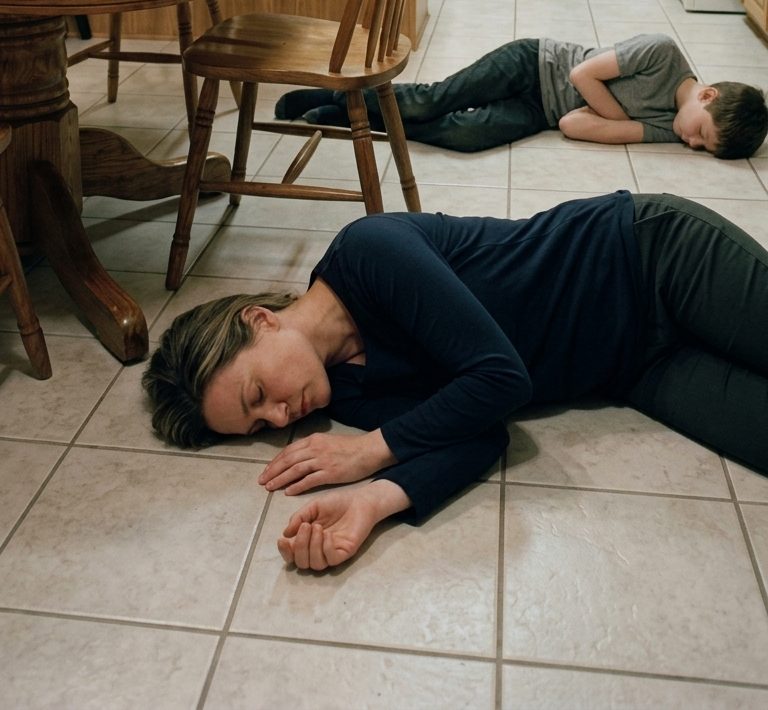
A few moments later, Noah’s fork slipped from his fingers.
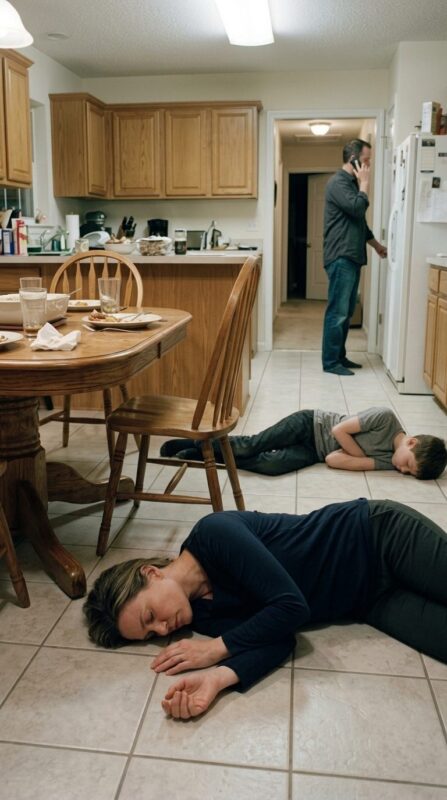
It struck the edge of his plate with a sharp clatter.
“Mom?”
His voice sounded weak.
He pushed his chair backward and tried to stand.
His legs folded beneath him.
I jumped up.
“Noah!”
I made it only a few steps.
Suddenly, my mouth felt painfully dry.
My arms seemed to weigh twice as much as they should.
The floor shifted beneath me.
I reached for the table but missed.
As my vision began to disappear, I looked toward Daniel.
He was watching us.
Not helping.
Not panicking.
Just watching.
“Daniel…”
He didn’t answer.
That was the last thing I remembered.
When I regained consciousness, bright hospital lights were above me.
I immediately tried to sit up.
“Noah. Where’s Noah?”
A doctor stopped me.
“Your son is alive. He’s stable.”
Only then could I breathe.
Tests showed that both of us had a prescription sedative in our bodies.
Neither Noah nor I had knowingly taken it.
The reason we survived had nothing to do with Daniel.
Our neighbor Betty had stopped by to collect a casserole dish she’d lent us earlier that week.
Nobody answered the door.
She noticed the kitchen lights were on, walked around the house, and looked through a window.
She saw Noah on the floor.
Betty called emergency services immediately.
Daniel was nowhere to be found when help arrived.
Several days later, Noah told me what he remembered.
He hadn’t completely lost consciousness.
After I collapsed, Daniel walked over to him.
Noah felt Daniel’s fingers against his neck as though he were checking something.
Then Daniel quietly said, “This will make everything easier.”
Noah could see the microwave clock from the floor.
He concentrated on those glowing numbers because focusing on them helped him remain conscious.
Daniel waited.
Nearly three minutes passed before he finally moved toward the telephone mounted near the pantry.
For a moment, Noah thought his stepfather was calling for an ambulance.
He wasn’t.
Investigators secured the house shortly afterward.
While Noah and I recovered, my sister Leah helped me deal with bills and unopened letters.
One envelope changed everything.
It was a foreclosure warning.
The paperwork referenced an $85,000 home-equity credit line.
In my name.
I stared at the document several times before telling Leah there had to be a mistake.
I’d never borrowed that money.
I’d never even applied for the account.
But the application contained information only someone close to me would have known.
My personal details.
Financial records.
And a signature designed to look like mine.
Designed—but not quite successfully.
Detective Elena Rivera was already investigating Daniel.
After obtaining permission to search his locked toolbox, police opened it.
Our phones were still inside.
So were financial documents and a prescription bottle associated with Daniel.
Beneath several dirty shop cloths, investigators found something else.
A prepaid cell phone.
Rivera visited me afterward.
“We recovered a call made from this phone shortly after you and Noah became unconscious.”
I felt cold.
“Who did he call?”
She didn’t answer immediately.
“We have a person connected to it. I need evidence before I tell you more.”
Three months passed before she contacted me again.
Investigators had linked the prepaid phone to someone connected with falsified financial records.
As they followed the evidence, they discovered that the home-equity loan wasn’t the beginning or end of Daniel’s secrets.
It was simply one piece.
Strangely, the financial betrayal wasn’t what stayed with me.
I kept thinking about those three minutes.
Noah and I had been helpless on the kitchen floor.
Daniel had a working telephone only a few steps away.
He could have called for help immediately.
Instead, the first call he made was connected to protecting whatever he’d been hiding.
Daniel was eventually taken into custody.
But an arrest didn’t magically restore our lives.
Noah stopped eating pasta.
Even the smell of tomato sauce made him uncomfortable.
My trigger was different.
Metal toolboxes.
Whenever I heard one slam shut, I was back in that garage listening to the padlock close around our only easy way to call for help.
Eventually, we agreed that we couldn’t heal while living in that house.
So we sold it.
On the morning we moved out, Noah and I walked through the empty rooms one final time.
We ended up in the kitchen.
The old wall phone was still beside the pantry.
Noah stared at it.
“That thing saved our lives.”
“Not exactly.”
He looked at me.
“Betty saved our lives.”
A small grin appeared.
“All because she wanted her casserole dish.”
I smiled.
“That’s why you always return people’s dishes.”
Noah laughed.
For months, laughter had been rare in our home.
Hearing it echo through that empty kitchen felt like something being returned to us.
Before walking outside, I took my father’s silver watch from my purse.
Police had given it back weeks earlier, but I’d kept it tucked away.
That morning, I finally fastened it around my wrist.
Noah noticed immediately.
“What time does it say?”
I checked.
“Ten seventeen.”
He shook his head.
“I don’t mean the clock.”
I knew what he was asking.
I reached for his hand.
“Then I’d say it’s time for us to leave.”
Our new apartment was nothing special.
It was smaller than our old house.
The couch didn’t match the chairs.
Noah complained that his bedroom felt like a closet.
But there was something our old home hadn’t given us in a long time.
Freedom.
That first Friday evening, we ordered pizza and ate together at the small kitchen table.
Our phones sat beside us.
No rules.
No locked toolbox.
No one watching.
Halfway through dinner, Noah’s phone vibrated.
For a second, both of us stared at it.
Then he glanced at me.
I raised an eyebrow.
He picked up the phone.
We started laughing.
There was something wonderfully ridiculous about how important that tiny moment felt.
A teenager checking his phone during dinner.
Completely ordinary.
Completely harmless.
And completely his choice.
Nobody could take our phones away anymore.
Nobody controlled what appeared on our plates.
Nobody stood over us waiting for us to become helpless.
We were simply eating pizza in our imperfect little apartment.
Noah reached across the table and took my hand.
“I think we’re really okay now.”
I’d heard similar words many times since leaving the hospital.
That evening, I finally felt them.
I squeezed his fingers.
“I think so too.”
My father’s watch continued ticking against my wrist.
For months, I’d imagined Daniel had taken years from us.
I’d thought he’d stolen our sense of safety and permanently divided our lives into before and after.
But I had been wrong about one thing.
He hadn’t taken what came next.
That part was still ours.
And this time, nobody else would decide how we lived it.