Every Sunday, the Kids Next Door Carried Trash Bags—But They Weren’t Cleaning
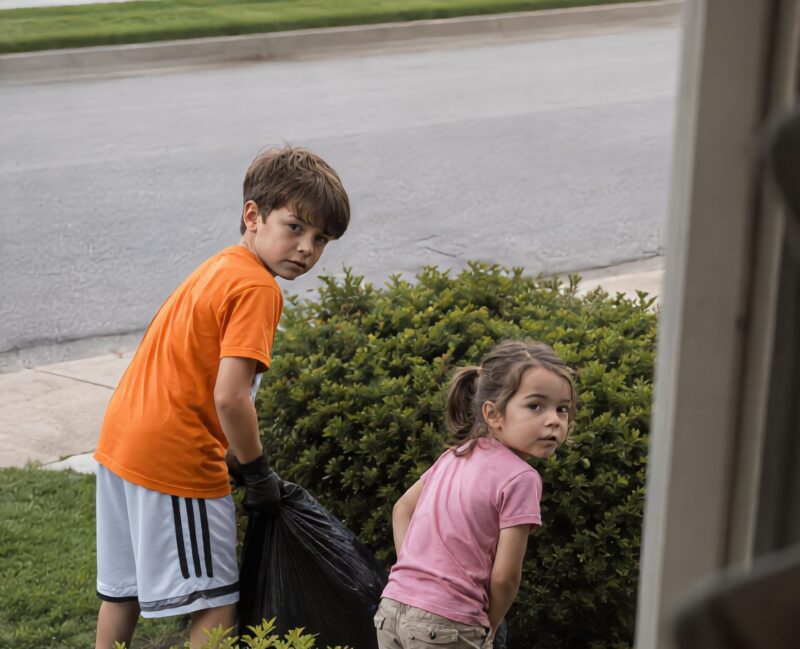
Every Sunday at almost exactly nine in the morning, Mia and her younger brother, Ben, appeared on our street carrying a large black garbage bag.
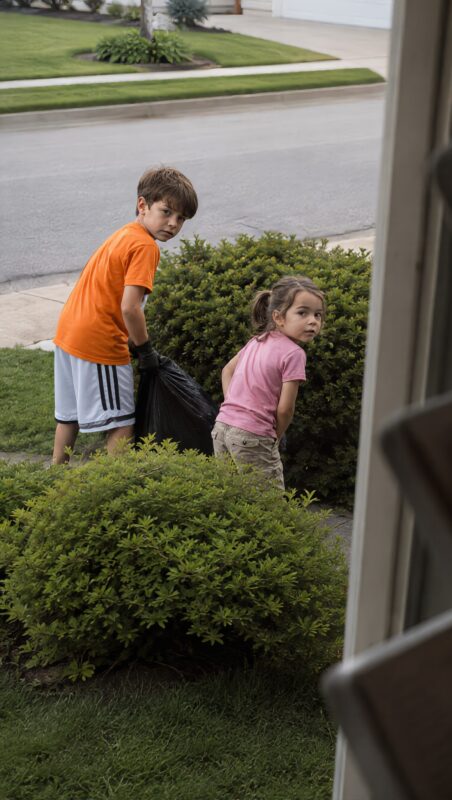
Mia was twelve. Ben was nine.
They walked slowly from one end of the block to the other, stopping beside hedges, mailboxes, parked cars, and garden fences.
We all assumed they were picking up litter.
Sometimes they actually did.
If Ben spotted an empty bottle, he tossed it into the bag. Mia collected food wrappers and cans from the curb.
Neighbors loved them for it.
“Those kids are being raised right,” Mr. Patterson across the street once told me.
I agreed.
Then one Sunday, I saw something I wasn’t supposed to see.
I was standing near my living room window when Ben approached the hedge outside my house.
He looked behind him.
Mia was several yards away.
Ben crouched down, reached into his jacket, and pushed something deep beneath the leaves.
Then he stood and hurried after his sister.
He hadn’t picked anything up.
He had left something behind.
A few minutes later, I went outside.
Beneath the hedge, I found a small plastic bag.
Inside was a flash drive wrapped in tissue paper.
There was also a folded note.
My name was written on it.
I unfolded the paper.
If something happens to Mom, please take this to the police.
Underneath, another sentence had been written in capital letters.
DON’T GIVE IT TO RICK.
Rick was their stepfather.
I stood beneath the hedge staring at those words.
For two years, Rick had lived next door with the children and their mother, Laura.
Everyone liked him.
He owned a successful home-security company and seemed to know half the town. He sponsored school events, attended neighborhood gatherings, and regularly offered to check people’s alarm systems for free.
He had the kind of personality that made strangers trust him almost immediately.
I had trusted him too.
Until that morning.
I took the flash drive inside and found an old laptop I rarely used.
Seven folders appeared when I opened it.
Audio.
Pictures.
Finances.
Mom.
Truck.
Dates.
If We’re Gone.
I opened the last folder first.
There was one video.
Mia appeared on the screen with Ben sitting beside her. They were squeezed into a dark closet, speaking barely above a whisper.
Mia looked directly at the camera.
“If you found this, we need help.”
She swallowed.
“If Mom is missing, call the police. If Ben and I are gone too, don’t believe anything Rick says.”
I felt cold.
Mia explained that Rick had taken control of Laura’s bank accounts and important documents.
He checked her phone.
He knew her passwords.
He tracked where she went.
According to Mia, their mother had once tried to take them to her sister Rachel’s house.
Rick brought them back.
The other folders contained recordings and photographs the children had quietly collected.
I didn’t need to understand every file to know that something was seriously wrong.
Then I found a document containing four names.
Laura.
Mia.
Ben.
Rachel.
A date appeared beside each one.
I closed the laptop.
Whatever I had stumbled into was beyond anything I should handle alone.
I called the police.
Detective Vasquez arrived shortly afterward with two officers.
I showed him the note, the flash drive, and several of the files.
His entire demeanor changed.
Within minutes, officers were knocking on Laura’s door.
No answer.
They called her name.
Nothing.
Then one officer raised his hand.
“Quiet.”
A faint sound was coming from somewhere near the back of the house.
Knock. Knock. Knock.
A pause.
Then three more knocks.
The officers entered.
They found Laura inside a locked laundry room.
She was shaken, but conscious.
Mia and Ben were nowhere in the house.
Detective Vasquez asked where they were.
Laura covered her mouth.
“He knows.”
“Rick?”
She nodded.
“He knows what they were doing.”
That was when we discovered how carefully the children had prepared.
I placed the flash drive on the table.
Laura stared at it.
“Where did you find that?”
“Under my hedge.”
Her eyes filled with tears.
“That means they finished.”
“Finished what?”
Laura looked at Detective Vasquez.
“There are twelve of them.”
Twelve flash drives.
For months, Mia and Ben had been copying the evidence and distributing it throughout the neighborhood.
They had hidden drives near houses belonging to people they thought might help.
The garbage bags were part of their plan.
Every Sunday, they collected enough actual litter to make their walks look normal.
Then, when nobody was watching, they left another copy somewhere safe.
“Why would children think to make twelve copies?” I asked.
Laura gave me an answer I have never forgotten.
“Because they knew Rick would find one.”
One copy could disappear.
Twelve were harder to erase.
Police immediately began searching for Rick’s truck.
Laura said he had taken the children out that morning, claiming they were going to breakfast.
A traffic camera eventually recorded his vehicle heading north.
Detective Vasquez showed Laura the route.
Her expression changed instantly.
“There’s a cabin.”
Rick’s family owned an isolated property outside town.
An alert went out.
Then we waited.
One hour.
Then another.
Laura barely moved.
Finally, Detective Vasquez’s phone rang.
He listened without speaking.
Then he looked at Laura.
“They have the children.”
She nearly collapsed with relief.
Mia and Ben were safe.
Later, we learned that Mia had found an old phone inside the truck. While Rick was distracted, she managed to activate its emergency function.
That signal helped authorities locate the vehicle before it reached the remote property.
Rick was taken into custody.
What investigators uncovered afterward made the children’s secret operation even more important.
The files they had saved helped authorities understand what had been happening inside the house. Investigators also found information suggesting Rick had been preparing his own explanation in case Laura disappeared.
He had spent years building a reputation as the reliable husband, generous businessman, and friendly neighbor.
He seemed to believe people would trust his version first.
Maybe they would have.
If Mia and Ben hadn’t prepared for exactly that possibility.
Rick could delete a recording.
He could take a phone.
He could find a hidden folder.
But he couldn’t erase evidence he didn’t know had already been scattered across twelve different properties.
Laura and the children eventually left the neighborhood and moved somewhere they could feel safe.
The story should have ended there.
But the flash drives kept appearing.
A neighbor found one taped behind his mailbox.
Another was hidden beneath a flowerpot.
One was discovered inside a waterproof bag behind a garden shed.
Each contained the same basic message.
If something happens to Mom, take this to the police.
Every discovery made me feel worse.
Those children had been walking past us for months.
We had smiled at them.
Praised them.
Some of us had even handed them extra garbage to put in their bags.
We thought they were performing a neighborhood chore.
In reality, they were quietly creating a backup plan.
Months later, I received an envelope with no return address.
Inside was a letter from Mia.
She said her mother was doing better.
Ben had stopped waking up frightened at night.
She had joined an art class and was learning to paint.
Near the bottom, she wrote something I still remember word for word:
Mom says we should have told grown-ups sooner. But I think we did. We told twelve people. We just had to wait for someone to look.
I sat with that letter for a long time.
Because she was right.
Sometimes people ask for help without standing in front of you and saying the words.
Sometimes the message is hidden inside a change in routine.
A strange behavior.
Something left where it shouldn’t be.
Months later, Laura brought Mia and Ben back to collect a few belongings they had left behind.
Before getting into the car, Mia approached me.
She held out another flash drive.
I hesitated before taking it.
“Is there something on this?”
“No.”
“Then what’s it for?”
She pointed toward the hedge outside my window.
“A reminder.”
“Of what?”
“To notice things.”
I closed my hand around it.
“I will.”
Mia and Ben never returned to their Sunday routine.
But something changed on our street after they left.
Now, several adults walk the neighborhood on Sunday mornings.
We carry garbage bags.
We pick up cans and wrappers.
We talk to neighbors we once only waved at.
And we pay closer attention.
Because the lesson Mia and Ben left behind had nothing to do with litter.
For months, two children walked our street carrying what looked like garbage.
But inside those ordinary Sunday walks, they were doing something far more important.
They were placing pieces of the truth where one person could never destroy all of them.
And beneath the leaves outside my window, they left one final possibility:
that eventually, someone would notice.