I Installed a Backup Camera—and Discovered What My Mother Did When I Was Gone
At exactly 9:15 that morning, my phone lit up while I was parked a few streets away from our house.

Nursery camera disconnected.
Again.
For nearly two weeks, the monitor had been cutting out at strange times. My mother, Eleanor, always blamed the internet.
“Your router is terrible,” she would say.
But something about the timing bothered me.
So the night before, I installed a small backup camera without telling anyone. It used a separate connection and would continue recording even if our home Wi-Fi went down.
I thought I might catch Eleanor interfering with the router.
Instead, I discovered why she wanted the cameras off.
When I opened the live feed, I saw my wife, Clara, kneeling beside the nursery crib.
Broken glass covered the floor. Several of her pills had been crushed beneath it.
Clara had only recently given birth to our son, Leo, and her recovery had been difficult. Her doctors had warned her to rest and avoid physical strain.
Yet she was on the floor, visibly exhausted, trying to gather the scattered pieces.
Then I saw my mother.
Eleanor stood near the doorway with Leo in her arms.
He was crying.
Clara reached toward him.
“Please give him to me.”
Eleanor stepped back.
“Finish cleaning first.”
Clara stared at her.
“I’m in pain.”
“You’re always in pain,” Eleanor replied. “Pick everything up. Maybe then you can hold him.”
I stopped breathing for a moment.
This was the same woman who posted photographs online describing Clara as “the daughter I never had.”
The same woman who told our relatives she had moved in because she wanted to help us through the exhausting first weeks of parenthood.
Everyone loved Eleanor.
She brought casseroles.
She bought baby clothes.
She posed for photographs with Leo.
But behind closed doors, something entirely different had been happening.
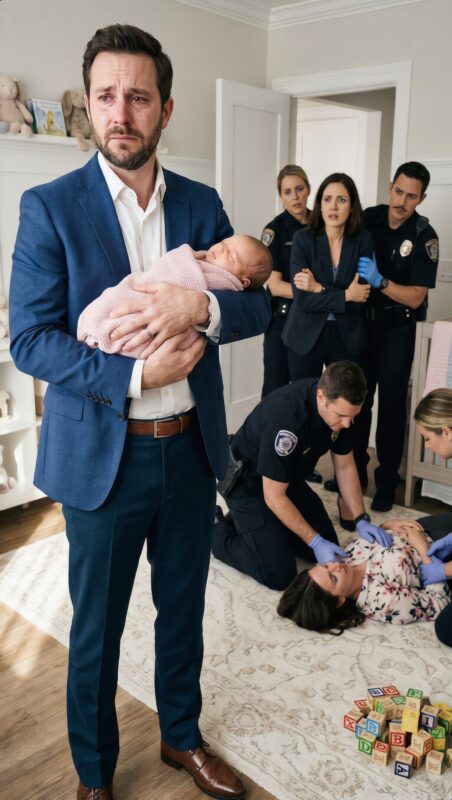
Since moving into our home, she had questioned almost everything Clara did.
If Leo cried, Eleanor blamed Clara.
If Clara rested, Eleanor called her lazy.
If she became emotional, Eleanor said she was being dramatic.
Whenever I noticed the tension, my mother had an explanation ready.
“She’s exhausted, Julian. Don’t worry. I’m taking care of her.”
I had believed that explanation for far too long.
Watching the camera feed, I reached for my car door.
I wanted to go home immediately.
Then I stopped.
If I walked inside furious, Eleanor would deny everything.
She would say Clara had dropped the glass herself.
She would claim she had only taken Leo to help.
And somehow, by the end of the argument, she would probably be the person demanding an apology.
So instead of confronting her immediately, I saved the recording.
Then I sent part of it to my older sister, Audrey.
Her phone call came less than a minute later.
At first, she could barely speak.
Finally, she said, “Julian, this happened to me too.”
“What?”
“When Sophie was born.”
Years earlier, after Audrey had her first child, she and Eleanor had suddenly stopped speaking for months.
Mom told everyone Audrey had become irrational and ungrateful.
I had believed her.
Audrey now told me what had actually happened.
Our mother had constantly criticized her parenting, taken the baby from her without permission, and made Audrey doubt whether she was capable of raising her own daughter.
Eventually, Audrey had forced Eleanor out.
Mom had spent years portraying herself as the wounded parent.
And I had never questioned her version of events.
“I should have believed you,” I said.
Audrey was quiet.
“Believe Clara now.”
I saved the footage in several places, contacted an attorney for advice, and drove home.
When I entered the nursery, Clara was sitting against the side of an armchair.
Eleanor immediately rushed toward me.
“Julian! Thank goodness.”
Her voice sounded concerned.
“Clara had another episode. She dropped her medication and nearly hurt herself. I’ve been trying to calm her down.”
Clara looked up at me.
Her face told a completely different story.
“She won’t give me Leo,” she whispered.
I turned toward my mother.
“Hand him to me.”
Eleanor frowned.
“Clara needs to rest.”
“Give me my son.”
“I’m trying to protect him.”
“From his mother?”
“From someone who clearly isn’t well enough to take care of him.”
I didn’t argue.
I simply took out my phone and pressed play.
Her own voice filled the room.
*Finish cleaning first.*
Eleanor froze.
The recording continued.
*Maybe then you can hold him.*
Her expression changed.
“Where did you get that?”
“The camera you didn’t know existed.”
She stared at me.
“You disconnected the nursery monitor,” I continued. “So last night I installed another one.”
For the first time, Eleanor had nothing prepared.
Then I mentioned Audrey.
“She watched the recording too.”
That changed everything.
My mother’s calm expression disappeared.
She accused Clara of setting her up.
Then she claimed the whole thing had been misunderstood.
Seconds later, she insisted she had only been joking.
When that failed, she began shouting that Clara was too weak to raise a child.
I walked toward her and took Leo from her arms.
Then I carried him to Clara.
She held him against her chest and closed her eyes.
I turned back to Eleanor.
“You need to leave.”
Her mouth fell open.
“Excuse me?”
“Pack your belongings.”
“I moved into this house to help you.”
“No. You moved into this house and hurt my wife when you thought nobody could see you.”
“I am your mother.”
“And Clara is my wife. Leo is my son.”
Eleanor stared at me.
“So you’re choosing her?”
I looked at Clara holding our baby.
“Yes.”
The answer came easier than I expected.
“You have ten minutes.”
Eleanor stormed upstairs.
While she packed, I called Audrey again and arranged for someone we trusted to stay with Clara while I handled the situation. I also began organizing professional support so Clara could recover without worrying about the house or the baby every second of the day.
Soon, Eleanor appeared with her suitcases.
Then she noticed what was waiting outside.
Two police vehicles.
Audrey had already contacted the authorities and provided information about the recording.
The officers did not arrest Eleanor that day, but they remained while she removed her belongings and then escorted her away from our property.
My mother kept shouting from the driveway.
“One day you’ll realize what that woman has done to this family!”
I stood at the door.
For the first time, I didn’t feel guilty.
Because Clara hadn’t destroyed anything.
She had simply survived what I should have noticed much sooner.
The following day, Eleanor began telling her version of the story online.
She described herself as a devoted grandmother who had sacrificed everything for her son, only to be thrown out because of an “ungrateful daughter-in-law.”
In the past, that story might have worked.
But this time, Audrey had proof.
She showed the original footage to relatives who began calling us for answers.
People who had defended Eleanor for years suddenly became quiet.
Several apologized to Audrey.
Others admitted that they had witnessed smaller incidents but had ignored them because Eleanor was always so convincing afterward.
The woman who had spent years controlling the family narrative could no longer control it.
There was a camera.
There was a recording.
And there were no excuses left.
The weeks after Eleanor left felt different.
Our house became quiet again.
Not the uncomfortable silence that had existed while she lived with us.
Real peace.
Clara slowly regained her strength. She stopped apologizing every time she needed to rest. She stopped asking whether she was doing something wrong whenever Leo cried.
Audrey visited regularly.
Sometimes she and Clara talked privately for hours.
I never interrupted them.
They understood something I was only beginning to understand myself.
One evening, I found Clara sitting outside with Leo asleep against her.
The Arizona sunset stretched across the horizon.
I sat beside them.
After a while, Clara leaned against me.
“I thought nobody would believe me,” she said.
That sentence stayed with me.
I had spent my entire life thinking loyalty meant defending your family no matter what.
But loyalty without truth isn’t love.
Sometimes the person who shares your blood is also the person causing the harm.
And protecting your family doesn’t always mean keeping everyone under the same roof.
Sometimes it means recognizing who makes that roof feel unsafe—and having the courage to show them the door.