FORTY-ONE PESOS FOR A PROMISE
Everyone laughed when Elena Villaseñor returned with an old man as her hired protector.
They stopped laughing when they learned his name.
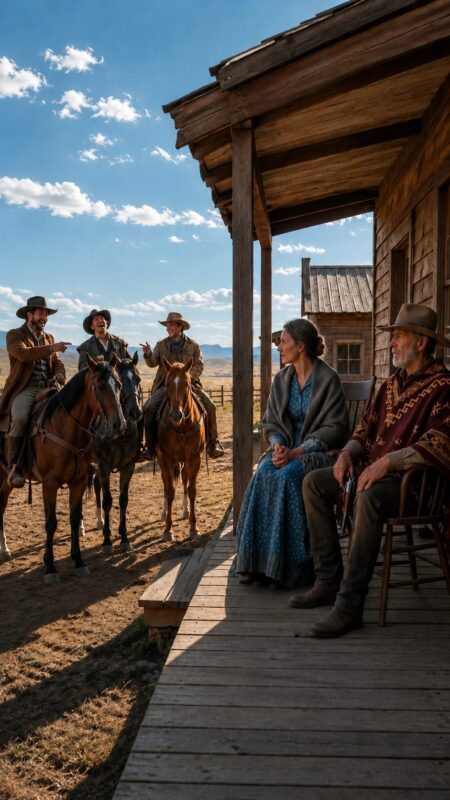
Six months earlier, Elena had buried her husband, Julián, beneath the dry Chihuahua earth.
He had spent years turning a stubborn patch of land into La Esperanza, a modest cattle ranch they believed would someday support their family. But a sudden fever took him in nine days, leaving Elena with forty-three head of cattle, a mortgage she could barely pay, medical bills she could not ignore, and fifteen-year-old Tomás Pineda, the only ranch hand who refused to abandon her.
Then the rains stopped.
Streams disappeared. Wells failed. Grass turned brittle beneath the relentless sun.
Yet one source of clean water remained.
The well at La Esperanza.
That was when Silvestre Carrasco became interested.
Carrasco controlled more land and cattle than anyone nearby. The drought was costing him animals every week, and Elena’s well offered an easy solution.
At first, he came with an offer.
“Sell me La Esperanza. You’ll walk away with enough money to start over.”
Elena shook her head.
“My husband built this place. I’m not selling it.”
Carrasco smiled as though her answer amused him.
Soon, six calves disappeared.
Days later, Elena discovered that part of her boundary fence had been moved during the night.
Then her granary burned.
She went to the sheriff.
He looked over the damage, asked a few meaningless questions, and finally said there was nothing he could do without evidence.
That was when Elena realized Carrasco’s influence reached farther than she had imagined.
She sold her remaining chickens and traveled to Santa Rosalía, hoping to hire someone willing to protect La Esperanza.
After paying her travel expenses, she counted the money left in her purse.
Forty-one pesos.
Inside a hotel cantina, she explained her situation to several armed men.
Their laughter answered her before their words did.
“Carrasco?” one of them said. “Lady, forty-one pesos wouldn’t convince me to say his name too loudly.”
Another raised his glass.
“Go home while you still have one.”
Elena walked toward the exit.
The hotel owner stopped her with a quiet gesture.
“Try him.”
He pointed toward the farthest table.
An older man sat beside the window with a cup of coffee untouched before him. His hair was gray, his face deeply weathered, and his clothes carried the dust of countless roads.
He looked more like a tired traveler than a hired gun.
Elena had nothing left to lose.
She sat across from him.
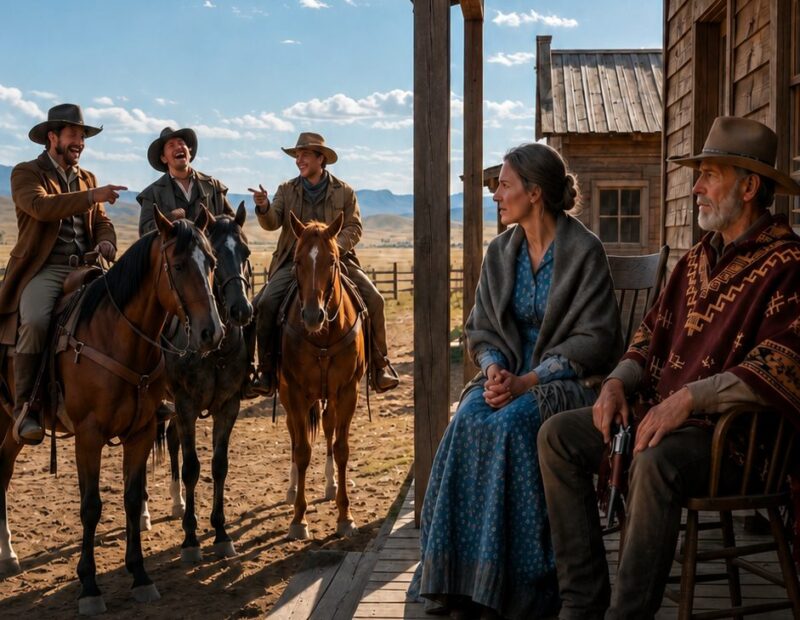
“My husband died six months ago. A rancher named Carrasco wants my land because of its well. His men have stolen from me and burned my granary. I need protection.”
The stranger glanced at her hands.
“How much can you pay?”
Elena placed every coin she had on the table.
“Forty-one pesos.”
He looked at the coins, then at her.
“When are you heading home?”
Elena blinked.
“Tomorrow morning.”
“I’ll be ready.”
His name was Gaspar Rojas.
Tomás nearly laughed when Elena introduced him.
“This is our protection?”
Gaspar heard him.
Instead of answering, he spent the afternoon examining La Esperanza. He studied the buildings, gates, fences, trails, and surrounding hills.
The following day, Carrasco appeared with three riders.
He looked Gaspar up and down.
“You went all the way to Santa Rosalía and brought back someone’s grandfather?”
His men laughed.
Gaspar said nothing.
Carrasco turned toward Elena.
“You have until Thursday. After that, my offer disappears.”
“So might your patience,” Gaspar said quietly. “But I’ll still be here.”
Carrasco stared at him for several seconds.
Then he rode away.
For the next three days, Gaspar prepared the ranch.
But not in the way Tomás expected.
When the boy asked to learn how to shoot, Gaspar refused.
“I need you thinking clearly, not trying to become a hero.”
Instead, he showed Tomás how to release the horses quickly if strangers entered the yard.
He positioned Elena where the ranch house provided cover and told her to keep Julián’s rifle nearby only if there was no other choice.
That evening, Elena found Gaspar cleaning two old revolvers.
His movements were slow but astonishingly precise.
She suddenly remembered a story Julián had once told her.
“Gaspar…”
He looked up.
“Were you once called El Zurdo de Parral?”
Tomás almost dropped the bucket he was carrying.
The name belonged to another age.
People still told stories about El Zurdo—a gunfighter whose speed with two revolvers had supposedly made armed men reconsider their courage.
Gaspar returned his attention to the revolvers.
“Stories improve every time somebody repeats them.”
“You didn’t answer.”
“No,” he said. “I didn’t.”
Thursday arrived.
Nothing happened during daylight.
Then, shortly after midnight, hoofbeats broke the silence.
Three riders approached La Esperanza.
A shot struck the barn door.
Gaspar gave Tomás a single nod.
The boy opened the corral.
Four horses exploded into the yard, kicking up a wall of dust as they thundered between the buildings.
The attackers shouted, suddenly unable to see clearly.
Gaspar remained calm.
One rider stepped forward.
A moment later, his weapon was on the ground.
The second tried to fire, but Gaspar moved before he could regain his aim and forced him to surrender.
The youngest man dropped his weapon immediately.
Within minutes, it was over.
Nobody had been killed.
Gaspar preferred it that way.
Dead men could not give evidence.
By sunrise, all three attackers were talking.
Carrasco had ordered the stolen cattle.
Carrasco had ordered the granary burned.
Carrasco had ordered the fence moved.
And Carrasco had been paying the sheriff to ignore complaints against him.
Tomás expected Gaspar to ride straight to Carrasco’s hacienda and settle the matter personally.
Instead, Gaspar went to the telegraph office.
He sent one message to a state judge.
Another went to a newspaper in Chihuahua.
The last was addressed to an old acquaintance who now commanded rural officers.
Only then did Gaspar visit Carrasco.
The wealthy rancher received him with armed men nearby.
Gaspar remained standing.
“The three men you sent are alive.”
Carrasco’s expression hardened.
“They’re also talking.”
Carrasco threatened him.
Gaspar did not react.
Then Carrasco tried another approach.
“How much?”
“For what?”
“To forget what you heard.”
Gaspar almost smiled.
“You misunderstand me. I already agreed on my price.”
“Who paid you?”
“A widow.”
“How much?”
“Forty-one pesos.”
Carrasco stared at him.
Gaspar continued.
“You leave Elena Villaseñor and La Esperanza alone. You compensate her for what you destroyed. If you need water, you negotiate for it like an honest rancher.”
“And if I refuse?”
Gaspar glanced toward the road.
“Then you can explain yourself to the people coming this way.”
By noon, officials and witnesses were arriving.
So were reporters.
Once investigators began examining Carrasco’s affairs, Elena’s case became only the beginning.
They discovered falsified property records, manipulated water rights, bribery, intimidation, and years of illegal land seizures.
The sheriff was removed from office.
Carrasco faced prosecution, and his family eventually contributed to the construction of a community water system.
La Esperanza remained Elena’s.
She began selling water to neighboring ranchers at reasonable prices. Within several years, her debts were gone, her herd was growing again, and the ranch was stronger than it had been before the drought.
Gaspar helped rebuild the granary.
When the work was finished, Elena woke one morning to find him tightening the saddle on his horse.
“Leaving?”
“Nothing here needs protecting anymore.”
Elena opened her hand.
Forty-one pesos rested in her palm.
“You forgot something.”
Gaspar looked at the coins.
“I didn’t forget.”
Before Elena could answer, Tomás walked around the corner carrying a hammer and a box of nails.
“The granary roof leaks.”
Gaspar looked toward the building.
Then toward his horse.
The animal had wandered over to the trough and was drinking contentedly.
Gaspar sighed.
“Traitor.”
Tomás grinned.
Gaspar removed the saddle.
He stayed.
Years later, Tomás became an attorney known for representing farmers, widows, and families who had little money but plenty to lose.
Elena helped establish a ranchers’ cooperative and was elected its first president.
And Gaspar Rojas never returned to the road.
A decade after the night Carrasco’s men came to La Esperanza, Elena placed forty-one pesos in a small wooden frame and hung it on the porch.
Below the coins, she wrote:
“Fortunes can purchase obedience. Sometimes forty-one pesos are enough to reveal a man’s character.”
Visitors eventually heard the story.
Most preferred the legend.
They said El Zurdo de Parral had ridden into La Esperanza and saved a helpless widow from a powerful enemy.
Elena never allowed them to tell it that way.
She had not been helpless.
Tomás had not needed to become a gunfighter to become brave.
And Gaspar had discovered that the greatest victory of his life was not defeating another man.
It was finding a place where he could finally put his revolvers away.
And stay.