Fifteen Students Vanished in 1986 — Nearly Four Decades Later, Their School Bus Emerged from the Ground
For almost forty years, the people of Hallstead County lived with a mystery no investigation had been able to solve.
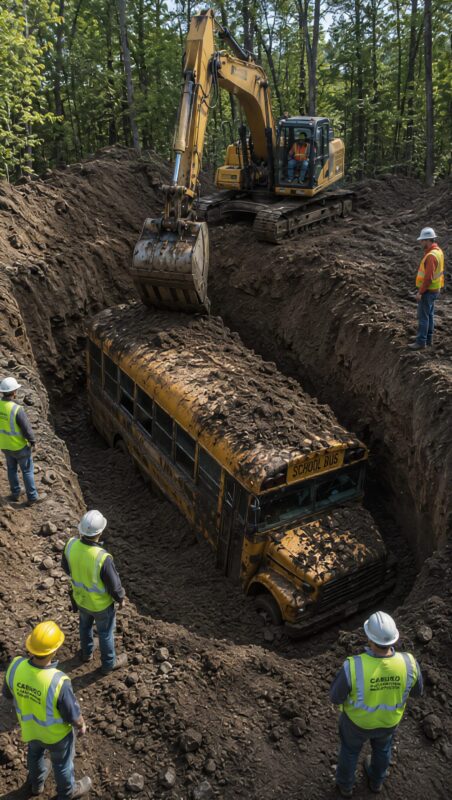
In May 1986, fifteen students from Holstead Ridge Elementary left for a class outing near Morning Lake. They climbed onto a yellow school bus that morning and disappeared before reaching their destination.
No convincing explanation ever followed.
Then, thirty-nine years later, the earth gave up its first secret.
On a misty morning, Deputy Sheriff Lana Whitaker was called to a construction site near Morning Lake. A crew restoring an old service road had struck a large metal object several feet underground.
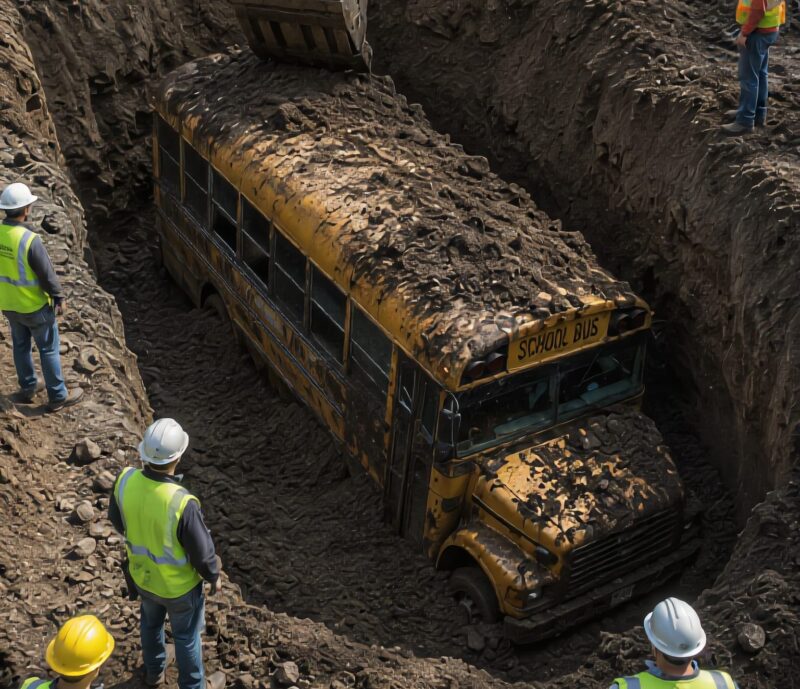
When workers cleared away the soil, faded yellow paint appeared.
A school bus.
For Lana, the discovery was painfully familiar.
She had attended Holstead Ridge Elementary in 1986. In fact, she had been scheduled to join that exact field trip. Chickenpox had kept her home, and she still remembered watching through her bedroom window as her classmates boarded the bus.
Now she stood beside its rusted remains.
Time had eaten through much of the vehicle. The seats were crumbling, metal panels were corroded, and dirt covered the floor. Investigators recovered an old lunchbox and a child’s shoe.
What they did not find was even more important.
There were no human remains.
While examining the driver’s area, Lana spotted a weathered sheet of paper near the dashboard.
It was the class roster.
All fifteen children’s names were still visible.
Below them, written in faded red ink, was a sentence that changed everything:
We never arrived at Morning Lake.
The original case had always contained troubling gaps.
Carl Davis, the newly hired driver, vanished along with the students. The substitute teacher assigned to accompany the class seemed to have almost no verifiable past.
Search teams found nothing substantial.
Years passed.
The case became a local legend.
Then, only hours after the bus was discovered, the impossible happened.
Two people fishing nearby found a barefoot woman stumbling along a road less than a mile from the excavation.
She appeared frightened and disoriented.
At the hospital, she repeatedly told staff members that she was twelve years old.
When asked her name, she answered:
“Nora Kelly.”
That name had been printed on missing-person posters thirty-nine years earlier.
Nora was one of the vanished students.
Lana entered her hospital room expecting to meet a stranger.
Instead, Nora stared at her as though recognizing a face from yesterday.
“You’re old now,” she murmured.
Lana’s heart raced.
“You remember me?”
Nora nodded slowly.
“You were sick. Chickenpox. You didn’t get on the bus.”
That detail had never been publicly emphasized.
Nora began describing scattered pieces of what she remembered.
The bus had turned away from the route to Morning Lake. At a fork in the road, someone was waiting for them.
After that came darkness.
Her next clear memory was waking inside an unfamiliar building. The windows had been covered, and the children were forbidden to use their real names.
“They gave us other names,” Nora explained. “After a while, they wanted us to believe the old ones belonged to somebody else.”
Investigators searched the bus again.
Behind a damaged wall panel, they discovered a photograph that had remained hidden for decades.
Several children were standing outside a boarded-up structure.
Far behind them stood a tall man with a beard.
The moment Nora saw the picture, she recognized the location.
Her memories led investigators to a neglected barn on County Line Road.
Inside, names and initials had been scratched into the walls.
Then officers opened a rusted container.
It was filled with old Polaroids.
The photographs showed the missing students at different ages, proving that at least some of them had survived long after 1986.
Every photograph had a name written on the back.
None matched the child’s real identity.
Another clue directed investigators toward Riverview Camp, an isolated retreat purchased shortly before the school bus disappeared.
The property had supposedly been abandoned for years.
It wasn’t empty.
Inside one of the buildings, Lana found a boy who called himself Jonah.
When she asked for his full name, he could not answer.
“What did your parents call you?” Lana asked.
The boy looked confused.
“I don’t know.”
Then he added quietly:
“They took that name from me.”
The investigation suddenly became much larger.
This was no longer a thirty-nine-year-old disappearance.
Whatever had happened to those children had continued long afterward.
Records eventually led authorities to Aaron Develin, another passenger from the missing bus.
Aaron was now an adult.
More astonishingly, he had been living quietly in Hallstead County.
He remembered other children attempting to escape.
He had refused to go with them.
“They taught us that leaving meant danger,” Aaron said. “I believed them. I thought staying was the only way to survive.”
He also remembered a place called the Sanctuary.
Police located its ruins far from the main road.
Among the debris were children’s belongings, old photographs, and a drawing bearing a simple message:
**We are still here.**
According to Aaron, the Sanctuary had partially burned years earlier.
Afterward, the youngest children were moved.
Their new destination was known only as Haven.
Searching the surrounding woodland, investigators found a split cedar tree concealing an underground entrance.
Below it stretched a series of hidden rooms.
There were bunk beds.
Drawings covered the walls.
Fifteen desks stood in one chamber.
Boxes of records had been preserved with remarkable care.
Again and again, the same instruction appeared:
**Obedience brings safety. Memory brings danger.**
The archives contained hundreds of photographs documenting children who had lived there over the years.
Among the records, one name appeared repeatedly:
Cassia.
Finding Cassia took weeks.
Eventually, investigators discovered that she had been living closer than anyone expected.
Her current name was Maya Ellison.
She owned a small bookstore in Hallstead.
Maya remembered almost nothing about her earliest years. She had always experienced flashes of places and people she couldn’t explain, dismissing them as childhood dreams.
Then Lana showed her a photograph of an old mural depicting a girl running between trees.
Maya’s expression changed.
Tears appeared in her eyes.
“Cassia,” she whispered.
Lana waited.
“I thought she was imaginary,” Maya said. “I never realized Cassia was me.”
The discoveries continued.
Several survivors were eventually located, each carrying different pieces of the same lost history.
No single person remembered the entire story.
But when their memories were combined, the pattern became clearer.
Some children had escaped.
Some had been given new identities and sent elsewhere.
Some had grown into adulthood without knowing who they had originally been.
Others remained missing.
The discovery of the buried school bus was supposed to answer Hallstead County’s oldest question.
Instead, it created dozens more.
A memorial now stands near Morning Lake, dedicated to those who vanished and those who eventually found their way back.
For thirty-nine years, people believed fifteen children had disappeared on an ordinary school trip.
The truth was far stranger.
They had not simply been hidden from the world.
Their names had been replaced.
Their memories had been manipulated.
Their identities had been rebuilt around a lie.
Someone had tried to erase fifteen childhoods and bury the evidence along with the bus.
But the ground kept the secret for only so long.
Eventually, even a buried past finds its way back into the light.