For nearly half a year, I thought I was losing pieces of myself.
Then one Sunday afternoon, I discovered someone might have been helping me lose them.
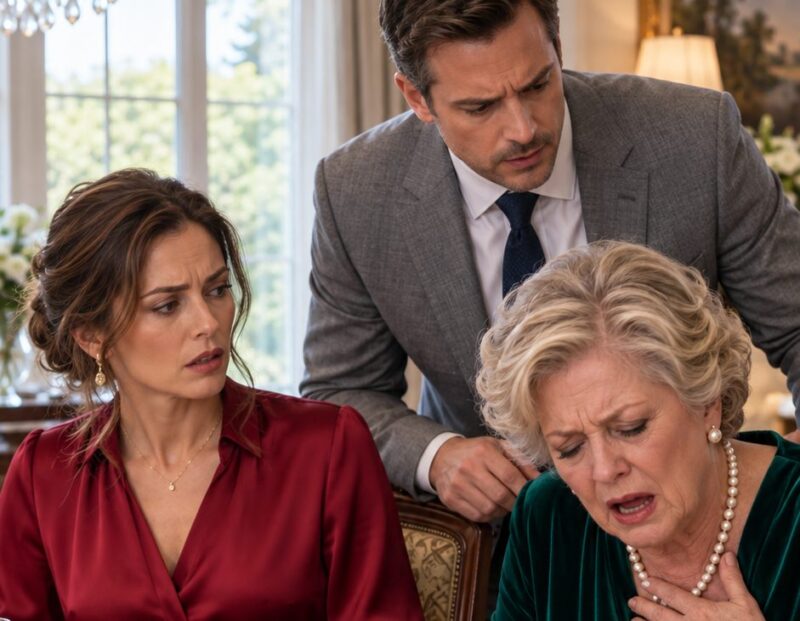
I was fifty, married to Mark for twenty-six years, and standing just outside our kitchen when I saw my husband lean over a bowl of soup meant for me.
Something pale fell from a small packet between his fingers.
Mark stirred the soup slowly until there was no visible trace of it.
Then he did something I will never forget.
He checked behind him.
People don’t usually look over their shoulders when they’re adding seasoning.
I backed silently into the hallway.
I didn’t confront him.
I didn’t scream.
I simply stored the image in my mind and walked into the dining room as though I had seen nothing.
Mark’s parents, Judith and Harold, were already seated. His brother Steve and Steve’s wife, Karen, were there too.
Sunday dinner had been a family tradition for years.
Usually, I found comfort in its predictability.
That evening, predictability felt dangerous.
For months, my health had been strange.
I’d walk into rooms and occasionally forget why I was there. Waves of dizziness forced me to grab countertops for balance. Some mornings, my body felt exhausted before the day had even started.
The memory problems frightened me most.
Mark always knew how to calm me.
“Everyone forgets things.”
“You’ve been doing too much.”
“Maybe this is just part of getting older.”
His explanations had sounded reasonable.
So reasonable that I’d gradually stopped trusting my own concerns.
Then he carried the soup into the dining room.
He placed my bowl down himself.
I stared at it.
Mark sat across from me.
A minute passed.
“You haven’t touched your soup.”
I forced a smile.
“I’m letting it cool.”
He nodded, but his eyes remained on me.
Then Karen asked Steve something, and everyone turned toward their end of the table.
I moved without thinking too much about what came next.
Judith’s untouched bowl was within reach.
I exchanged it with mine.
A few minutes later, Judith stopped talking in the middle of a sentence.
Her spoon slipped against the edge of the bowl.
“Mom?” Steve said.
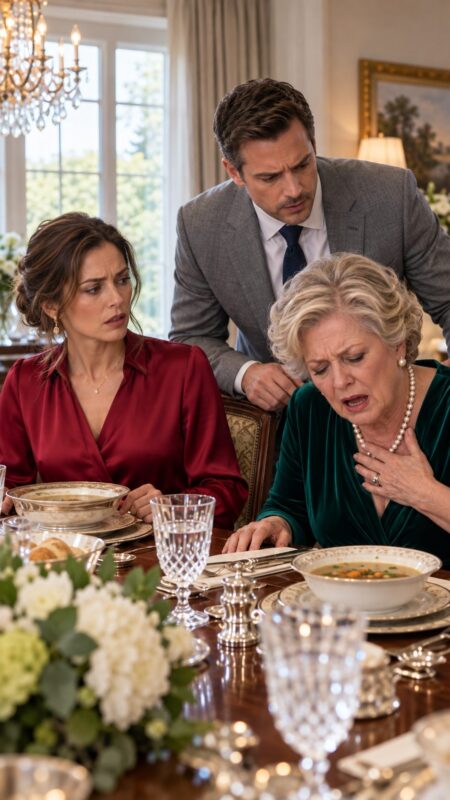
She blinked slowly.
“I feel strange.”
When she tried to get up, her knees buckled.
Harold caught her before she fell.
The room erupted.
Karen reached for her phone. Steve moved chairs out of the way. Harold kept calling Judith’s name.
I remained seated for one extra second.
Because Mark wasn’t looking at Judith.
He was staring directly at me.
He looked confused.
Then frightened.
I wasn’t dizzy.
I wasn’t sleepy.
I wasn’t confused.
And when Mark understood that, his face lost its color.
An ambulance took Judith to the hospital.
I went with everyone else and behaved like a worried daughter-in-law.
Inside, however, one thought kept repeating.
That bowl was supposed to be mine.
Later, when I had an opportunity to return home alone, I put on gloves.
I collected the bowl Judith had eaten from and the spoon beside it.
Then I searched the dining area.
Underneath the table was a tiny torn packet.
I sealed everything separately.
The following morning, I called my physician.
I expected her to tell me I was overreacting.
Instead, she became unusually quiet while reviewing my chart.
“Diane, there was something in one of your previous blood tests.”
“What kind of something?”
“A trace of a prescription sedative.”
My hands went cold.
She explained that the concentration had been small enough that, without additional context, it hadn’t provided a clear explanation for my symptoms.
Then she asked:
“Who usually prepares what you eat and drink?”
I didn’t answer immediately.
Images began appearing in my mind.
The coffee Mark brought me almost every morning.
The smoothies he had started making several months earlier.
The nighttime tea he’d occasionally insist would help me sleep.
The dinners he’d suddenly volunteered to prepare.
I had interpreted all of it as affection.
“My husband,” I finally said.
I arranged independent laboratory testing of the material from dinner.
The report confirmed the presence of a prescription medication in the soup.
Its possible effects included fatigue, poor coordination, dizziness, confusion, drowsiness, and memory impairment.
I read that list again and again.
It looked like a summary of my previous six months.
I was also told that repeated smaller exposures could potentially make a person appear mentally diminished over time.
Then came a detail I hadn’t expected.
There were indications that the packet might have been handled by more than one person.
Mark might not have been acting alone.
I needed someone who knew how to follow facts instead of emotions.
That person was Tom Reynolds, a retired detective.
Tom began digging through the parts of our life I’d never thought to examine.
Insurance was first.
There was a $2 million policy on my life.
I knew the policy existed.
I did not know its value had been substantially increased eight months earlier.
Documents authorizing the change carried my signature.
It was a good imitation.
But I hadn’t signed them.
Next came Mark’s business.
The successful image he presented to everyone was hiding serious financial trouble.
Debt was accumulating faster than he could manage it.
Suddenly, the insurance policy looked very different.
But Tom kept searching.
And what he found next suggested this wasn’t only about insurance money.
Material connected to Judith’s home revealed conversations between her and Mark.
Hearing them was worse than reading any financial document.
They discussed my health as if it were a project.
One conversation concerned my forgetfulness.
Another mentioned how often I seemed exhausted.
They discussed medical records and whether doctors had written down my complaints.
Then they moved to my separate inheritance.
And eventually, they began using one particular word.
Guardianship.
That was when the larger picture emerged.
My confused moments weren’t merely being noticed.
They were being collected.
If enough evidence could be assembled to make me appear incapable of managing my own decisions, my competence could potentially be challenged.
And if control over my affairs shifted to someone else, so could influence over my finances and property.
Tom discovered that Judith had been researching the process and keeping copies of information concerning my medical history and assets.
I sat with those discoveries for a long time.
Mark had spent months telling me not to worry about my memory.
Behind my back, those same memory problems were apparently being treated as evidence.
For a while, I continued living in the house while the situation was documented and reviewed.
It was like sharing a home with a stranger wearing my husband’s face.
“Coffee?”
“No, thanks.”
“You look tired.”
“I’m fine.”
“Are you sure? You’ve seemed forgetful lately.”
Every sentence now had a second meaning.
I started remembering how many times Mark had asked those questions in front of other people.
Eventually, Judith recovered.
Not long afterward, Mark suggested restarting Sunday dinner.
I said yes.
He probably interpreted my agreement as proof that everything had returned to normal.
It hadn’t.
The same six people sat around our dining table.
For several minutes, conversation remained ordinary.
Then I placed a folder beside my plate.
Mark noticed.
“What’s in there?”
I looked at him.
“My memory.”
He frowned.
I opened the folder.
“Turns out it’s working perfectly.”
I placed the laboratory report on the table.
Then the insurance paperwork.
Then documents showing the disputed signature.
Next came Mark’s financial records.
Finally, I laid down copies of the guardianship research.
Nobody reached for their food.
But I wasn’t finished.
I connected my laptop to the television.
Judith’s voice filled the room.
She was discussing my supposed decline.
Then came Mark’s voice.
He talked about medical documentation.
Another recording mentioned my inheritance.
Another covered the house.
Another touched on his financial problems.
And then everyone heard the word guardianship.
Karen’s hand flew to her mouth.
Steve turned toward Mark.
“What have you done?”
Mark ignored him.
He stared at me.
“Where did you get this?”
I clicked the next recording.
His own voice answered for me.
Harold had remained silent through everything.
Finally, he turned toward Judith.
For years, Harold said, he had mistaken avoiding confrontation for protecting the family.
Then he looked around the table.
“This isn’t a family being protected,” he said. “This is a family being destroyed by silence.”
Afterward, the evidence went through the proper investigative process. Medical findings, insurance records, disputed signatures, financial information, communications, and the guardianship material were examined.
My marriage ended.
And my mysterious illness began disappearing with it.
Not instantly.
But week by week.
The dizzy spells stopped coming.
The fog lifted.
I could concentrate for hours again.
My energy returned.
I began remembering ordinary things without immediately questioning whether my memory was accurate.
That last part mattered most.
My body recovered faster than my confidence did.
For months, I’d been taught to treat every mistake as evidence that my mind was failing.
I had to learn how to believe myself again.
Eventually, I sold the house.
I wanted somewhere with no history attached to it.
I found a cottage in Brown County that probably scared away more sensible buyers.
The porch wasn’t level.
The kitchen needed renovation.
The garden was mostly weeds pretending to be landscaping.
I bought it.
The first night, I made tea in my imperfect kitchen and carried it outside.
I sat on the porch alone.
Nobody asked whether I’d remembered to lock the door.
Nobody commented on how tired I looked.
Nobody watched me drink.
I could hear leaves moving in the trees and insects somewhere beyond the garden.
Nothing else.
I had once thought silence meant something was being hidden from me.
Now it meant nobody was controlling the story around me.
Almost two years later, Harold, Steve, and Karen came for dinner.
We ate blueberry pie on the porch because my dining table wasn’t large enough.
Nobody cared.
At some point, Karen raised her glass.
“To better traditions.”
We all drank to that.
I looked at the three of them and thought about how much importance I’d once placed on Sunday dinners, anniversaries, family rituals, and keeping everyone together.
I had confused togetherness with closeness.
They aren’t the same.
People can share a table and still betray one another.
They can share blood and still destroy trust.
They can maintain traditions while everything meaningful underneath those traditions disappears.
Family isn’t created by sitting in the same room every Sunday.
It’s created when you know the people beside you respect your boundaries, your choices, and your safety.
I learned that lesson in the worst possible way.
But I learned something else too.
The most important moment wasn’t when the laboratory report arrived.
It wasn’t finding the insurance documents.
It wasn’t hearing the recordings.
It happened before all of that.
It happened in the hallway.
I saw something that frightened me, and instead of accepting another explanation, I finally trusted myself enough to pay attention.
That quiet instinct became the first thing I reclaimed.
Then came my health.
My independence.
My home.
My confidence.
And eventually, my peace.
For twenty-six years, I thought the life Mark and I had built was the foundation beneath me.
When it collapsed, I expected to fall with it.
Instead, I discovered something stronger underneath.
Myself.