I’m Rick Dalton, fifty-two, and I own a modest heating and air-conditioning business in Fort Wayne, Indiana. I have a handful of guys working for me, and whenever they ask where I learned to take pride in doing a job properly, my answer is always the same.
My father, Jack.
At seventy-four, Dad still has hands that look like they were built for fixing things. He spent half a century at the GM plant in Anderson, then somehow found enough energy after work to repair whatever was broken for family, friends, and neighbors.
Dad has never been good at speeches. He shows people he cares in practical ways. A furnace quits in January? He arrives with tools. Your car refuses to start? He’s already under the hood. A neighbor needs help replacing a water heater? Dad somehow finds the time.
Karen, my wife, came from another kind of family.
Her parents, Don and Margaret, made serious money investing in commercial property. Their world revolved around presentation. What you wore mattered. Where you worked mattered. The neighborhood you lived in mattered.
And, although nobody admitted it openly, your social standing mattered most of all.
For twelve years, I watched them look down on Dad.
They were clever enough never to insult him directly. Instead, there were little comments about his work clothes, uncomfortable smiles when he discussed the factory, or sudden changes of subject whenever he mentioned repairing cars.
I noticed.
Dad noticed too.
But neither of us said anything.
I told myself I was protecting the peace.
Looking back, I was mostly avoiding an argument.
That changed on Thanksgiving morning.
I called Dad while Karen was preparing dinner.
“I’ll come get you around noon,” I told him.
There was a short silence.
“Actually, son, don’t worry about it.”
I frowned.
“What do you mean?”
“Karen phoned yesterday. Sounds like you’re going to have a full house. She thought maybe I’d enjoy a quiet day here instead.”
That explanation made absolutely no sense.
Dad was the kind of man who could enter a room full of strangers and leave knowing half their life stories.
Then I understood.
He wasn’t telling me the whole truth because he didn’t want to cause trouble between Karen and me.
I hung up and walked into the dining room.
Karen was straightening silverware.
“Did you tell Dad not to come today?”
Her hands stopped moving.
“Rick…”
“Did you?”
She exhaled.
“I thought it would be easier.”
“For whom?”
“You know my mother.”
I waited.
Finally, Karen said what she had apparently been thinking for years.
“Sometimes your father smells like motor oil. Or grease. Mom notices those things. I didn’t want everybody feeling uncomfortable during dinner.”
For several seconds, I just looked at her.
Then I remembered a winter morning years earlier when our furnace died during a cold snap.
Dad had driven nearly forty minutes on icy roads, climbed into our basement, found the problem, replaced the damaged part, and refused payment.
Nobody complained about grease on his hands then.
That was when everything became painfully clear.
Karen wasn’t embarrassed by a smell.
She was embarrassed by what Dad represented.
A factory worker.
A mechanic.
A man who spent his life earning money with his hands.
I looked at the perfectly arranged Thanksgiving table.
“All right,” I said.
Karen relaxed.
Then I added, “Cancel dinner.”
Her expression changed instantly.
“What?”
“I’m taking Thanksgiving to Dad.”
“Rick, my parents are coming soon.”
“They can still come. I just won’t be here.”
I went into the kitchen and started filling containers with turkey, stuffing, sweet potatoes, casserole, rolls, and pie.
Karen followed me.
“You’re leaving me here?”
“I’m going where my family member was told he wasn’t welcome.”
“That isn’t fair.”
“No. What happened to Dad isn’t fair.”
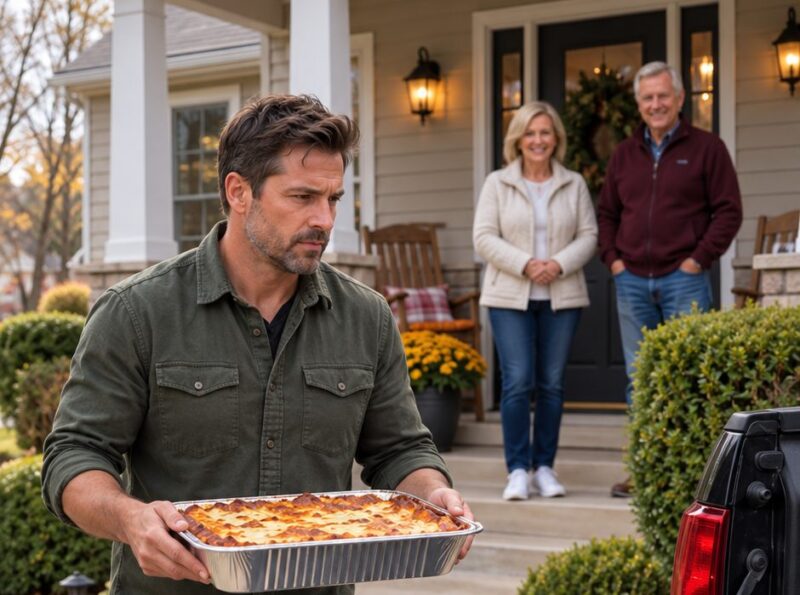
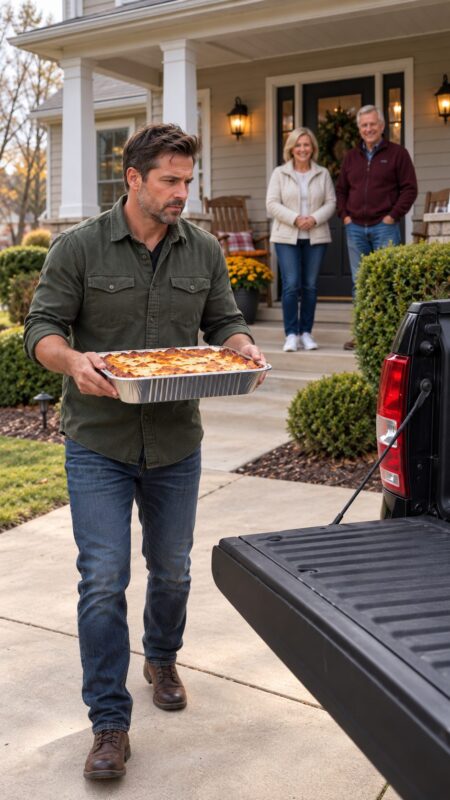
Less than twenty minutes later, I was standing on his porch carrying enough food for six people.
When Dad opened the door, confusion crossed his face.
“What happened?”
“Nothing,” I said. “Move over. Dinner’s getting cold.”
A smile slowly appeared.
We ate Thanksgiving dinner at the same scarred wooden table he had built when I was a kid.
There were no expensive decorations.
No carefully folded napkins.
No arguments about appearances.
Just turkey, football, coffee, and Dad telling me about a neighbor’s old Silverado he was trying to bring back to life.
The familiar scent of coffee and machine oil lingered in the house.
For the first time that day, I felt exactly where I belonged.
Dad never pushed me for an explanation.
Eventually, while we were eating pie, he said quietly, “You should probably be home with Karen.”
I put down my fork.
“I should’ve spoken up for you years ago.”
He shrugged.
“I can handle myself.”
“I know you can. That doesn’t mean you should have to.”
Dad looked down at his pie.
After another bite, he said, “Karen made this?”
“Yeah.”
He nodded approvingly.
“She’s always been good at pumpkin pie.”
I almost laughed.
He had been excluded from her home hours earlier, and the harshest thing he could think to say was that she baked well.
That was simply who he was.
When I returned home later, Karen’s parents were gone.
The dining room looked strangely empty despite the untouched plates still arranged around the table.
Karen was sitting by herself.
I sat across from her.
Then I told her what I should have said years earlier.
“My dad is not someone we hide when your parents visit. He isn’t something embarrassing that needs to be managed. That man taught me almost everything worthwhile about being dependable. If somebody feels uncomfortable because he worked in a factory and likes fixing engines, they can live with being uncomfortable.”
Karen didn’t argue.
She cried.
Then we talked until late into the night.
The conversation wasn’t easy, but it was necessary.
I eventually realized Karen hadn’t woken up that morning intending to hurt Dad. She had simply carried her parents’ ideas about money, status, and respectability into adulthood without ever examining them.
That didn’t excuse what she had done.
But it meant she could change.
Two days later, I grabbed my jacket to visit Dad.
Karen appeared at the door.
“Can I go with you?”
I hesitated.
“You don’t need to perform an apology.”
“I’m not.”
“He’ll probably be working in the garage.”
“I know.”
“You might come home smelling like oil.”
For the first time, she smiled.
“I think I’ll survive.”
When we arrived, Dad was bent over a carburetor.
Karen stayed beside him most of the afternoon.
She asked what each part did. Why certain engines failed. How he knew what needed replacing.
And Dad patiently explained everything.
He never tried to make her feel guilty.
He never mentioned Thanksgiving.
He simply welcomed her into his world.
Nothing magically healed that afternoon.
Twelve years of tension doesn’t vanish in a few hours.
But it was a beginning.
Several weeks later, Don called me and referred to Thanksgiving as an unfortunate “miscommunication.”
I didn’t debate his choice of words.
Instead, I gave him one simple boundary.
“Dad is invited whenever we host a family holiday. Nobody gets to make him feel like he needs permission to belong here.”
There was silence on the phone.
Then Don said he understood.
At Easter, Dad returned to our dining table.
By some accident, he ended up sitting beside Don.
At first, their conversation was painfully stiff.
Then Don asked about the Silverado.
Ten minutes later, they were discussing engines.
Twenty minutes after that, they were arguing about the Cubs.
I watched them from across the table and almost couldn’t believe it.
For twelve years, everyone had assumed these two men had nothing in common.
Apparently, nobody had bothered to let them discover otherwise.
Dad had also brought a cherry pie.
Not for himself.
Months earlier, my niece Natalie had casually mentioned that cherry was her favorite.
Dad remembered.
Of course he did.
That night, after everyone left, I thought about the light above Dad’s porch.
He had kept that porch light burning for as long as I could remember.
When I was young, I thought it was simply a habit.
Now I understood it differently.
Dad had spent his entire life making sure people could find their way to him when they needed help.
He always opened the door.
He always pulled out another chair.
He always made room.
And after that Thanksgiving, I decided I would finally return the favor.
As long as my father walks through my front door, he will never have to wonder whether he belongs there.
There will always be a chair waiting for him at my table.