For twenty-five years, everyone assumed Richard deserved credit for the man Ethan became.
The truth came out during Ethan’s graduation celebration, when my husband raised a champagne glass and turned my greatest act of love into a cruel joke.
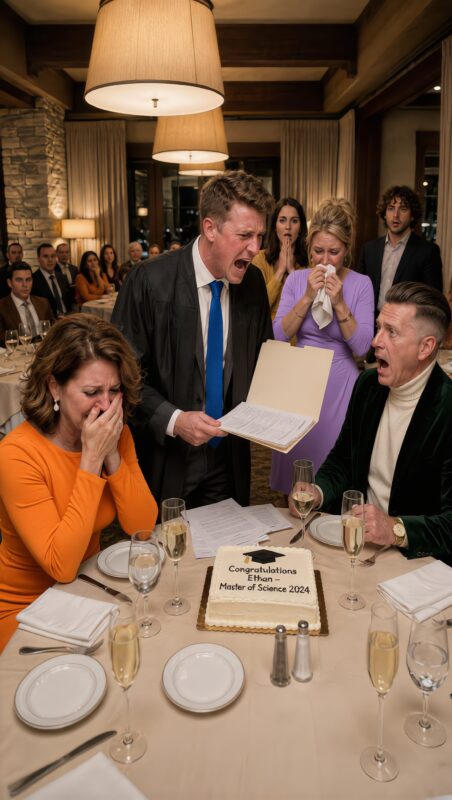
“Margaret deserves an award,” Richard announced. “Not every wife would raise her husband’s child with another woman.”
The entire table fell silent.
Richard smiled as though he had said something clever.
Ethan didn’t.
He rose from his chair, reached for a thick envelope beside him, and said five words that changed everything.
“She was the one paying.”
Richard’s face went pale.
But to understand that moment, you have to go back to the night Ethan became my son.
It was raining hard in Chicago when Richard arrived home carrying a newborn wrapped in a blue blanket.
I knew immediately that something was wrong.
“The baby’s mother is moving away,” Richard said.
I stared at him.
“Who is his father?”
Richard said nothing.
Sometimes silence is a confession.
My marriage could have ended that night.
Perhaps it should have.
But then the baby began crying.
I looked down at his tiny face and realized he had entered the world already carrying the consequences of decisions he had never made.
So I held him.
His name was Ethan.
Richard put his surname on the paperwork.
I became the person Ethan called when he was scared.
I stayed awake beside him when he was sick. I attended every school performance I could. I helped with homework, packed lunches, sat through freezing football games, listened when his heart was broken, and celebrated every achievement as though it were my own.
Because it was.
Richard enjoyed telling people he was Ethan’s father.
Actually behaving like one interested him much less.
Whenever parenting was pleasant, Richard appeared.
Whenever it became difficult or expensive, he found somewhere else to be.
I quietly filled the gaps.
Ethan never knew how many gaps there were.
At least, I thought he didn’t.
Years later, he completed his master’s degree at Northwestern.
Richard organized a lavish dinner and invited practically everyone who mattered to him—relatives, colleagues, family friends, and several of Ethan’s classmates.
Then champagne loosened Richard’s tongue.
He stood and decided to entertain the room at my expense.
“Margaret raised my mistress’s kid,” he said with a laugh. “I handled the money. She handled everything else.”
No one joined him.
Ethan pushed back his chair.
“That isn’t what happened.”
He placed the envelope in front of Richard.
Inside was a history of our family that Richard never expected anyone to assemble.
Receipts.
Bank statements.
Medical invoices.
Tuition payments.
Loan documents.
Ethan had spent months tracing where the money had actually come from.
Mine.
When he broke his arm as a boy, Richard complained about the medical bill and refused to cover what insurance didn’t.
I sold the bracelet my grandmother had left me.
Years later, Ethan earned a place in an advanced mathematics program. Richard called it unnecessary.
I worked extra hours until I could afford it.
When Northwestern accepted Ethan, Richard told friends that his son’s education was taken care of.
At home, his attitude was different.
He called Ethan a financial burden.
So I borrowed against the house my father had left me.
I never wanted Ethan to know.
Children shouldn’t grow up calculating the price of being loved.
But somehow, Ethan had found the evidence.
He looked at me across the table.
“You made sure I never felt unwanted,” he said. “I’m not letting him rewrite what you did.”
Then he addressed everyone.
“My mother is Margaret. Not because we share DNA. Because she showed up every single day.”
Richard accused him of being disrespectful.
Ethan remained calm.
“I know exactly who deserves my gratitude.”
Then he revealed the detail Richard could not tolerate.
He had legally changed his surname.
From Caldwell to Whitaker.
My family name.
For a moment, Richard simply stared at him.
Then his anger erupted.
“You cannot erase who you are!”
Ethan answered quietly.
“I’m not erasing anything. I’m honoring it.”
Richard ordered me to stop him.
Instead, I surprised both of them.
“He doesn’t need my permission.”
Richard turned toward me.
“Sit down.”
For most of our marriage, commands like that had worked.
This one didn’t.
“No.”
The word felt unfamiliar coming from me.
But it also felt wonderful.
Richard began listing everything he supposedly had given us.
The house.
Security.
A comfortable life.
That was when I corrected another story he had repeated for years.
“You didn’t buy our house. My father left it to me.”
His expression changed.
“You simply lived there.”
Ethan opened the folder again.
This time, he removed a letter.
I recognized it immediately.
Months earlier, Richard had discovered that I was considering divorce.
His response had been a written threat.
If I left him, he promised to drag the process out, challenge every asset, and make separating from him as exhausting and expensive as possible.
Fear had kept me quiet.
But not forever.
I had made a private decision long before that graduation dinner.
Once Ethan finished school, I would leave.
Richard’s humiliation had simply brought the truth into the open sooner.
He searched the table for allies.
None appeared.
His brother told him he had embarrassed himself.
A colleague quietly warned that what she had heard that evening raised serious questions about Richard’s conduct.
Only then did he begin to panic.
His fear wasn’t about losing his family.
It was about losing the image he had carefully built.
Ethan walked around the table and offered me his hand.
“Ready?”
I took it.
Behind us, Richard shouted, “If you leave now, don’t expect to come back!”
I stopped at the doorway.
Twenty-five years of marriage stood behind me.
My future stood beside me.
I didn’t turn around.
“That’s the idea.”
We walked into the rain together.
Three weeks later, the divorce papers were filed.
Richard fought.
He argued over property, finances, and anything else he could use to keep control.
But his threats no longer lived in darkness.
I had documents.
I had witnesses.
And, for the first time in years, I had support.
Eventually, I found a small townhouse near Lake Michigan.
There was no grand dining room and no expensive furniture.
On the first night, Ethan and I ate noodles from cardboard containers while sitting on the living-room floor.
He lifted his drink.
“To our first peaceful dinner.”
I laughed and raised mine.
“To many more.”
Months afterward, Ethan surprised me with a bracelet.
The engraving contained only three words:
Chosen. Loved. Home.
I ran my fingers across them.
“You’ve already given me enough,” I whispered.
“So have you,” he said.
Richard eventually tried calling me.
He insisted that biology made Ethan his son.
I didn’t argue with biology.
I argued with everything Richard believed it entitled him to.
“Being someone’s father requires more than being responsible for their birth.”
“You stole him from me,” Richard said.
“I didn’t have to.”
There was silence.
“You spent years teaching him exactly who you were.”
Richard finally muttered that he had lost everything.
That wasn’t true.
He hadn’t lost everything.
He had thrown away what mattered and only noticed after it was gone.
Later that evening, Ethan came for dinner.
Rain covered the windows, almost exactly as it had on the night he first arrived in my arms.
We talked for hours.
At one point, Ethan asked me something I had never considered.
“When did you decide I was really your son?”
I smiled.
There had never been a ceremony or a single dramatic moment.
“I think I decided every day.”
And perhaps that was the answer.
People liked to say I had sacrificed twenty-five years raising the child of my husband’s affair.
I no longer saw it that way.
Richard’s betrayal brought Ethan to my doorstep.
Everything afterward belonged to Ethan and me.
I chose a baby who needed someone to stay.
Years later, that baby became a man who chose to stand beside me when I finally found the courage to leave.
Richard believed blood gave him permanent ownership of a place in Ethan’s life.
He was wrong.
Blood can explain where a person came from.
Love is what determines where they belong.
And family is built by the people who keep choosing to be there.