Gavin Rourke arrived at our divorce hearing as though the verdict had already been written in his favor.
Three attorneys surrounded him. An ironclad prenuptial agreement sat among their files. And beside him was Sloane Pierce, the woman he intended to marry as soon as our divorce became official.
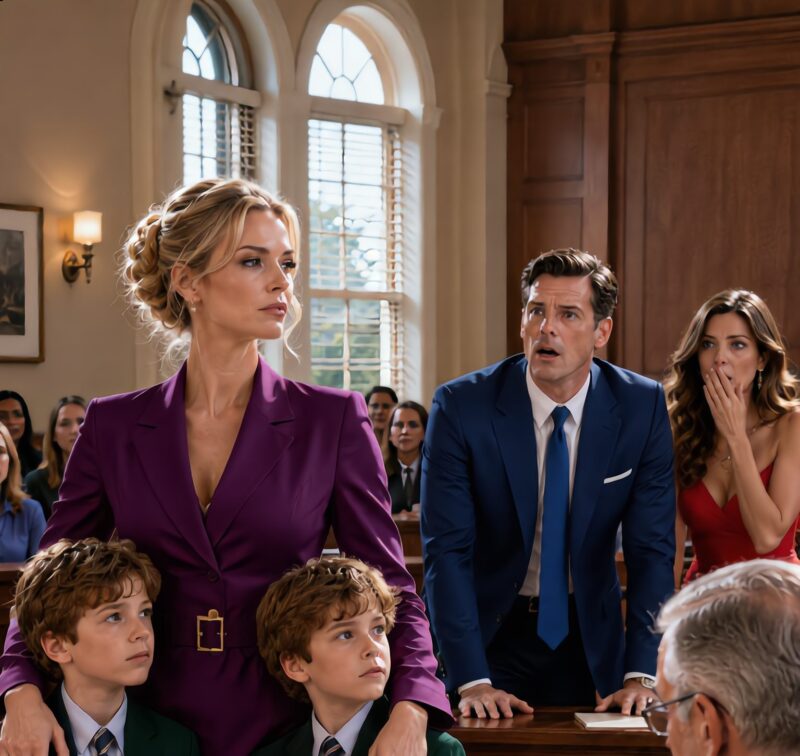
Gavin expected to leave the courthouse with control of Rourke Regional Mobility, most of our wealth, and primary custody of our eight-year-old twins, Nolan and Parker.
He had prepared for every argument.
He hadn’t prepared for the document in my bag.
For more than a decade, the public had known Gavin as the man who built Rourke Regional Mobility from nothing. His photograph appeared in business publications, and his name was printed on programs at charity galas and industry conferences.
People called him a visionary.
I was rarely mentioned.
When I was, I was described as Cassandra Rourke, the devoted wife who had given up her career to raise our children.
I had allowed that story to survive.
Until that morning.
Gavin sat beside Sloane, his company’s public relations director and future wife, while one of his attorneys explained why I supposedly deserved almost nothing.
According to him, Gavin had created the business alone.
I had no real career.
No significant assets.
No independent source of income.
And the prenup, he insisted, protected everything Gavin had built.
Judge Marian Beckett listened without interruption.
Then she looked at me.
“Mrs. Rourke, where is your attorney?”
“There isn’t one, Your Honor.”
Gavin glanced toward Sloane with an amused smile.
“I’ll be representing myself,” I added.
His smile widened.
It lasted less than five minutes.
I placed a sealed envelope in the clerk’s hands.
Inside were certified copies of Rourke Regional Mobility’s original incorporation records.
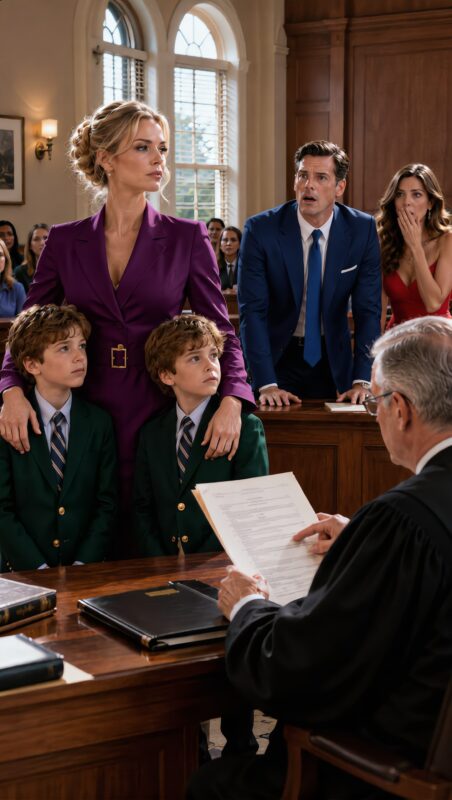
Judge Beckett read the first page, then the second.
When she reached the ownership section, she stopped.
“Mr. Rourke?”
Gavin straightened.
“Can you explain why Cassandra’s maiden name appears here as the company’s original majority shareholder?”
The color drained from his face.
The filing was unmistakable.
At the time the company was formed, seventy-four percent of it belonged to me.
“That isn’t possible,” Gavin said.
Judge Beckett lifted the document slightly.
“This record was certified by the state. Are you claiming it was falsified?”
Gavin looked at his attorneys.
None of them answered.
Because there was nothing to dispute.
Fifteen years earlier, Rourke Regional Mobility had consisted of a battered shuttle van, an aging laptop, and a small desk in the apartment Gavin and I shared.
Gavin had the confidence to sell an idea.
I had the resources to turn that idea into a functioning business.
My aunt had left me a townhouse. I sold it and invested nearly all the money in the company.
I secured financing with my credit.
I filed the registration documents.
I arranged insurance and permits.
I managed contracts, payroll, bookkeeping, and regulatory requirements.
And while Gavin searched for customers, I continued working another job because someone still had to pay the rent and keep food on our table.
In those days, Gavin called Rourke Regional Mobility “our future.”
Years later, he began calling it “my company.”
The change happened gradually.
After Nolan and Parker were born, both boys needed more of my time. Nolan required regular therapy, while Parker had frequent medical appointments.
I stepped away from the company’s daily management.
I never surrendered my ownership.
But Gavin began telling a different story.
First, he introduced himself as the founder.
Later, he became the sole founder.
Eventually, my role vanished altogether.
For years, I didn’t challenge him publicly.
Then he told Nolan and Parker that I had never contributed to the company and wouldn’t be able to support them without him.
That ended my silence.
During a court recess, Gavin followed me into the hallway.
“What are you trying to do to me?”
I turned around.
“Nothing. I’m simply refusing to protect the version of history you invented.”
One of his attorneys joined us.
“Mrs. Rourke, is that the only documentation you have?”
“No.”
“How much more is there?”
“Fifteen years’ worth.”
I began counting.
“Tax records. Loan guarantees. Board minutes. Payroll files. Contracts. Emails. Financial statements.”
His expression tightened.
Behind him, Sloane stared at Gavin.
“You told me Cassandra was never involved.”
Gavin avoided her eyes.
When the hearing resumed, his attorneys tried another approach.
The prenup.
“The agreement protects Mr. Rourke’s business interests,” one attorney argued.
“I agree,” I said.
He hesitated.
“Then Rourke Regional Mobility should be protected.”
“Only the portion that actually belongs to him.”
Silence spread through the courtroom.
Then Judge Beckett found another document.
It was six years old.
The agreement would have transferred nearly all my ownership rights to Gavin for ten dollars.
There was only one problem.
I had never signed it.
Judge Beckett looked over her glasses.
“Mrs. Rourke, have you seen this before?”
“Yes.”
“When?”
“Three days after my aunt’s funeral.”
I looked directly at Gavin.
“He told me it was ordinary company paperwork and asked me to sign it immediately.”
I hadn’t.
Sloane slowly turned toward him.
This time, the disbelief on her face was impossible to hide.
Then came the issue Gavin believed would destroy me.
Custody.
His legal team argued that I had no dependable income and therefore couldn’t maintain the twins’ standard of living.
I reached beneath the table and removed another folder.
Inside were contracts, invoices, bank statements, and eighteen months of business records.
I hadn’t been unemployed.
I had built a consulting practice.
Transportation companies hired me to solve problems involving licensing, regulatory compliance, contract systems, and financial operations.
The work had become profitable enough to cover the mortgage, insurance, school expenses, household costs, and savings without Gavin’s income.
He stared at the documents.
“You told me you were helping people you knew.”
“I was.”
“They were paying you?”
“They were clients.”
“Why didn’t you tell me?”
That question almost made me laugh.
“You haven’t asked what I do with my days in years.”
I never tried to convince Judge Beckett that Gavin didn’t love our children.
He did.
But loving them wasn’t the same as putting them first.
I explained that throughout the divorce, Gavin had treated custody like another asset he needed to win.
The judge eventually ruled that Nolan and Parker would live with me during the school week. Gavin would have them on alternating weekends and for one dinner each week.
He was disappointed.
But that wasn’t what frightened him.
Judge Beckett also ordered an extensive review of Rourke Regional Mobility’s ownership records, financial history, and corporate decisions.
I watched Gavin when she announced it.
For the first time since entering the courtroom, he didn’t look angry.
He looked scared.
That evening, he called me.
I answered but said nothing.
“What exactly do you want?” he asked.
“The truth.”
“You’ve made your point.”
“I don’t think I’ve even found the whole point yet.”
Another silence followed.
Then his voice changed.
“What are you planning to do with the company?”
And suddenly I understood what mattered most to him.
He didn’t ask whether Nolan was upset.
He didn’t ask how Parker was handling the custody arrangement.
He didn’t apologize for erasing fifteen years of my work.
He asked about the company.
“I’ll decide when I know everything.”
Then I hung up.
The following morning, something was attached to my front door.
A plain envelope.
No stamp.
No name.
No return address.
I took it inside before the boys came downstairs.
The first page was a corporate resolution dated nine years earlier.
It claimed that I had approved changes affecting my voting power in Rourke Regional Mobility.
The date caught my attention immediately.
I had been in the hospital that week.
Then I saw the signature.
Cassandra Rourke.
My name.
My handwriting.
Almost.
Someone had done an excellent job copying it.
But whoever had written it made one tiny mistake I never made.
A handwritten message appeared across the top of the resolution.
“Find out what they changed while you were in the hospital.”
My stomach tightened.
There was a second sheet underneath.
Unlike the first, it contained only one line.
“Ask Gavin why your mother called him the night before she died.”
I read it twice.
Then a third time.
Gavin had always insisted that he and my mother hadn’t spoken during the final week of her life.
He had been very specific about it.
Too specific, I suddenly realized.
From upstairs came the sound of Nolan and Parker arguing over whose turn it was to choose the music on the way to school.
A moment later, they both started laughing.
Their ordinary morning continued while I stood motionless in the kitchen, holding evidence that suggested our entire family history contained another lie.
Until then, I had believed the divorce hearing was about exposing what Gavin had done to my company.
Now I understood something far more unsettling.
The ownership records weren’t the end of the secret.
They were the beginning.
And whatever Gavin had spent years hiding hadn’t started in the courtroom.
The judge had simply unlocked the first door.