He shared his lunch with a boy in a wheelchair, unaware of who the child truly was. But the day a sleek luxury car stopped outside the site, his ordinary life quietly shifted onto a new path.
Mornings in the city arrived heavy, thick with heat and dust. The air carried the scent of cement, rust, and engines that never seemed to rest. To Cicero, it was simply the smell of work—of life itself. Years beneath the open sky had toughened his skin and carved strength into his hands, yet his eyes still held a calm, almost gentle light. He was not a man of speeches; his craft spoke instead. Every wall he built, every beam he set, stood as proof of patience and precision. He came early, left late, and wore the same faded clothes day after day—quietly consistent, like the rhythm he lived by.
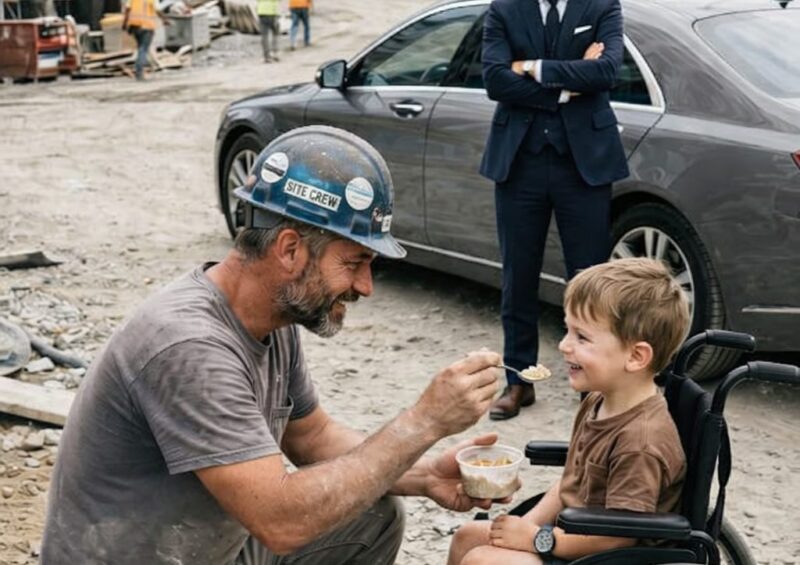
At the construction site, noise never stopped. Machines roared, voices clashed, and dust filled the air. Yet at lunchtime, Cicero always withdrew to a quiet corner near the fence that bordered the street. Sitting on an old bucket, he opened his worn metal lunchbox. Inside: simple food—rice, beans, sometimes a little meat or an egg—prepared by his wife, Maria, before sunrise. He ate slowly, watching strangers pass by, as if he were standing still while the rest of the world rushed forward.
One particularly hot Tuesday, he noticed the boy. Across the fence sat a child in a wheelchair—small, silent, dressed in a loose blue shirt. He didn’t ask for anything. He didn’t move much at all. He just watched the cranes, his eyes following their slow movements through the sky. No adult stood nearby. The sight stayed with Cicero.
The next day, the boy was there again. And again the day after. Something inside Cicero stirred—an ache he couldn’t ignore. He thought of his grandchildren, their laughter echoing through his home, their endless motion. This boy had none of that. Finally, he walked over.
“Are you thirsty?” he asked softly.
The boy looked at him for a long moment, then gave a small nod.
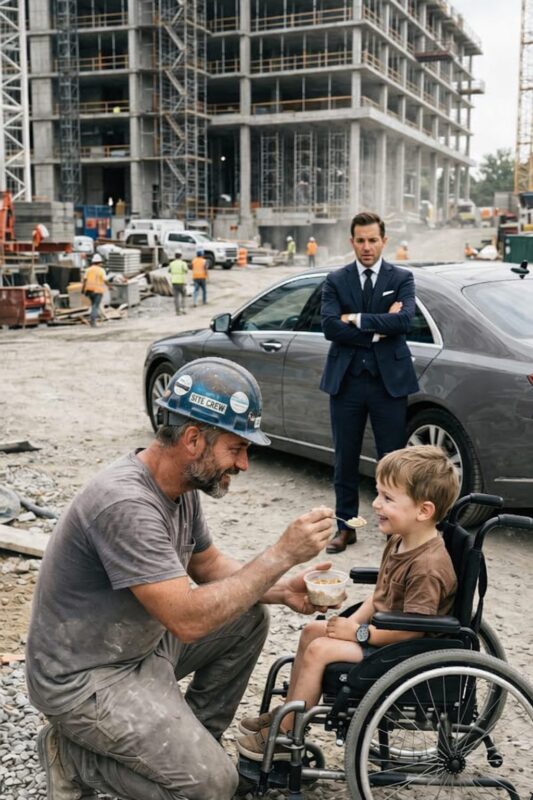
Cicero passed him his water bottle. The child drank eagerly and returned it with a quiet, wordless thanks. The following day, Cicero brought extra food. Then more the next. Without a word, Maria began adding portions to his lunchbox. Cicero even fashioned a small surface from scrap wood so the boy could eat more easily. They shared meals without needing conversation. Cicero would talk about his work—about how every brick mattered, how one weak piece could bring everything down. The boy listened intently, as if every word mattered.
Not everyone approved. Some workers mocked him openly, laughing at his “new charity project.” They called the boy names, dismissed him as useless. Cicero rarely responded, but when he did, his voice carried quiet strength: “You learn a man’s worth by how he treats those who have nothing to offer.” For a moment, that was enough to silence them.
One day, the heat became unbearable. The boy looked unwell—his face pale, his body fragile under the sun. Without hesitation, Cicero set aside his tools and created a makeshift shade using a tarp, tying it carefully to the fence. He placed a cushion beneath the boy’s head. When the child weakly squeezed his hand, Cicero felt something tighten in his chest. The noise around him faded into nothing.
Then, suddenly, the atmosphere shifted.
A powerful engine roared at the gate. A black luxury car came to an abrupt stop. From it stepped a man in an expensive suit, his face tense with panic.
“Miguel! My son!”
The boy turned with effort—and for the first time, he made a sound. The man rushed forward, dropping to his knees beside him. It was Daniel Valadares, the owner of the entire project. The same child others had mocked was his missing son.
Daniel’s eyes quickly took in the scene—the lunchbox, the water, the shade carefully built against the fence. Then he turned to Cicero.
“Was it you?” he asked, his voice no longer commanding, but humbled.
Cicero lowered his gaze slightly. “He was just a child who needed care.”
Daniel explained, his voice unsteady, that Miguel lived with severe autism and partial paralysis. Surrounded by professionals all his life, he had rarely been treated simply as a boy. Yet here, someone had seen him differently—without labels, without distance.
He offered money. Cicero stepped back.
“No,” he said calmly. “Kindness isn’t something you put a price on.”
Time passed, and the impact of that moment spread further than anyone expected. The construction plans were changed. Part of the building was transformed into a center dedicated to children with disabilities—free for those in need. Soon after, Cicero received a letter. Not a notice, but an invitation. He was offered a position overseeing maintenance and supporting the people within the new center.
He accepted—not for the promotion, but for the chance to remain close to Miguel.
Now, there were no barriers between them. No fence, no harsh sun, no cruel voices. Only a garden, shared meals, and a quiet bond built without effort.
Cicero came to understand a simple truth: the strongest foundations are not made of concrete, but of compassion. And sometimes, the smallest gesture—given without expectation—can transform lives in ways no wealth ever could.