I had spent nearly forty-eight hours trying to create the kind of Christmas people remember for all the right reasons.
The house smelled of cinnamon, roasted turkey, and pine. Presents filled the space beneath the tree, candles flickered along the mantel, and the dining table was set with the china Thomas and I had received as a wedding gift.
All I wanted was one warm evening with my family.
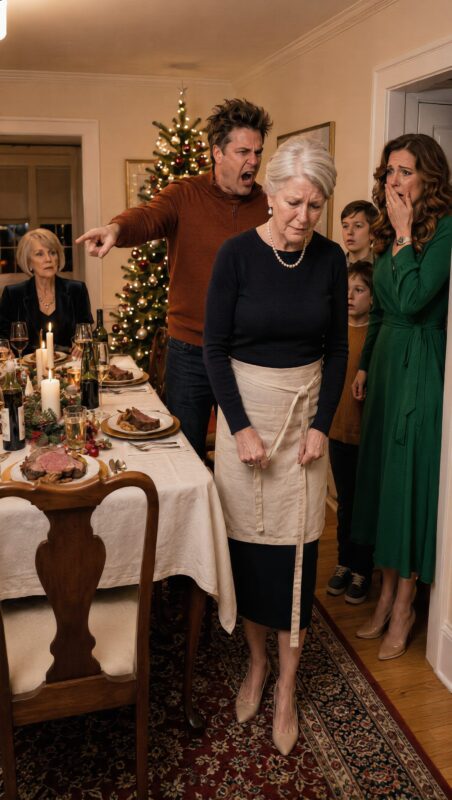
Instead, my son-in-law turned Christmas dinner into the moment I finally stopped keeping quiet.
Everyone was gathering around the table when Brandon stepped in front of me.
“Not that chair,” he said.
At first, I thought I had misunderstood him.
“Excuse me?”
He pointed toward the other end of the table.
“You’ll need to sit somewhere else.”
I looked past him.
Donna, Brandon’s mother, was sitting in my usual place, holding a glass of wine and chatting as though nothing unusual had happened.
That chair had been mine for thirty-one years.
Thomas and I had bought our Ohio home when Claire was only six. From that spot, I had watched my daughter blow out birthday candles, celebrated her graduation, welcomed new family members, and shared countless Thanksgiving and Christmas dinners.
After Thomas died, sitting there somehow made his absence a little easier to bear.
Brandon knew that.
Everyone did.
“Donna is our guest of honor tonight,” he announced.
*Our guest?*
It was my house.
My table.
My dinner.
I turned toward Claire.
She was standing near the kitchen counter with her hands clasped tightly in front of her.
“Claire?”
She looked at me for half a second before lowering her eyes.
That was when I understood.
This wasn’t a misunderstanding.
She knew.
And she was too afraid of her husband’s reaction to say anything.
I looked around the room.
I had purchased every ingredient for dinner. I had decorated the house, wrapped the gifts, stocked the wine, and spent hours cooking because Claire had asked me to host Christmas.
Yet I was apparently expected to smile while someone else decided where I was permitted to sit in my own home.
Something inside me became remarkably calm.
I untied my apron.
Then I picked up my purse and coat.
Claire finally looked up.
“Mom, where are you going?”
“Out.”
“But dinner—”
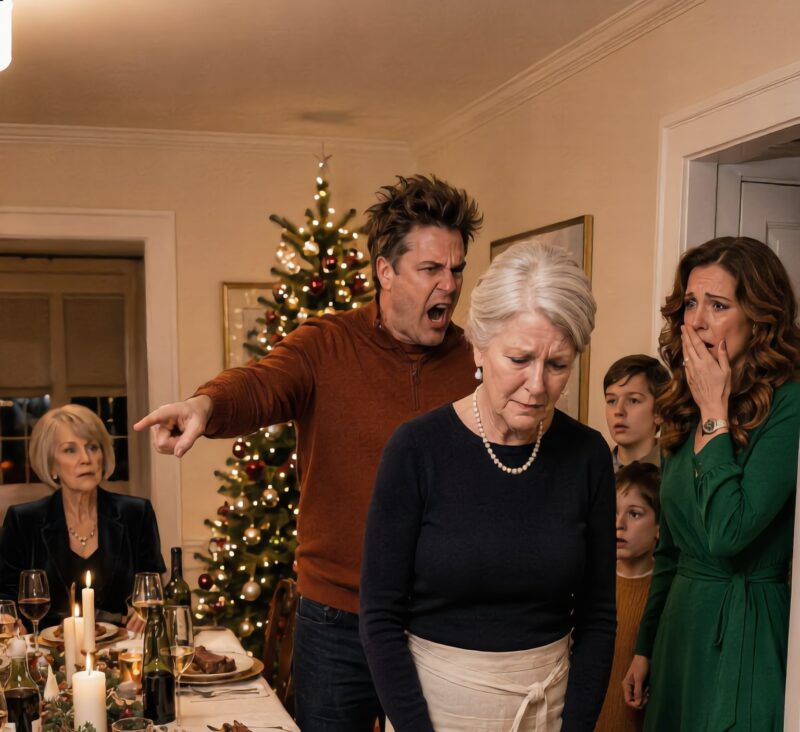
“Dinner is ready.”
I slipped on my coat.
“What isn’t ready is me pretending this is acceptable.”
Then I walked out the door.
I ended up at a little café that was still open for Christmas. There were only a handful of customers inside.
I ordered coffee and sat beside the window.
My phone began vibrating almost immediately.
Brandon.
I declined the call.
He tried again.
I declined that one too.
Then Claire called.
I answered.
“Mom, please come home.”
“Why?”
“Because everyone is upset.”
I almost laughed.
“Are they upset because I’m gone, Claire, or because I refused to sit quietly and be humiliated?”
She didn’t answer.
For years, I had noticed changes in my daughter.
The Claire I remembered had opinions about everything. She laughed loudly, argued passionately, and never needed anyone’s permission to speak.
Marriage to Brandon had gradually changed that.
She apologized constantly. She checked his expression before answering questions. She let him control decisions that should have belonged to both of them.
I had noticed.
I simply hadn’t wanted to admit how serious it had become.
“Listen to me,” I said. “I’m not returning tonight. But tomorrow, you can bring Lily and Owen here.”
“And Brandon?”
“No.”
Several hours later, a message arrived from him.
*You made a scene and ruined Christmas.*
I stared at those words for a moment.
Then I typed:
*I didn’t ruin Christmas. I stopped pretending.*
The following morning, a car pulled into my driveway.
Claire climbed out with Lily and Owen.
The children ran toward me.
Lily wrapped both arms around my waist.
“Grandma, why did Daddy make you move?”
Children have a way of asking the question adults desperately try to avoid.
I brushed the hair from her face.
“Because sometimes people forget that respect matters more than getting their own way.”
Later, while the children played upstairs, Claire sat across from me at the kitchen table.
“I’m sorry.”
Her voice trembled.
“I should have said something last night.”
“Yes,” I replied gently. “You should have.”
She wiped her eyes.
“I kept telling myself that if nobody argued, Christmas would stay peaceful.”
“And was it peaceful?”
Claire shook her head.
Then she told me what Brandon had said before she left that morning.
If she came to my house, she wasn’t welcome back.
For several seconds, neither of us spoke.
Finally, I reached across the table and took her hand.
“Then you stay here.”
“With the kids?”
“Especially with the kids.”
That afternoon, Brandon arrived.
He pounded on the door and demanded that Claire come outside.
I kept the door locked.
Then Claire appeared beside me.
“Leave, Brandon.”
“This is ridiculous. Open the door.”
“No.”
Her voice wasn’t loud.
It didn’t need to be.
For the first time in years, she had said no without immediately apologizing for it.
Brandon threatened to cut off her access to their money.
I pulled out my phone and started recording.
He noticed.
A minute later, he walked back to his car.
That evening, Claire asked me to help her find an attorney.
The next few weeks were difficult, but they were also transformative.
She opened an account that only she could access. She collected bank statements, important documents, and old messages she had been afraid to delete.
She met with a family attorney and began making decisions for herself again.
By January, she had started the legal separation process.
A few months later, she found a position at a pediatric clinic.
Her first major purchase with her own paycheck was nothing glamorous—a used car.
But I had rarely seen her look prouder.
Then December returned.
On Christmas morning, Lily decorated cookies while Owen tried to sneak pieces of icing whenever nobody was watching.
Claire handled the mashed potatoes.
I prepared the turkey.
Music played in the kitchen.
People laughed without checking whether someone else approved.
That was the biggest difference.
Nobody was walking on eggshells anymore.
When dinner was ready, we carried everything into the dining room.
I approached the chair I had occupied for more than three decades.
For months, I had thought about what happened there the previous Christmas.
I had believed Brandon humiliated me by taking away my seat.
But I finally understood that I had given that chair far too much power.
A chair was wood and fabric.
Belonging was something else entirely.
I pulled it out and looked at Claire.
“You sit here.”
She stared at me.
“Mom, that’s always been your place.”
“No,” I said. “My place is wherever I choose to be.”
I touched the back of the chair.
“And tonight, I choose to sit beside you.”
Claire slowly took the seat.
I sat next to her.
Lily began passing around her handmade place cards. Owen complained that his sister had given him the smallest piece of bread.
And suddenly we were laughing.
Not cautiously.
Not politely.
Really laughing.
Later, Claire and I stood together at the sink washing dishes.
She handed me a plate.
“Can I ask you something?”
“Of course.”
“Do you ever wish you had stayed that night? Maybe things could have been handled differently.”
I dried the plate and looked toward the dining room.
My grandchildren were playing near the Christmas tree.
Claire was smiling.
The house felt peaceful.
Not the artificial peace that comes from everyone remaining silent.
Real peace.
“No,” I said. “Leaving was the first honest thing any of us had done in a long time.”
Brandon believed that telling me to surrender my chair would remind me who was in control.
He miscalculated.
Because that Christmas, I learned something far more important than where I belonged at the table.
I learned that keeping the peace and surrendering your dignity are not the same thing.
Sometimes walking away isn’t defeat.
Sometimes it’s the moment you finally stop asking for permission to stand your ground.
And when I walked out of my own Christmas dinner that night, I didn’t abandon my family.
I opened a door.
A year later, my daughter was finally strong enough to walk through it.