I Married My Dying Patient to Grant Her Last Wish—But After the Funeral, Her Sister Uncovered a Secret That Almost Ruined My Life
I agreed to marry a terminally ill eighteen-year-old girl because she had one final request. I never imagined that a simple ceremony in a hospital room would put everything I’d worked for at risk. But shortly after her funeral, her sister handed me a small wooden box. Inside was a secret worth hundreds of thousands of dollars—and it nearly ended my career as a doctor.
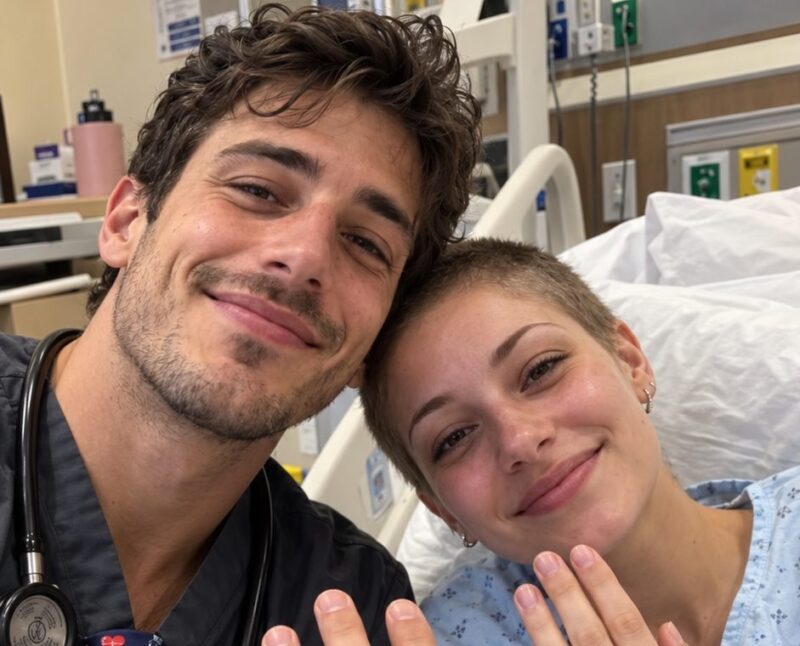
My name is Lucas Bennett. At thirty, I was still struggling to repay the enormous loans I’d taken out to attend medical school.
I’d devoted most of my adult life to becoming a physician. Long nights, endless examinations, missed birthdays, and financial sacrifices had become normal parts of my existence.
I believed nothing could shake my determination to practice medicine.
Then Alicia entered my life.
She was eighteen and undergoing treatment for a severe illness. Despite everything she was facing, she possessed an extraordinary ability to make people laugh.
Every morning, she greeted me with a playful remark.
“Dr. Bennett, you’re looking very serious again. Is smiling against hospital policy?”
Her humor brought warmth to an otherwise difficult ward.
But six weeks after I began treating her, the situation changed dramatically.
Her condition worsened, and further treatment offered little hope.
The medical team believed she had only days remaining.
One evening, Alicia asked me to stay after my rounds.
“Doctor, there’s something I desperately want to do before it’s too late.”
I sat beside her.
“Tell me.”
She hesitated before speaking.
“I want to get married.”
I assumed she was talking about someone she loved.
Then she added:
“To you.”
I stared at her, completely stunned.
“Alicia, you know that isn’t appropriate. I’m your physician.”
“I know,” she replied softly. “I’m not pretending we’re in love. I just want one beautiful memory that isn’t connected to hospitals, treatments, or being sick.”
She paused.
“Everyone keeps telling me what I can and cannot do. I want to make one important choice for myself.”
Her words affected me more deeply than I expected.
Professionally, the answer should have been no.
Yet I convinced myself that granting her wish would bring a little happiness into her remaining days.
I arranged for a colleague to take responsibility for her medical care.
Then I accepted her proposal.
The following afternoon, we held a modest ceremony in her hospital room.
There were no expensive decorations or elegant wedding clothes.
A nurse created symbolic rings from soft strips of bandage. Alicia wore a white scarf, and her older sister, Nora, brought a bouquet of flowers.
Two nurses and a hospital chaplain witnessed the ceremony.
We exchanged vows as Alicia rested against her pillows.
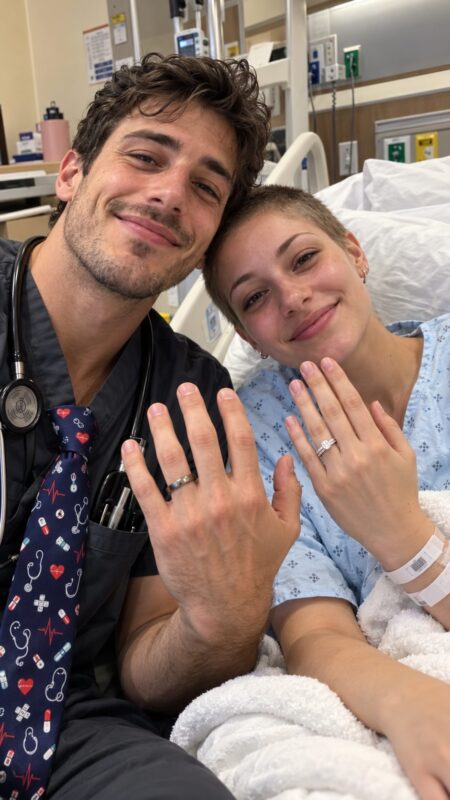
When it was over, she looked at me with a radiant expression.
“See, Lucas? Even you can make a girl’s dream come true.”
Nora wiped away her tears.
“Thank you,” she whispered. “I haven’t seen my sister this happy in such a long time.”
Two days later, Alicia passed away.
I attended the funeral with a heavy heart.
I thought that would be the end of our unusual story.
I was wrong.
As people gathered outside the chapel, Nora approached me carrying a carved wooden box.
“Alicia asked me to give you this after she was gone.”
I thanked her and lifted the lid.
Inside were our wedding photograph, a handwritten note, and an official envelope bearing the name of a law firm.
I opened the legal documents.
My breath caught.
Alicia had named me as the recipient of the inheritance she’d received from her grandmother.
The amount was far greater than anything I’d ever possessed.
With that money, I could have eliminated my medical school debt, moved into a better home, and finally stopped worrying about bills.
But before I could say anything, Nora noticed the figures.
She grabbed the papers.
“What is this?”
“Nora, I just found out myself.”
Her expression changed from confusion to disbelief.
“She gave you all her inheritance?”
I nodded slowly.
“Apparently.”
She stepped backward.
“Now everything makes sense.”
“What do you mean?”
“You married my sister because you knew she had money!”
The accusation struck me like a blow.
“That’s not true. I never asked her for anything!”
“She was dying, Lucas! She was young, frightened, and vulnerable. And you were the doctor she trusted!”
I tried to explain that I hadn’t known about the inheritance.
Nora refused to listen.
“I’m going to tell the hospital what you did.”
That evening, I barely slept.
The money represented the financial security I’d dreamed about for years.
But keeping it would raise serious questions about whether I’d taken advantage of my position.
The next morning, I called Alicia’s attorney.
“I want to decline the inheritance.”
He asked whether I understood what I was giving up.
“I do. Please prepare whatever documents are necessary.”
Once everything was signed, I informed Nora.
“I’ve formally refused the money.”
Her answer was immediate.
“That doesn’t prove you’re innocent. It only proves you’re afraid of getting caught.”
The following day, Dr. Patel, the senior physician who supervised my work, summoned me to his office.
His expression told me something was wrong.
“Lucas, I need your badge.”
I felt my stomach tighten.
“Why?”
“A complaint has been submitted concerning your marriage to Alicia. Until the investigation is complete, you’re suspended from clinical duties.”
“But I transferred her care before the ceremony.”
Dr. Patel shook his head.
“Changing her attending physician didn’t eliminate the professional boundary. She was your patient when this relationship began, and you were responsible for recognizing that.”
I wanted to argue.
Instead, I placed my identification badge on his desk.
For the first time since entering medical school, I wondered whether I would ever work as a doctor again.
At home, I opened Alicia’s handwritten note.
I’d been so shocked by the legal documents that I hadn’t read it.
Dear Lucas,
If you’re reading this, I hope you’re not wearing that serious expression you always have at work.
I know our wedding wasn’t ordinary, but it meant something to me.
For one afternoon, I wasn’t just a patient waiting for another medical result. I was a young woman celebrating something she’d chosen for herself.
You once told me how difficult medical school had been and how much money you still owed.
Grandma wanted Nora and me to have happy futures. I won’t have the opportunity to spend my share, so I wanted to give it to someone who could.
You helped me feel hopeful when almost everything seemed hopeless.
Now I want you to enjoy the life you’ve worked so hard to build.
And please, Lucas, remember to smile.
Thank you for everything.
Alicia
I remained seated for a long time, holding the letter.
She hadn’t been manipulated into making that gift.
At least, that was what her words suggested.
But I also understood something painful.
Even if Alicia had made her decision freely, I had failed to maintain the distance my profession required.
My desire to make her happy had clouded my judgment.
And now I was facing the consequences.
Several days later, Nora published a photograph of our wedding online.
Alongside it, she wrote that a doctor had married her dying teenage sister and then appeared in documents granting him a large inheritance.
The post spread rapidly.
People I’d never met condemned me.
Former colleagues avoided discussing my case. Friends who once called regularly became distant.
With no hospital income and bills continuing to arrive, I began working part-time at my father’s hardware store.
Each morning, I stocked shelves, unloaded deliveries, and wondered whether my medical career was already over.
One afternoon, I discovered the little bandage ring from our ceremony tucked inside my coat pocket.
I stared at it.
I remembered Alicia joking about my inability to smile.
Then I remembered her sister’s devastated expression outside the funeral chapel.
I realized I needed to speak to Nora again.
I called and asked her to meet me somewhere quiet.
She reluctantly agreed.
At a small café, I placed Alicia’s scarf, our symbolic wedding ring, and the documents confirming my rejection of the inheritance on the table.
“I’m not asking you to forgive me,” I said.
Nora folded her arms.
“Then why are we here?”
“Because you deserve the truth. I made a serious mistake by agreeing to the marriage. But I never knew Alicia intended to leave me money.”
She studied the documents.
“You expect me to believe that?”
“I don’t expect you to believe anything without evidence. I’m only asking you to describe what you personally witnessed when the investigators contact you.”
Nora looked down at the photograph.
For several moments, neither of us spoke.
Finally, she said, “Alicia talked about that wedding constantly. She was so excited.”
I nodded.
“She was.”
“I helped choose the flowers. I even asked the nurse to make those ridiculous little rings.”
Her voice trembled.
“I just couldn’t understand why she would give away everything Grandma left her.”
“Neither could I,” I admitted.
Nora took a deep breath.
“I still think you should have refused her proposal.”
“You’re right.”
She looked surprised by my answer.
“I should have found another way to honor what she wanted without crossing that boundary,” I continued. “I understand that now.”
After a long silence, Nora agreed to cooperate with the investigation.
She told the hospital that Alicia had initiated the marriage, that Nora herself had helped organize the ceremony, and that she had no direct evidence I’d known about the inheritance beforehand.
Her statement didn’t erase what I’d done.
But it helped establish the facts.
Several weeks later, the hospital informed me of its findings.
The investigation had uncovered no evidence that I’d pursued the marriage for financial benefit.
Nevertheless, the review concluded that I’d seriously breached professional ethics.
My suspension would end, but I would receive a formal reprimand. I also had to complete additional ethics training and work under close supervision.
I accepted every condition.
The outcome didn’t instantly repair my reputation.
My student loans remained unpaid, and some colleagues continued to question my judgment.
But I hadn’t lost the chance to continue practicing medicine.
On the morning I returned to work, I stood outside the oncology department holding a new identification badge.
Dr. Patel approached.
“Lucas, I hope you understand how close you came to losing your career.”
“I do.”
“Compassion is essential in medicine. But it must be guided by sound judgment.”
I nodded.
“I won’t forget that again.”
Months later, Nora contacted me.
Alicia’s estate had been settled in accordance with its legal provisions, and the family had arranged for part of the funds they received to support young patients who needed financial assistance.
Nora sent me a photograph of a thank-you letter from one of the families.
Beneath it, she wrote:
I think Alicia would have been happy about this.
I kept her message.
Over time, my professional life slowly returned to normal.
I continued treating patients, worked to regain the confidence of my colleagues, and became more careful about the decisions I made.
Sometimes, when I encountered someone struggling through a difficult diagnosis, I remembered Alicia’s determination to find joy in the smallest moments.
She had taught me that every patient deserves dignity, compassion, and the opportunity to be heard.
But the mistake I made taught me something equally important.
A doctor’s responsibility isn’t simply to fulfill every wish, even when the request comes from someone facing unimaginable hardship.
Sometimes, the most compassionate response is also the most difficult one.
I had wanted to give Alicia a perfect final memory. Instead, I learned that genuine care requires more than good intentions. It demands wisdom, professional responsibility, and the courage to say no when saying yes could cause harm.