I moved before I had time to think it through.
Carefully, I rose—just enough to place myself between the girl and the aisle as the man at the counter turned and spotted her.

For a split second, his expression emptied. Not confusion. Not concern. Something colder—calculation, like a plan slipping out of control.
“There you are,” he said, forcing a pleasant tone as he walked toward us. “Come on, sweetheart. Time to go.”
The girl stayed frozen.
Boone slid his menu aside and leaned back slightly. “Doesn’t look like she’s in a hurry.”
The man stopped a few steps away. Up close, he looked worse—sweat beading along his temples, his jaw tightening, fingers twitching at his side.
“That’s my daughter,” he said sharply.
The girl whispered, almost soundlessly, “No.”
That was all I needed.
“She says otherwise,” I replied, meeting his gaze.
Silence spread across the diner, one table at a time, until even the kitchen quieted.
He let out a short, empty laugh. “Kids make things up.”
“She doesn’t sound like she is.”
He stepped forward again—but Boone stood.
The shift was immediate.
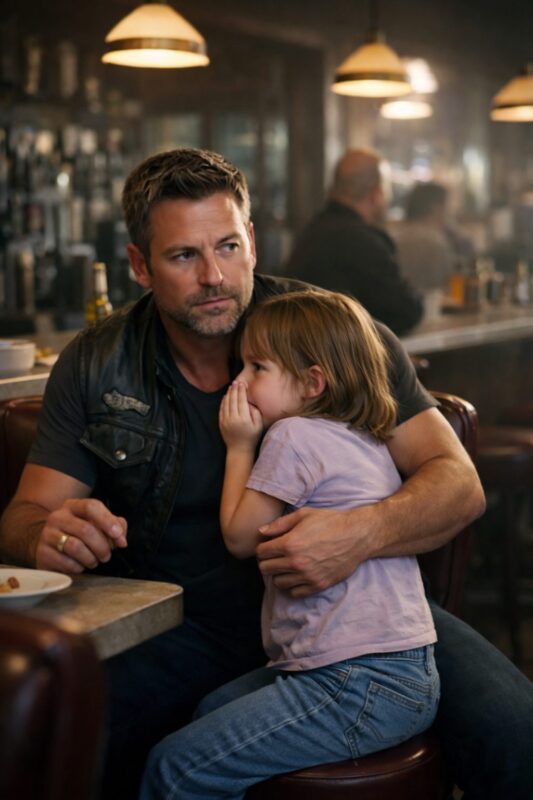
Boone didn’t raise his voice or square up. He simply stood there, solid as a wall, and suddenly the man looked smaller.
“Take a step back,” Boone said.
The man hesitated, eyes flicking toward the exits, then to the faces now watching him closely. He realized too late he’d lost control of the room.
“This is all a misunderstanding,” he said. “She gets nervous.”
I lowered myself to the girl’s level. “What’s your name?”
She swallowed hard. “Lila.”
“Emily,” the man snapped. “Her name is Emily.”
The girl shook her head quickly. “No. Lila Grace.”
A low murmur moved through the diner.
Details expose lies.
I stood again. “You sure about that?”
His expression hardened. “You’re crossing a line.”
“No,” I said evenly. “I’m listening to a child asking for help.”
He changed tactics. “Her mother and I are going through a rough time. She’s confused.”
Lila clutched my vest tighter.
Then, in a trembling voice, she said the words that changed everything:
“He took me from a motel.”
The air turned heavy.
Boone shifted, sealing off the aisle. Behind the counter, Marlene grabbed the phone.
The man noticed—and snapped.
He lunged.
Not toward Boone—but toward Lila.
I caught his arm mid-motion, twisted it, and drove him into the booth. Dishes rattled, coffee splashed. Boone was on him instantly, forcing him down.
“Sit,” Boone growled.
Instead, the man reached into his jacket.
Chairs scraped as people tensed.
I slammed his wrist against the table. A small phone slid out and hit the floor.
Not a weapon—but still dangerous.
Boone pinned him firmly in place.
“The sheriff’s on the line!” Marlene called out.
“Report a possible abduction,” I said.
Lila trembled. Manny knelt beside her, his rough exterior softened by calm reassurance. “You’re okay. Stay with us.”
The man looked around, panic rising. “You don’t understand—you can’t call them.”
That wasn’t fear of arrest.
It was fear of something worse.
Boone’s voice dropped. “Why not?”
The man didn’t answer. He just glanced toward the window.
Outside, a dark SUV had rolled into the lot. No one stepped out.
They were watching.
A cold weight settled in my stomach.
“Who are they?” I asked.
No response.
Lila saw the vehicle and began to shake. “That’s them,” she whispered.
“Them who?”
Her voice cracked. “The men from the room.”
Not a home. A room.
“Are there more kids?” I asked quietly.
She nodded.
“How many?”
“I don’t know.”
The silence deepened, heavier than before.
Boone looked down at the man. “You’re going to start talking.”
“I was only supposed to move her,” he said hoarsely. “Just her.”
Marlene’s grip on the phone slipped.
Outside, an engine revved—a signal.
A man stepped out, calm and deliberate. Two more followed.
Boone muttered, “This just got worse.”
“Lock the door,” I said.
Marlene didn’t hesitate.
The men kept approaching.
One of them smiled when he saw the lock.
That smile was worse than anger.
“They don’t care about me,” the man whispered.
“Who are they?” I pressed.
His answer came out hollow:
“People who buy children.”
The words settled like ice.
Lila broke into sobs. Boone’s face turned pale with fury.
Outside, the man tapped the glass, then raised his phone.
On the screen—a small boy.
Lila screamed. “My brother!”
Something inside me hardened instantly.
“They’re using her,” I said. “She’s leverage.”
I crouched beside her. “Listen to me—they’re not taking you. Not from here.”
Sirens echoed faintly in the distance.
Too far away.
Too late.
The men outside heard them. They didn’t panic.
They adjusted.
Moments later, the SUV sped off as the sheriff arrived.
Inside, tension lingered—fear, anger, urgency.
The deputy burst in. “What happened?”
I looked toward the road, then back at Lila.
“Not enough.”
A few minutes later, we got an address.
And when I read it, my blood ran cold.
Not a motel.
An old church camp—twelve miles east.
A place we knew well.
Cabins. Locked basements. A hidden back road.
Boone met my eyes.
We both understood immediately.
They hadn’t just taken children.
They’d been hiding them right under our noses.