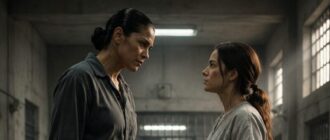
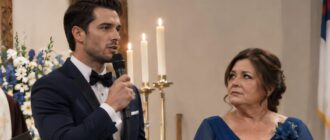
For twelve years, Willow Creek knew me as the daughter who never came home.
According to the story everyone had heard, my father became ill while I was building a military career somewhere far away. He waited for me. I ignored him.
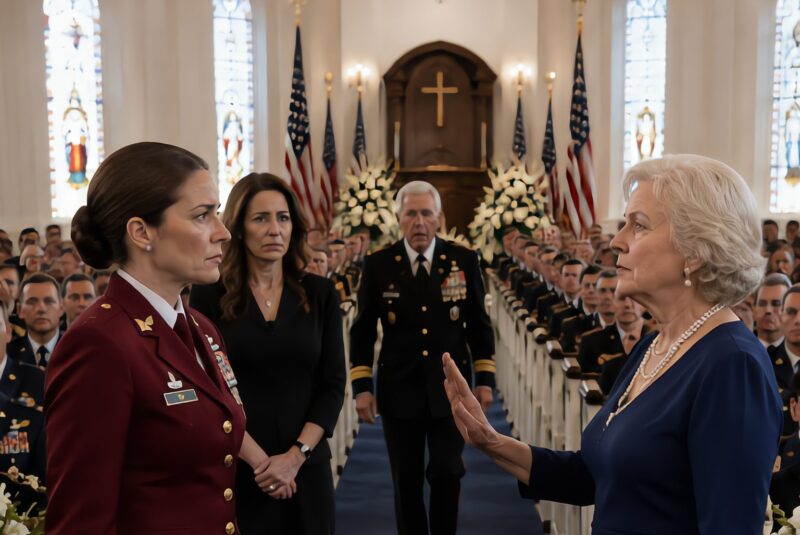
Then he died.
There was only one problem with that story.
It wasn’t true.
My mother had simply repeated it for so long that eventually no one questioned it.
On the morning of Dad’s memorial, I stood before a hotel mirror in my Navy dress uniform.
I almost changed clothes three times.
Not because I was ashamed of the uniform.
Because I knew Mom would be furious when she saw it.
Then I remembered Dad’s last letter.
There was one sentence I had read so many times that I knew it by heart:
Rebecca, when they honor me, wear what you earned. Stand there as my daughter and as the officer you became.
I adjusted my jacket.
Then I left.
My father, Colonel Thomas Carter, had been a legend in our little corner of Willow Creek.
He had spent decades in the Army before returning home. After retirement, he helped veterans find work, encouraged teenagers considering military careers, and never seemed capable of walking past someone who needed assistance.
The church was packed for him.
I entered through the rear doors.
The effect was immediate.
People stopped talking.
Heads turned.
A few faces showed surprise.
Others showed judgment.
I had seen those expressions before.
My sister Anna spotted me near the entrance.
For a moment, she didn’t move.
Then she hurried toward me.
“You actually came.”
“I was always coming.”
Before she could answer, Mom appeared.
Her gaze went directly to my uniform.
“No.”
I knew that tone.
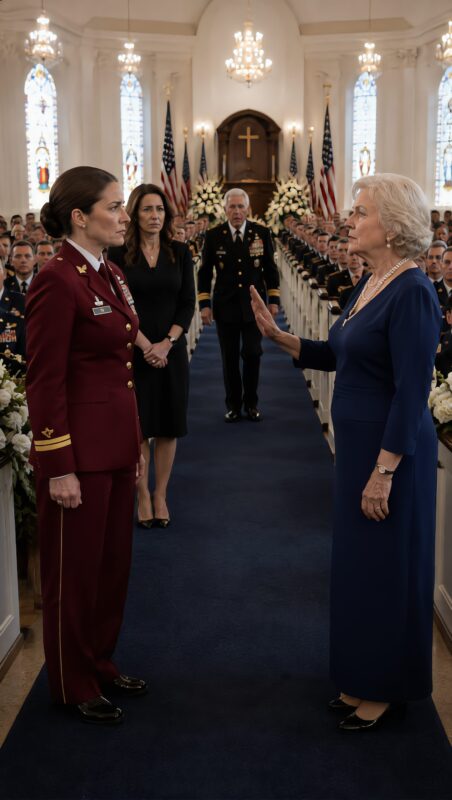
“You’re changing before you enter this church.”
“I’m already inside.”
“Don’t be clever with me.”
“Dad asked me to wear it.”
Her jaw tightened.
“Your father spent years wondering why his daughter had forgotten him. You don’t get to appear now dressed like some kind of hero.”
Several people were listening.
Mom knew it.
That was the point.
I felt the old instinct to defend myself rise inside me.
But how could I explain twelve years of silence in a church aisle?
How could I tell them about the calls that went unanswered?
The letters that received no replies?
The two emergency leave requests I submitted when Dad became seriously ill?
Both had been denied.
Then, six weeks before Dad died, I was seriously injured overseas and evacuated to a military hospital in Germany.
Mom knew where I was.
Yet apparently, Willow Creek had been told only that I hadn’t bothered to return.
I was about to answer when a man’s voice carried through the sanctuary.
“Elaine, that’s enough.”
Major William Hayes rose from the front pew.
He had served alongside Dad years earlier and remained one of his closest friends.
He walked toward us slowly, carrying a sealed envelope.
Mom’s confidence disappeared.
“William, stay out of this.”
“I can’t.”
“This concerns my family.”
Major Hayes looked at me.
“Thomas made it concern me.”
He raised the envelope.
“Your father left instructions.”
The room grew quiet.
“He said that if Rebecca arrived in uniform, I was to read this before the service continued.”
Mom took a step toward him.
“You don’t need to do that.”
“Yes,” he said. “I do.”
He opened the envelope.
Then he faced the congregation.
“Thomas Carter wanted everyone here to know that his daughter did not abandon him.”
A whisper moved through the church.
Major Hayes continued.
“Rebecca attempted to return home. Her emergency leave requests were denied. At the time of Thomas’s death, she was recovering in Germany from injuries sustained overseas.”
People began looking toward Mom.
Her face had gone pale.
“That’s not the whole story,” she said.
“No,” Major Hayes replied. “It isn’t.”
Then he read Dad’s message.
*If my daughter stands in this church wearing her uniform, no one is to make her ashamed of it. She earned the right to wear it. I am proud of her service, and anyone who dishonors her dishonors my wishes.*
A veteran near the front stood.
Then another.
Within seconds, men and women throughout the church were rising.
I had expected hostility that morning.
I had not expected them to stand for me.
Major Hayes waited until the room settled.
Then he reached into his jacket.
What he removed wasn’t another letter.
It was a small brass key.
“There is something Thomas wanted Rebecca to see.”
He walked toward the memorial display near Dad’s photograph and knelt beside a wooden cabinet underneath it.
The key opened a hidden compartment.
Inside was a cedar box.
My name was carved across the lid.
Major Hayes carried it to me.
When he opened it, I forgot about everyone else in the room.
The box was filled with envelopes.
My envelopes.
I recognized the handwriting.
I recognized the stamps from different countries.
I even recognized a coffee stain on one I had written during a night shift years earlier.
I stared at them.
“I sent these to Dad.”
“I know,” Major Hayes said.
“I thought he threw them away.”
“He never received them.”
I turned toward Mom.
Anna did too.
“What does that mean?” she asked.
Major Hayes answered.
“Thomas discovered them six months before he died. They had been hidden in a locked cabinet.”
Anna’s voice changed.
“Mom?”
Mom folded her arms.
“I was trying to protect him.”
“From Rebecca’s letters?”
“From being disappointed again.”
I couldn’t speak.
All those years, I had assumed Dad had chosen silence.
He hadn’t even known I was reaching for him.
Major Hayes removed more documents from the box.
Copies of my leave applications.
Hospital records.
Logs showing attempted telephone calls.
Then he pulled out a small recorder.
Mom moved immediately.
“William, don’t play that.”
He pressed the button.
My father’s voice filled the church.
It sounded weaker than I remembered.
But it was him.
“Rebecca, if William is playing this, then I’m gone.”
My throat tightened.
“I found your letters. I found the records of your calls. I know about your leave requests, and I know why you couldn’t come home.”
I closed my eyes.
“You didn’t leave me, Rebecca. Someone made us both believe the other had stopped trying.”
Mom began protesting.
The recording continued.
Dad had expected that.
“Elaine, my physician and attorney are with me while I record this. I am fully aware of what I’m saying.”
Mom fell silent.
Dad explained what he had learned.
For years, she had intercepted my letters and prevented calls from reaching him.
When neighbors asked about me, she told them I was too busy with my career to care about my family.
Her resentment had begun when I left Willow Creek.
She had wanted me nearby.
I wanted something larger.
Every promotion became proof, in her mind, that I had chosen the Navy over her.
Eventually, she decided Dad should believe the same thing.
Then his voice softened.
“Rebecca, listen carefully.”
I gripped the edge of a pew.
“You became exactly who I hoped you would become.”
My eyes filled with tears.
“I never needed you to make your world smaller just so I could remain at the center of it.”
That sentence broke something open inside me.
Then came the words I had waited years to hear.
“You did not fail me.”
For twelve years, I had carried guilt that never belonged to me.
Dad’s voice lifted it in seconds.
But his recording contained one more surprise.
Before his death, he had created the Colonel Thomas Carter Service Foundation.
The organization would provide scholarships to young people entering the military, nursing, emergency services, and other public-service careers.
Dad had already selected its first director.
Me.
When the recording ended, Major Hayes turned toward me.
He saluted.
The veterans followed.
This time, I didn’t lower my eyes.
I walked to the front of the church.
I looked at the people who had believed a lie about me for more than a decade.
Then I looked at Dad’s photograph.
“I spent twelve years wondering whether my father died believing I didn’t love him.”
My voice nearly failed.
“But I wrote.”
I touched the cedar box.
“I called.”
I looked at my uniform.
“I tried to come home.”
Then I faced Dad’s photograph again.
“You asked me to wear this without shame.”
I straightened my shoulders.
“I finally can.”
After the memorial, Major Hayes gave me the cedar box and one final envelope.
Inside were documents transferring Dad’s cabin at Millstone Lake to me.
Several weeks later, I drove there alone.
Nothing seemed to have changed.
Dad’s old fishing equipment was still stacked by the wall. His chipped coffee mug sat inside a cupboard. The place smelled faintly of wood smoke and pine.
While cleaning his desk, I noticed one floorboard didn’t sit properly.
Underneath it, I found a notebook.
Dad’s handwriting filled the pages.
Near the end, two lines stopped me.
Rebecca will blame herself for the years we lost.
She must never believe they were her fault.
I sat beside his desk until the sunlight disappeared from the windows.
For the first time since his death, I cried without guilt.
The foundation opened the following spring.
Anna joined me on the board.
Our first scholarships went to young people pursuing careers Dad would have admired.
Mom refused to accept what had happened.
She called several times, insisting that I tell people the memorial had been emotional and that her actions had been misunderstood.
I refused.
I had spent twelve years living beneath her version of events.
I wasn’t going to help her rebuild it.
Then, eighteen months later, an envelope arrived.
Mom had written my name across the front.
Her letter contained no excuses.
She admitted hiding my correspondence.
She admitted blocking calls.
She admitted allowing Dad to believe I had stopped trying to reach him.
Then she wrote something I never expected.
*Every time your father spoke proudly about you, I heard proof that you no longer needed me. I confused being unable to control your life with being excluded from it.*
The final sentence was simple.
*I am sorry, Rebecca.*
I didn’t rush to forgive her.
An apology could acknowledge twelve years of damage.
It couldn’t erase them.
We began with letters.
Months later, we tried phone calls.
Slowly, she learned that if she wanted a relationship with me, the truth could no longer be negotiable.
Years passed.
Then Major Hayes died.
I attended his memorial wearing the same Navy uniform Dad had asked me to wear.
Mom attended too.
When I approached the lectern, the veterans rose.
A moment later, Mom stood with them.
Afterward, she found me outside.
She touched the sleeve of my uniform.
“Your father would be proud.”
For once, I didn’t soften the truth for her.
“He already was.”
She looked down.
Then she nodded.
“I know.”
For most of my adult life, I thought I needed Willow Creek to believe me.
I thought clearing my name meant convincing every person who had ever judged me.
Eventually, I understood that I had been chasing the wrong thing.
My father had discovered the truth before he died.
He knew I had never stopped reaching for him.
And he was proud of the life I had built.
That mattered more than the whispers of an entire town.
People sometimes ask what Major Hayes gave me when he placed that little brass key in my hand.
They expect me to say the cedar box.
Or Dad’s letters.
Or the evidence that finally cleared my name.
But the key opened something much more important.
It opened the version of myself I had spent twelve years defending.
Rebecca Carter.
Thomas Carter’s daughter.
Anna’s sister.
A naval officer.
A veteran.
And a woman who had loved her father across every ocean, every deployment, and every mile that separated them.
My uniform never made any of those things true.
It simply became the day I finally stopped letting someone else’s lie make me ashamed of them.