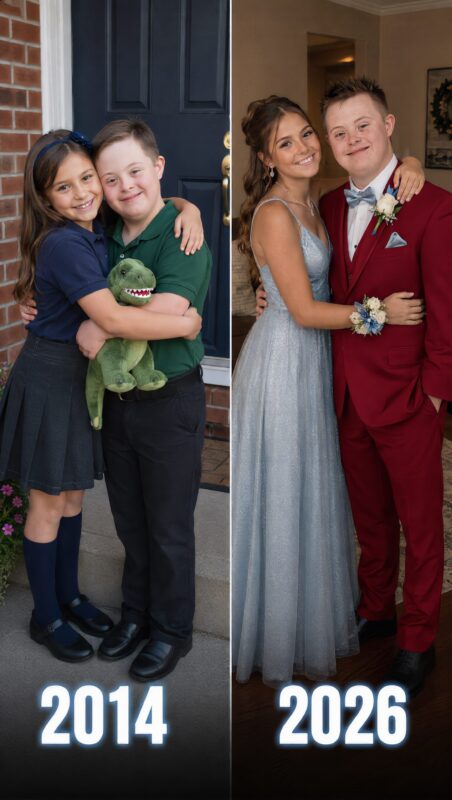
I was six when I promised my best friend, Noah, who has Down syndrome, that one day we’d go to prom together.
At eighteen, he showed up at my front door in a navy suit, ready to collect on that promise.
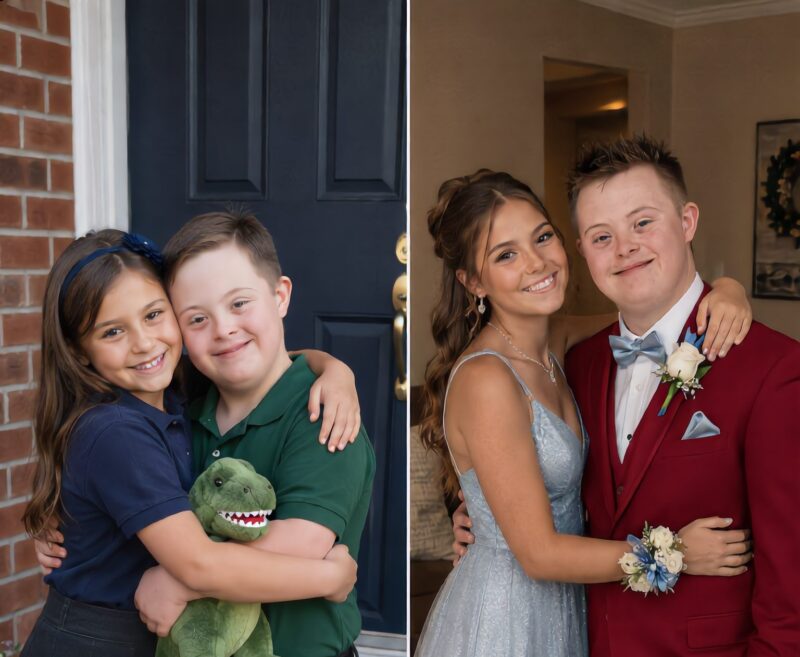
Before we could leave, however, my mother called me upstairs, shut my bedroom door, and asked me to make one more promise—this time to her.
Noah and I became friends during our first week of first grade for the most important reason imaginable to two six-year-olds.
Neither of us would eat raisins.
We discovered this during lunch and immediately decided we were meant to sit together.
After that, we were almost impossible to separate.
One afternoon, another child made a cruel remark to Noah.
“Nobody’s ever going to marry you.”
I became furious.
“Yes, they will. Someone will love him.”
The boy smirked.
“Then you do it.”
I forgot about the exchange almost immediately.
Noah didn’t.
Later, he found me near the playground.
“Chrissy?”
“Yeah?”
“Could you love me?”
I was six. Marriage meant fancy clothes and cake as far as I was concerned.
So I thought carefully.
“Maybe. But we should go to prom first.”
His eyebrows lifted.
“What’s that?”
“A dance for people who are almost grown-ups.”
Noah held out his pinkie.
“Then promise we’ll go.”
I linked my finger with his.
“Okay. Promise.”
Years passed, and that tiny agreement disappeared somewhere in the back of my memory.
For Noah, apparently, it never went anywhere.
Our friendship changed as we grew, but it never disappeared.
Noah became obsessed with baseball. He memorized statistics, players, scores, and facts that I couldn’t imagine anyone voluntarily remembering.
I became obsessed with art.
He accompanied me through museums while pretending not to be bored.
I listened to his endless analysis of pitchers while pretending I understood all of it.
But our friendship wasn’t built on shared hobbies.
It was built on showing up.
When I was twelve, my father left.
The divorce changed our house almost overnight.
I became quiet. I stopped wanting to explain how I felt. Sometimes I barely wanted to talk at all.
Most people tried to make me feel better.
Noah didn’t.
He sat beside me.
That was it.
Years later, I failed my first driving test.
The next afternoon, Noah arrived with two ice cream cones.
He handed me one.
“This is because you tried.”
I pointed at the other.
“What’s that one for?”
He took a bite.
“Because I’ve seen you drive.”
I laughed so hard I nearly dropped mine.
Another time, criticism from an art teacher convinced me that I wasn’t talented enough. I seriously considered giving up drawing.
The following morning, I discovered one of my old childhood pictures taped inside Noah’s locker.
It was supposed to be a dinosaur.
It looked like an angry potato with a tail.
I stared at him.
“Why is that in your locker?”
“To remind you not to quit.”
“That drawing is terrible.”
“Exactly.”
He pointed at it.
“You can’t stop until your dinosaurs improve.”
That was Noah’s gift.
He didn’t arrive with grand speeches or perfect solutions.
He simply knew how to remain beside someone until the worst moment passed.
Then, early in our senior year, Noah appeared at my locker and silently extended his pinkie.
I stared at it.
“What?”
“First grade.”
It took me several seconds.
Then I remembered.
“Oh my gosh. Prom.”
His face brightened.
“Yes.”
“You still remember that?”
“I remember important things.”
Then he casually added, “I bought my bow tie.”
“When?”
“November.”
I laughed.
“Prom isn’t until spring!”
“I know.”
“Why would you buy it that early?”
He looked at me as though the answer were obvious.
“Someone else might buy it.”
So our childhood promise became an actual plan.
When prom night arrived, Noah appeared at my house wearing a navy suit and holding a corsage decorated with rosemary.
I touched the greenery.
“Rosemary?”
“The florist told me it means remembrance.”
He gave me a proud smile.
“I remembered.”
Behind me, I heard Mom sniff.
I turned around.
She was crying.
“Christina, come upstairs with me for a minute.”
Her tone made me nervous.
Inside my bedroom, she closed the door.
Then she locked it.
“Mom, what’s going on?”
“You’re going to prom,” she said quickly. “I’m not stopping you.”
“Then why are we locked in here?”
“Because I need to tell you something first.”
I crossed my arms.
“If you’re worried because Noah has Down syndrome—”
“This has nothing to do with that.”
She sat on the edge of my bed.
“Do you remember how you were after your father left?”
I certainly remembered.
“You stopped eating lunch at school.”
My expression changed.
“I never told you that.”
“No. Noah did.”
I stared at her.
Mom explained that during the worst months of the divorce, Noah had once found her sitting alone in her car outside school.
She had been crying.
He knocked on the window because he wanted to talk about me.
“He told me you weren’t eating much,” Mom said. “He said you didn’t laugh anymore. He was worried because you hardly spoke.”
My throat tightened.
“Why didn’t you tell me?”
“I didn’t know how.”
She paused.
“Then he asked whether you were broken.”
I looked down.
“What did you say?”
“I told him no.”
Mom’s voice trembled.
“And he said, ‘That’s good. I don’t know how to repair people. I just know how to stay with them.’”
For a moment, I couldn’t speak.
Suddenly I could see those school lunches again.
Me staring at food I didn’t want.
Noah sitting nearby.
Never demanding answers.
Never insisting that I talk.
He had simply stayed.
Mom continued.
“I asked him to do something for me that day.”
“What?”
“I asked him to watch out for you.”
“You asked Noah?”
“I was scared, Christina. I didn’t know how to help you, and somehow he could still make you smile.”
“What did he say?”
“Just ‘Okay.’”
Mom lowered her head.
“But later, I started seeing your friendship differently. Every time you defended Noah, changed plans because he wasn’t included, or stood beside him when someone treated him badly, I worried you were giving up parts of your own life.”
She looked at me.
“I kept asking myself how much Noah needed you.”
Her fingers tightened around mine.
“I never asked how much you needed Noah.”
And suddenly I remembered everything.
The ice cream.
The terrible dinosaur drawing.
The museum trips.
The baseball conversations.
The silent lunches.
All the moments when he had quietly stood beside me without asking for anything in return.
People often assumed I was the one helping Noah.
But friendship had never worked that way between us.
Sometimes I supported him.
Sometimes he supported me.
Most of the time, neither of us kept score.
“So what’s the promise?” I asked Mom.
She smiled through her tears.
“I don’t want you going tonight because a six-year-old version of you made an agreement.”
She paused.
“I want you to go only if the person you are now genuinely wants to be there.”
I smiled.
“Then you don’t need a promise.”
“Why?”
“Because I already chose to go.”
Mom hugged me.
When we returned downstairs, Noah looked at his watch dramatically.
“You were gone forever.”
“It was ten minutes.”
“That’s almost forever before prom.”
Mom walked toward him.
“Can I ask you something, Noah?”
He looked suspicious.
“What?”
“May I have the first dance?”
“Here?”
“Yes.”
“This isn’t prom.”
Mom turned on music anyway.
They awkwardly moved around the living room for half a minute before Noah stepped away.
“Christina is better.”
Mom laughed.
“Good. She’s the one you’re taking.”
Then her smile softened.
“Thank you, Noah.”
He frowned.
“For what?”
“For being there when she needed someone.”
Noah looked toward me.
Then he shrugged.
“She does that for me too.”
Mom went completely still.
I think that was the moment she finally understood.
At prom, when the first slow song started, Noah appeared in front of me and held out his hand.
“Ready?”
“For what?”
“My dance.”
I grinned.
“You’ve waited twelve years. Another minute won’t hurt.”
“No.”
He kept his hand extended.
“Twelve years is enough.”
So I took it.
Less than ten seconds later, he stepped directly on my foot.
“Noah!”
“What?”
“You stepped on me.”
He glanced at my shoes.
“Those are dangerous.”
“My shoes didn’t move.”
“Your dress confused me.”
“That doesn’t even make sense.”
We started laughing.
And nothing dramatic happened.
Nobody formed a circle around us.
Nobody applauded.
Nobody treated Noah like a hero or treated me like I was doing something extraordinary.
We were simply two friends at our senior prom.
We danced badly.
We laughed too loudly.
We took ridiculous pictures.
Later, my feet hurt so much that I removed my heels and handed them to Noah.
He carried them without complaint.
Eventually, he became too warm and handed me his jacket.
So I carried that.
Walking out of prom, we probably looked ridiculous—Noah holding my shoes while I carried his jacket.
But somehow it represented our friendship better than anything else could.
We had never been a story about one person saving another.
There was no permanent helper and no permanent person being helped.
We simply traded the weight whenever one of us needed to.
My mother had spent years believing that one of us must be sacrificing something for the other.
That night, she understood what we’d known since childhood.
Friendship wasn’t a debt.
The promise we made at six wasn’t important because we were obligated to keep it.
It mattered because, twelve years later, we still wanted to.
When we were children, Noah once told my mother that he didn’t know how to fix people.
Maybe that was exactly why he had always been so good at friendship.
He never believed I needed fixing.
He just stayed.
And whenever life became difficult for him, I stayed too.
At six, neither of us had understood much about love, adulthood, or promises.
But somehow we understood the part that mattered most.
You don’t always have to rescue the people you care about.
Sometimes you simply walk beside them.
You carry their shoes when their feet hurt.
They carry your burdens when yours become too heavy.
And when the world gets difficult, neither person has to face it alone.
Sometimes the most important promise isn’t “I’ll fix everything.”
It’s much simpler:
“I’ll still be here.”