I WENT TO CHICAGO FOR MY SON’S BIRTHDAY—BUT FOUND HIM HOMELESS WITH HIS TWINS
I had imagined dozens of ways Daniel might react when I surprised him for his thirty-second birthday.
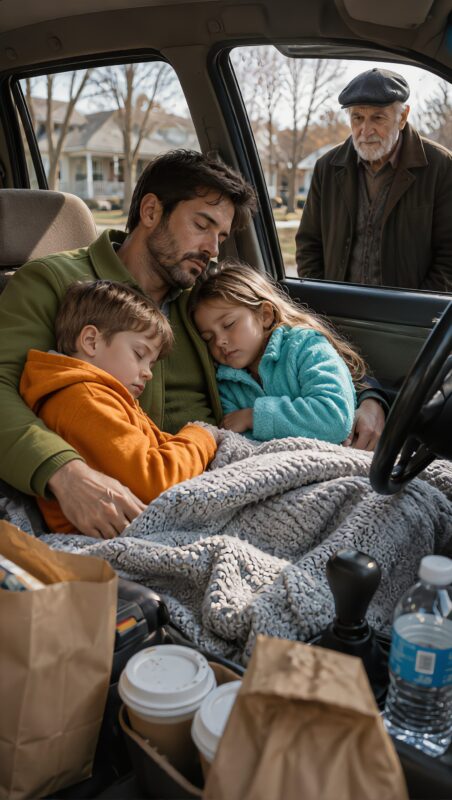
Finding him asleep in a car with his two children was never one of them.
I had flown from Seattle to Chicago without telling him. By the time I reached the parking area near O’Hare, the March cold cut straight through my coat.
Then I spotted Daniel’s Honda.
At first, I thought he might be waiting for someone.
Then I looked through the misted window.
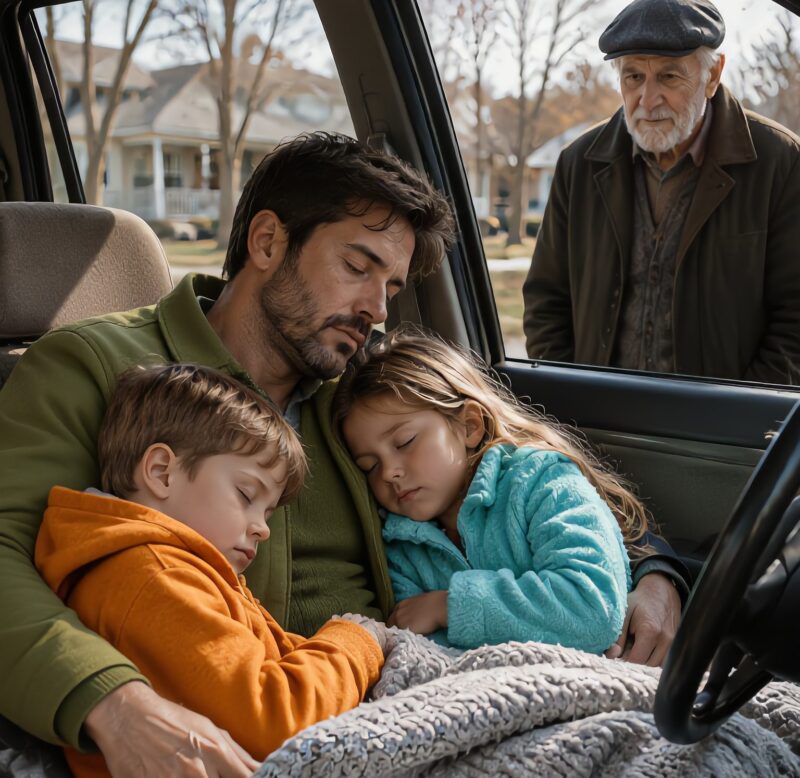
My son was asleep in the driver’s seat.
Behind him, his five-year-old twins, Caleb and Noah, were huddled beneath a blanket. Bags of clothes, groceries, toys, and bottled water occupied nearly every empty corner of the vehicle.
I tapped gently on the glass.
Daniel woke with a start.
When he recognized me, his face changed.
Not happiness.
Humiliation.
He climbed out and quietly shut the door behind him.
“Dad, what are you doing here?”
“I came for your birthday.”
His eyes dropped toward the pavement.
I glanced at the boys.
“How long have you been living like this?”
Daniel hesitated.
Then he whispered, “The boys think it’s an adventure.”
That was enough.
I didn’t question him there.
An hour later, we were inside a warm diner. Caleb and Noah were happily covering pancakes with syrup while Daniel sat across from me, barely touching his coffee.
“Start talking,” I said.
“It’s complicated.”
“Then we have plenty of time.”
He rubbed both hands over his face.
Three months earlier, his marriage had begun to collapse.
Daniel’s technology company was experiencing financial problems. His wife, Lauren, convinced him that their house could be vulnerable if the business failed.
Her solution sounded reasonable at the time.
Put the property entirely in her name.
Protect the family home.
Daniel trusted her and signed the paperwork.
Soon afterward, he returned home to find that his key no longer worked.
The locks had been replaced.
Then he learned about the protective order.
Lauren claimed Daniel had become volatile and that she feared for herself and their children.
She produced screenshots of messages that appeared threatening.
Her relatives backed her account.
Daniel denied sending several of the messages, but denial meant little against what looked like documented evidence.
His time with Caleb and Noah was restricted to supervised visits.
Then came another disaster.
His company failed.
Lauren had been closely involved with its financial accounts, and Daniel discovered that substantial sums had been transferred shortly before their separation.
Some of the money appeared to have gone to accounts associated with Lauren’s father, Charles.
By the time Daniel understood how much had happened, there was almost nothing left.
No house.
No company.
Very little money.
And only limited access to his children.
When it was his turn to have the twins, he had nowhere appropriate to take them.
Eventually, the Honda became their temporary shelter.
I stared at my son across the diner table.
“Why didn’t you tell me?”
Daniel gave a tired laugh.
“Because everyone kept saying I was irresponsible and unstable. After a while, I started wondering whether they were right.”
“And you thought I would agree?”
“I thought you’d be ashamed of me.”
I leaned forward.
“I’m angry with you.”
His expression fell.
“For not calling me sooner.”
He looked away.
I reached across the table and put my hand over his.
“We can’t fix three months in one afternoon. But we can make sure tonight looks different from last night.”
That became our first goal.
Not revenge.
Not proving anyone wrong.
Stability.
I helped Daniel secure a small apartment. Nothing luxurious—two bedrooms, secondhand furniture, and a kitchen barely large enough for a table.
To Caleb and Noah, it might as well have been a palace.
Daniel found reliable employment and continued therapy.
Then we hired Melissa Grant.
Melissa was a family-law attorney who listened carefully and reacted to almost nothing.
When Daniel finished telling his story, she closed her notebook.
“I’m not interested in which family can tell the more convincing story,” she said.
“What are you interested in?” Daniel asked.
“Records.”
So we started collecting them.
A forensic accountant examined the finances of Daniel’s failed company.
The review identified approximately $280,000 in questionable transactions connected to Lauren and Charles.
Some transfers lacked contracts.
Others had no corresponding invoices.
Several did not resemble ordinary business expenses at all.
But money wasn’t the only issue.
Daniel’s supervised visits with the twins were being documented by independent professionals.
Those reports became increasingly important.
Lauren’s relatives had described Daniel as unpredictable and intimidating around his sons.
The neutral observers saw something else.
Caleb and Noah greeted their father enthusiastically.
They climbed onto him while he read stories.
They brought him toys.
When they were upset, they sought comfort from him.
The supervisors repeatedly described Daniel as patient, attentive, and emotionally controlled.
There was no observable behavior suggesting the twins were frightened of him.
Then Melissa arranged for digital specialists to examine the alleged threatening messages.
Their findings raised serious questions.
Some timestamps didn’t align with available carrier data.
Several supposed messages could not be matched to transmission records.
Certain screenshot files also showed indications of editing.
The case that had once seemed impossible to challenge suddenly looked very different.
Six months after I first saw Daniel behind that fogged windshield, we entered the courtroom again.
This time, he had more than his word.
He had a job.
A home.
Therapy records.
Independent visitation reports.
Financial analysis.
Digital evidence.
Melissa presented everything methodically.
Eventually, Lauren was questioned about the screenshots.
She admitted that relatives had helped assemble some of the material and that she could not personally confirm every image.
That mattered.
The court expanded Daniel’s parenting time and ordered further review of the allegations.
Nothing changed overnight.
Real life rarely works that way.
There were additional hearings and evaluations. More documents had to be examined. More questions had to be answered.
Months later, Daniel was granted the majority of parenting time.
Lauren remained part of the twins’ lives under clearly established arrangements, but members of her family could no longer control the supervision process.
The financial dispute continued separately.
A significant amount of money was eventually restored, while evidence involving other possible wrongdoing was passed to the relevant authorities.
Daniel could have spent the rest of his life being angry.
Instead, he concentrated on rebuilding.
He eventually started another technology business.
This time, he established strict financial oversight from the beginning. No single person controlled the accounts, and every major transaction required proper documentation.
He continued therapy even after nobody required him to.
And I moved closer.
That decision transformed my previously quiet apartment into a disaster zone populated by toy dinosaurs, juice boxes, crayons, and mysterious single socks.
I loved every minute of it.
Nearly a year after my birthday surprise went so terribly wrong, I was sitting in Daniel’s living room watching Caleb and Noah construct a Jenga tower.
Daniel sat beside me.
For a while, we simply watched the boys argue about which block should come out next.
Then Daniel said, “Dad?”
“Yeah?”
“I still think about that car.”
“So do I.”
“If you hadn’t found us…”
He stopped.
I waited.
“I might have stayed there much longer than I should have.”
“Why?”
“Because I thought needing help meant they were right about me.”
I turned toward him.
“Listen to me. Helping you didn’t require me to believe every word you said without question.”
Daniel looked surprised.
“I helped because you deserved the same thing everyone deserves—the chance to have the facts examined before being judged.”
He nodded slowly.
Before either of us could continue, Caleb shouted.
“Grandpa! Emergency!”
I looked down.
Their Jenga tower had developed a dangerous lean.
Noah was holding one block halfway out.
“He’s ruining it!” Caleb complained.
“I know what I’m doing,” Noah insisted.
“You definitely don’t,” Caleb said.
I sat on the floor beside them.
Caleb pointed urgently at the tower.
“Save it!”
For a second, I was somewhere else.
Back in that airport parking lot.
I remembered condensation running down the Honda’s windows.
I remembered the cold biting my hands.
I remembered seeing my grandchildren asleep beneath one blanket.
Most of all, I remembered Daniel’s expression when he realized I had found him.
He had believed his life was over because everything supporting it had collapsed at once.
But losing what you built is not the same as losing the ability to build.
I looked at Caleb.
“I might not be able to save the tower.”
His eyes widened.
“Why not?”
“Because sometimes things fall.”
Right on cue, Noah moved the wrong block.
The tower collapsed.
Caleb groaned.
Noah laughed.
Then Caleb started laughing too.
I picked up one of the scattered pieces.
“But you know the good thing about falling towers?”
“What?” Caleb asked.
“You still have the blocks.”
Daniel was standing behind us.
Our eyes met.
He understood exactly what I meant.
Then he sat down on the carpet and began collecting pieces.
Noah handed him a block.
Caleb handed me another.
A year earlier, Daniel thought he had reached the end of his story.
He hadn’t.
There was no miracle that restored everything exactly as it had been.
There was something more useful.
A second chance.
Not to rebuild the same life.
To build a better one.
Caleb stacked the first block.
Noah added the second.
Daniel placed the third.
And I realized that this was what family was supposed to be.
Not people who prevent you from ever falling.
People who sit beside you afterward, gather what remains, and help you begin again.