“If you let me remain here, I’ll look after the little ones,” Aurelia Mendoza said. “At least until winter is over.”
Elías Barragán stood silently in the doorway of Rancho El Enebro, studying the exhausted stranger before him.
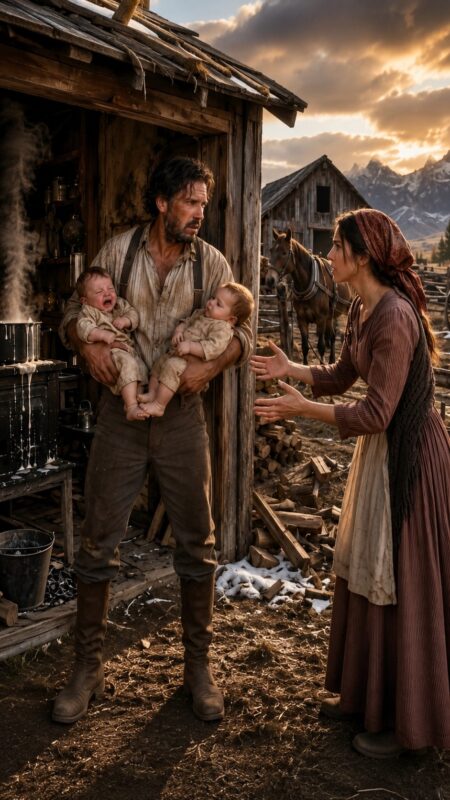
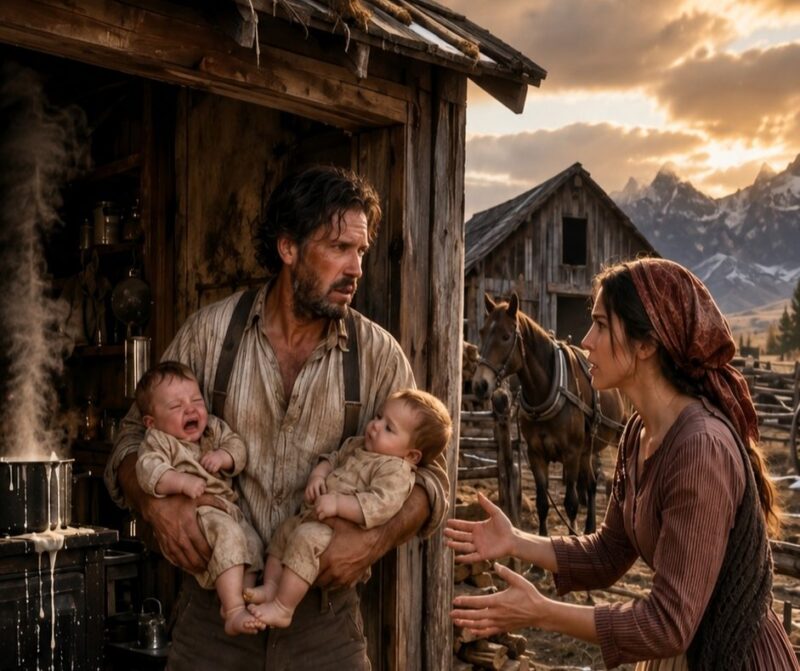
Inside, a pot of milk was burning on the stove. Mateo screamed in his arms while Elena tugged at the front of his shirt, demanding to be picked up.
Elías had faced stampeding cattle, repaired fences beneath violent skies, and worked through injuries without complaint.
But since becoming a widower, two small children had proven harder to manage than anything the ranch had ever thrown at him.
Aurelia had appeared at his door in September 1889 with dust on her clothes and almost nothing in her possession. She had asked for a drink of water and permission to sleep somewhere warm for a single night.
Instead, she had walked into a home still haunted by loss.
“Let me take her,” Aurelia said, nodding toward Elena.
Elías stiffened.
For a moment, he considered refusing.
Then another cry filled the kitchen.
Reluctantly, he handed the little girl over.
Aurelia tucked Elena against her chest and began rocking her with slow, patient movements. Within minutes, the child’s sobs became quiet breaths.
Elías stared at her.
“What are you expecting from me?”
“Nothing you cannot give,” Aurelia answered. “Meals. A roof. A warm corner to sleep in. Let me stay until the thaw.”
Nearly a year earlier, a sudden fever had taken Elías’s wife, Lucía.
She had left behind two infant children, a grieving husband, and a ranch that had slowly begun slipping into disorder.
Elías had done his best.
But survival and living were not the same thing.
Aurelia understood that better than most.
Two years earlier, she had buried her own husband. When her work disappeared soon afterward, so did the last pieces of stability in her life.
By the time she reached El Enebro, everything she owned could fit beneath one arm.
Elías could offer her no wages.
What he could offer was a vacant room.
Aurelia accepted.
The next morning, she began noticing things Elías had stopped seeing.
Cold air crept through cracks in the walls. Half the house was being heated even though no one used those rooms. The twins’ cribs stood too far from the stove.
Without ceremony, Aurelia went to work.
She closed unnecessary rooms, sealed the worst drafts, moved the children closer to the warmth, and hung thick blankets to trap the heat around their sleeping area.
The difference was immediate.
The twins stopped waking so often during the night.
The woodpile stopped disappearing quite so quickly.
Then Aurelia opened the storeroom.
She frowned.
Potatoes were sprouting in one corner. Fruit had begun to spoil. Dampness had crept into sacks of grain.
Elías followed her inside.
“My family has stored provisions here for generations.”
Aurelia picked up a rotten apple.
“Then perhaps generations of Barragáns have been feeding winter better than themselves.”
Elías did not appreciate the remark.
But he could not argue with the apple.
Together, they emptied the room.
Aurelia separated what could still be eaten from what had to be discarded and changed the way the remaining supplies were stored.
Not every idea worked.
One afternoon, she discovered that a method she had insisted upon had ruined part of their food supply.
Elías expected an excuse.
Instead, Aurelia sighed.
“I was wrong.”
That surprised him more than the mistake itself.
She cleaned up the mess and tried again.
From that day forward, Elías trusted her judgment—not because Aurelia was always correct, but because she never valued her pride more than the truth.
The change at El Enebro came quietly.
Mateo gained weight.
Elena stopped coughing at night.
The kitchen became warm again.
Then, one afternoon, laughter drifted through the house.
Elías froze where he stood.
He had not realized how long it had been since he had heard that sound.
Aurelia never spoke of becoming the twins’ new mother.
She never moved Lucía’s belongings or tried to remove her presence from the ranch.
When Elías finally unlocked the bedroom that had remained closed since his wife’s death, they found a notebook among Lucía’s possessions.
Every page was filled with her handwriting.
There were lists of supplies, planting instructions, household records, and careful notes about seeds she had saved for the coming spring.
Aurelia turned the pages slowly.
“We should follow this,” she said.
Elías looked at her.
“You don’t want to do it your own way?”
Aurelia closed the notebook.
“Your wife knew this land. I would be foolish to ignore what she learned.”
So Lucía’s labels remained exactly where she had placed them.
Her records continued to be used.
And the seeds she had prepared for a spring she would never see were carefully protected.
As autumn surrendered to winter, Aurelia became increasingly watchful.
She reinforced the northern side of the house with tightly packed hay. She insisted that snow be removed from the roof before it became dangerously heavy. Extra feed was stored near the livestock.
Finally, she stretched ropes between the house and the barn.
Their neighbor Hilario burst out laughing when he saw them.
“What are you doing, Aurelia?” he shouted. “Afraid the barn will wander away?”
She tied another knot.
“Laugh now. Hold the rope later.”
Hilario laughed even harder.
December brought another visitor.
Beatriz, Lucía’s mother, arrived determined to take Mateo and Elena away.
From the moment she entered the house, her eyes followed Aurelia with suspicion.
“So this is what you want?” Beatriz finally demanded. “To become their new mother?”
Aurelia did not flinch.
“No.”
The answer seemed to surprise her.
Aurelia gestured around the room.
“They already have a mother. You can see her everywhere if you bother to look.”
Beatriz did.
Lucía’s handwriting still marked the storage jars.
Her notebook rested safely on a shelf.
Her seeds were waiting for spring.
Nothing had been erased.
Still, Beatriz remained unconvinced.
She intended to leave with her grandchildren as soon as the weather allowed.
But then the ranch grew unnaturally quiet.
The animals became restless.
A pale circle formed around the moon.
Aurelia stood outside that evening, staring toward the mountains.
Something was coming.
She checked every window, every door, every supply, and every knot in the guide ropes.
Hours later, the storm arrived.
The wind struck Rancho El Enebro like a living creature.
By midnight, snow had covered the windows.
The world beyond the house disappeared completely.
Yet inside, the twins remained warm.
The hay packed against the northern wall absorbed much of the wind’s force.
The roof endured because Aurelia had refused to let old snow accumulate.
Then came trouble from the barn.
One of the cows had gone into labor.
Elías wrapped the guide rope around his gloved hand.
Without it, he might not have found the barn ten paces away.
The calf arrived weak.
For several frightening minutes, it barely moved.
Aurelia and Elías worked together, rubbing warmth into its small body until it finally lifted its head.
Then the rope snapped tight in Elías’s hand.
Once.
Twice.
Someone was pulling from outside.
They followed it into the blizzard.
Hilario was there.
He was barely standing, one arm wrapped around a post while three shivering calves crowded beside him.
His barn had collapsed under the storm.
He had tried to reach El Enebro.
Without the rope, he would have walked past it and vanished into the snow.
Hilario had mocked Aurelia for preparing for something he could not imagine.
Now that preparation had saved him.
No one mentioned his laughter.
They simply brought him inside.
The blizzard lasted three days.
When sunlight finally broke through the clouds, Rancho El Enebro looked like a small island surrounded by an ocean of snow.
But it remained standing.
The house was intact.
The barn had survived.
The animals were alive.
The food stores were dry.
And Mateo and Elena were safe.
That night, Beatriz stood beside the twins as they slept beneath a blanket Lucía had begun but never finished.
For the first time, she saw Aurelia differently.
Her daughter had protected these children through the knowledge she had left behind.
Aurelia had protected them by refusing to let that knowledge disappear.
“I’m leaving,” Beatriz said the next morning.
Aurelia lowered her eyes.
“I understand.”
“Without the children.”
Aurelia looked up.
Beatriz took a breath.
“I thought you had come here to take Lucía’s place.”
She glanced toward her grandchildren.
“Now I understand. You made sure her place was never taken from her.”
Winter slowly loosened its grip on El Enebro.
One evening, Elías found Aurelia standing near the front door.
It was the same place where she had once arrived with nothing but a blanket and a request for shelter.
“I want you to stay,” he said.
Aurelia smiled faintly.
“You already have someone to care for the children.”
“That isn’t why I’m asking.”
She turned toward him.
Elías stepped closer.
“I spent a long time trying to keep my old life from disappearing. You taught me that surviving isn’t the same as moving forward.”
He paused.
“I want you here for whatever we build next.”
Aurelia looked past him at the home that had given her shelter when she had nowhere else to go.
Then she took his hand.
“I cannot give you back the life you lost, Elías.”
“I know.”
“But perhaps we can make another.”
They married when the first patches of earth appeared beneath the melting snow.
Weeks later, spring finally reached Rancho El Enebro.
Aurelia carried Lucía’s carefully preserved seeds into the garden and planted them one by one.
Nearby, Mateo chased a wooden toy through the grass while Elena followed him, laughing.
When Elena stumbled, Aurelia lifted her into her arms.
The little girl wrapped both arms around her neck.
“Mamá,” she murmured.
Aurelia became perfectly still.
Perhaps Elena had only discovered a new sound.
Perhaps the word meant more.
Neither Aurelia nor Elías tried to decide.
Elías simply smiled.
Rancho El Enebro had survived its hardest winter.
Not because its walls were unbreakable.
Not because its people never made mistakes.
And not because they could undo everything they had lost.
It survived because they learned that honoring the past and choosing a future were not opposites.
Sometimes, the strongest families are not the ones that escape the storm untouched.
They are the ones who gather what remains, open the door to someone new, and begin building again.