Just three days after I gave birth to my daughter, doctors discovered that my heart was dangerously weak. While I lay in a hospital bed, frightened about my future, my husband walked in with an envelope.
Inside were divorce papers.
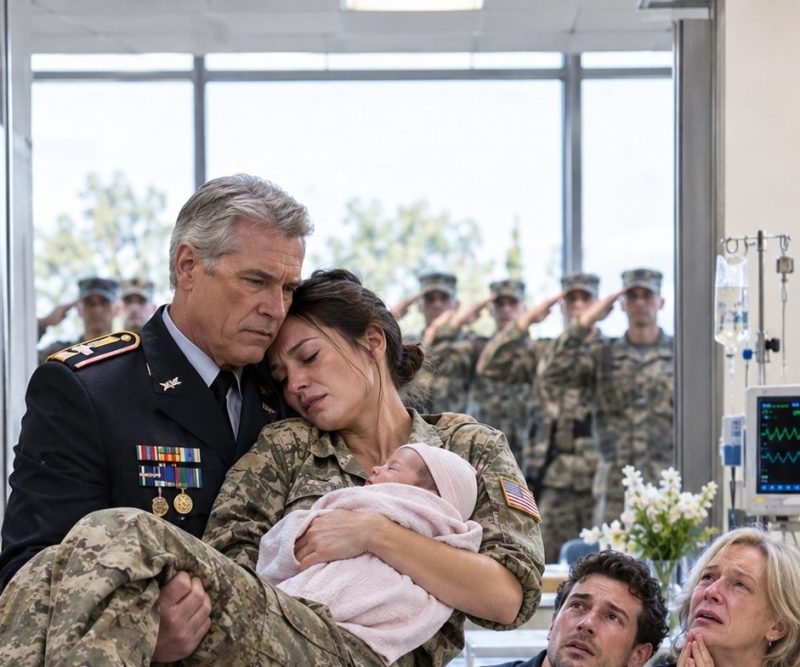
«Take your daughter and get out,» he said. «I didn’t marry you to spend my life looking after a sick woman.»
He expected me to cry, beg, and sign whatever he put in front of me.
Instead, I made one phone call.
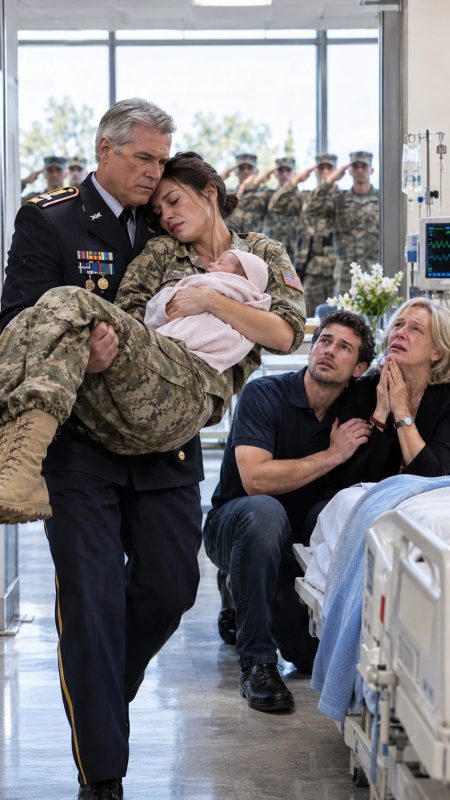
Thirty minutes later, my father entered the hospital with two attorneys. He looked at my husband, placed a folder on the table, and gave a simple instruction.
«Start with the house.»
That was the moment my husband’s arrogance began to crumble.
My name is Meredith Foster. I’m thirty-eight years old, a major in the United States Army stationed at Fort Carson, Colorado, and a new mother to a beautiful little girl named Nora.
I had spent years learning how to remain calm under pressure. But nothing in my military career had prepared me for what happened after my daughter’s birth.
Nora arrived healthy, and for a few precious hours, I believed everything was going to be perfect.
Then I started struggling to breathe.
My legs became swollen, my chest felt unusually tight, and even speaking for long periods left me exhausted.
After several examinations, the doctors explained that I had developed peripartum cardiomyopathy, a serious condition that had weakened my heart.
They assured me that treatment was available, but recovery would require patience, medication, and careful medical supervision.
I was terrified.
Not only for myself, but for the newborn daughter who needed me.
I expected my husband, Brent, to stand beside me.
Instead, he began asking questions about hospital bills, insurance coverage, and how much my treatment might cost.
At first, I assumed he was simply frightened.
Then, on the third afternoon after Nora’s birth, he appeared beside my bed holding a large white envelope.
«We need to settle something,» he announced.
He dropped the envelope onto my blanket.
I opened it and saw the words «Petition for Dissolution of Marriage.»
For several seconds, I couldn’t speak.
«You’re divorcing me? Now?»
Brent folded his arms.
«I’m not signing up for years of medical appointments and uncertainty. You can take Nora and move somewhere else.»
«Our daughter is three days old, Brent!»
«Then you’ll have plenty of time to figure things out while you’re recovering.»
His indifference hurt more than anything he had said during our marriage.
Before I could answer, his mother, Joyce, entered the room.
I hoped she would tell him to reconsider.
Instead, she pulled out her phone.
«Your parents need to take responsibility for you,» she declared.
She called my father, Malcolm Foster, and immediately began complaining.
«Malcolm, your daughter is ill, and Brent cannot be expected to carry this burden. You need to come and get her.»
I heard my father’s voice rise on the other end.
«Put Meredith on the phone.»
Joyce reluctantly handed it over.
«Dad?»
«Are you safe, sweetheart?»
«I’m in the hospital. Brent just gave me divorce papers.»
There was a brief silence.
Then my father spoke with remarkable calm.
«Your mother and I are coming.»
«Dad, bring the property documents. And ask Naomi to come with you.»
«I understand.»
Naomi Ellis had represented our family for years.
What Brent apparently forgot was that the beautiful house we occupied in Colorado Springs had never been purchased with his money.
My parents had helped establish a family trust before our wedding, and the trust had acquired the property.
Brent had been allowed to live there during our marriage.
He had signed an occupancy agreement acknowledging that arrangement.
But over the years, he had started behaving as though the house belonged to him.
He spoke about its value, planned renovations, and occasionally reminded me how fortunate I was to live in such an expensive neighborhood.
Now he was ordering me to leave it.
He had no idea what was about to happen.
Less than half an hour after my phone call, three dark SUVs stopped outside the hospital entrance.
My father entered first, followed by my mother, Naomi Ellis, and another attorney named Peter Sloan.
Brent looked at the group and smirked.
«Seriously? You brought an entire legal team because I asked for a divorce?»
Nobody laughed.
My father approached my bed and gently asked how I was feeling.
Then he picked up the divorce petition, examined the first page, and handed it to Naomi.
«Start with the house.»
Peter placed a thick folder on the table.
Inside were the trust agreement, the recorded property deed, and Brent’s signed occupancy documents.
Naomi turned toward my husband.
«Mr. Foster, before you make any further demands concerning this property, you should understand its legal ownership.»
Brent shrugged.
«It’s our marital home.»
«It has been your marital residence,» Naomi corrected. «But the property is owned by a family trust. You are not listed as an owner.»
His expression changed.
«What are you talking about?»
Peter showed him the deed.
«The trust acquired the property before your marriage. You also signed an agreement confirming that your permission to occupy the house did not give you an ownership interest.»
Joyce stood abruptly.
«That’s ridiculous! My son has lived there for years!»
My mother looked directly at her.
«Living in someone else’s property doesn’t automatically make you its owner.»
Brent grabbed the documents and began reading.
«I thought Meredith and I owned the place together.»
I finally found my voice.
«You were present when we discussed the trust before our wedding. You signed the paperwork yourself.»
He said nothing.
Naomi continued.
«Any questions concerning occupancy, marital rights, or possession will be handled through the appropriate legal process. But you cannot simply declare that Meredith must leave or claim the property as exclusively yours.»
Brent slowly sat down.
The man who had confidently ordered me out of my home only minutes earlier suddenly seemed uncertain about where he stood.
Then Naomi turned to me.
«Meredith, you do not need to sign anything today. You also do not have to make immediate decisions about custody or the future of your marriage.»
My father pulled a chair beside my bed.
«Your only job right now is to recover and look after Nora. We’ll help with everything else.»
For the first time since my diagnosis, I felt that I could concentrate on getting better.
Brent left the room without another argument.
But the story didn’t end there.
Four days later, while I was still receiving treatment, he returned.
This time, he carried a bouquet of flowers and a small knitted hat for Nora.
He looked exhausted.
«Meredith, can we talk?»
I nodded.
He placed the gifts on the bedside table.
«I made a terrible mistake. I was scared about the medical expenses, the baby, and what would happen if you couldn’t recover.»
I studied his face.
«Brent, being afraid wasn’t your mistake.»
He looked confused.
«Then what was?»
«You decided that your fear mattered more than my health. You abandoned me when I needed you.»
He stared at the floor.
«You’re right.»
For a moment, neither of us spoke.
Then he asked the question I had expected.
«Can we stop the divorce? Can we try again?»
I looked toward Nora, who was sleeping peacefully beside me.
«I can’t give you that answer today.»
He nodded.
«I understand.»
But I wasn’t sure he truly did.
When the doctors finally discharged me, I didn’t return to our house.
Instead, Nora and I moved temporarily into my parents’ home.
My mother had prepared a bedroom with fresh curtains, a comfortable chair, and a bassinet beside the bed.
My father drove me to follow-up appointments whenever I needed assistance.
They never treated me as a burden.
They simply made sure I had the space and support necessary to heal.
Meanwhile, Naomi continued handling the legal matters involving the house.
Brent found a rented apartment and began seeing Nora under a parenting schedule we had agreed upon.
To his credit, he took those responsibilities seriously.
He learned how to prepare bottles correctly, kept track of Nora’s feeding times, and arrived when he said he would.
He began asking about her health, her sleep, and the little changes that came with each passing week.
I was glad he was becoming a more attentive father.
But being a responsible parent didn’t automatically repair the damage he had done to our marriage.
My recovery was not straightforward.
Some mornings, I woke up feeling stronger and more hopeful.
On other days, fatigue reminded me that healing couldn’t be rushed.
I followed my doctors’ recommendations and tried to focus on small improvements rather than expecting everything to return to normal overnight.
Through it all, Nora gave me another reason to keep looking forward.
Her tiny fingers wrapped around mine. Her curious eyes followed my face. And every new milestone reminded me that life was continuing, even while I was recovering.
Several months passed before Brent and I sat down together with Naomi to discuss our next steps.
He looked different from the man who had thrown divorce papers onto my hospital bed.
Less arrogant. More thoughtful.
«I’ve been thinking about everything,» he began. «I know I failed you. But I want to become someone you can trust again.»
I listened carefully.
«I want us to be a family,» he continued. «A real family.»
I took a moment before responding.
«Brent, a family isn’t something you get to walk away from when life becomes difficult and return to when things improve.»
He lowered his head.
«I know.»
«An apology matters. But trust requires much more than words.»
He agreed to attend counseling and continue demonstrating that he could be a dependable father.
I agreed that we could explore whether rebuilding our relationship was possible.
But I made no promises about reconciliation.
The divorce proceedings remained unresolved while I considered my future.
I had spent too much time worrying about what everyone else expected from me.
Now I needed to understand what I wanted for myself and my daughter.
After the meeting, my father walked beside me toward the parking lot.
Before I opened the car door, he stopped.
«Meredith, there’s something I want you to understand.»
I turned toward him.
«You have spent your adult life serving your country and helping other people. But you don’t have to prove your strength by refusing help when you need it.»
My eyes filled with tears.
He continued.
«You will always have a place with us. Healthy or sick, married or divorced, successful or struggling. None of that changes the fact that you’re our daughter.»
I couldn’t immediately find the words to answer.
For weeks, I had been trying to understand how someone who once promised to love me through every hardship could become so distant when I became ill.
My father had just reminded me what dependable love looked like.
It wasn’t about expensive gifts, grand speeches, or perfect circumstances.
It was about showing up when things were difficult.
Today, the house remains protected by the family trust.
Brent continues working toward becoming a consistent, involved father.
Nora is growing, and my health is gradually improving under my medical team’s care.
As for my marriage, I still haven’t made a final decision.
Perhaps Brent and I will eventually find a way to rebuild what was lost.
Perhaps we will move forward separately while raising our daughter with mutual respect.
Either way, I no longer believe that my future depends on his willingness to stay.
I know that I have people who will stand beside me, and I know that I can make decisions without surrendering my dignity.
Three days after becoming a mother, I thought my entire world was falling apart.
My husband placed divorce papers on my hospital bed because he saw my illness as a burden.
My father arrived with attorneys because he saw his daughter as someone worth protecting.
And through everything that followed, I learned a lesson I hope Nora will carry with her one day:
Love isn’t proven when life is easy. It’s revealed by the choices people make when everything becomes difficult.
I cannot control the choices Brent made.
But I can choose the kind of life my daughter and I will build from here.
And this time, that future will be shaped by respect, stability, and the people who understand what it truly means to stand by someone.