Matteo Álvarez had spent six years learning the quiet language of his daughters’ blindness.
Every movement they made carried hesitation—small steps, careful pauses, hands searching the world before trusting it. It was a rhythm he understood completely.
Until one afternoon, it vanished.
In the crowded plaza of San Belluno, Matteo glanced up from his phone—and felt something was wrong.
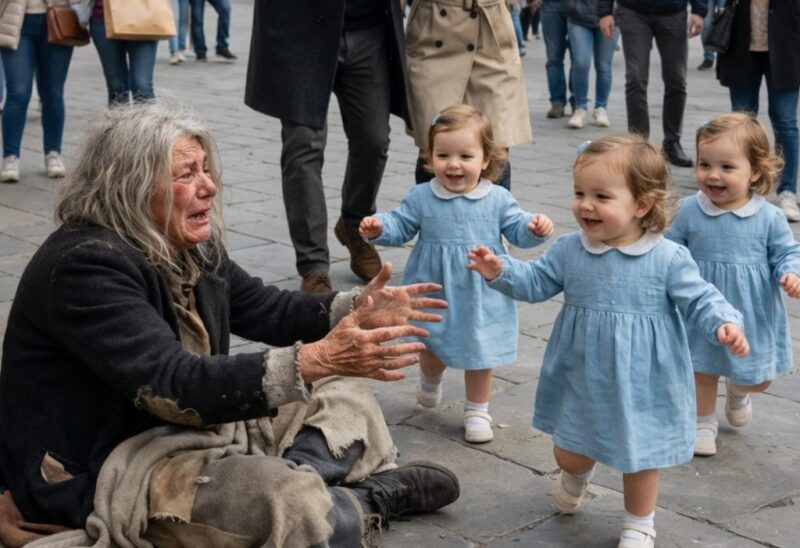
His daughters were running.
Not cautiously. Not uncertainly.
They moved with precision, weaving through people, avoiding obstacles without a single misstep. No outstretched hands. No fear.
It shouldn’t have been possible.
“Stop!” the caregiver shouted, panic rising in her voice.
Matteo called their names, but they didn’t respond. They were drawn forward, as if guided by something unseen.
Then he saw her.
An elderly woman sat quietly near the fountain, her worn coat draped loosely around her shoulders. She didn’t move. She simply waited.
The girls ran straight to her.
“Grandma!” they cried, throwing themselves into her arms.
The word struck Matteo like lightning.
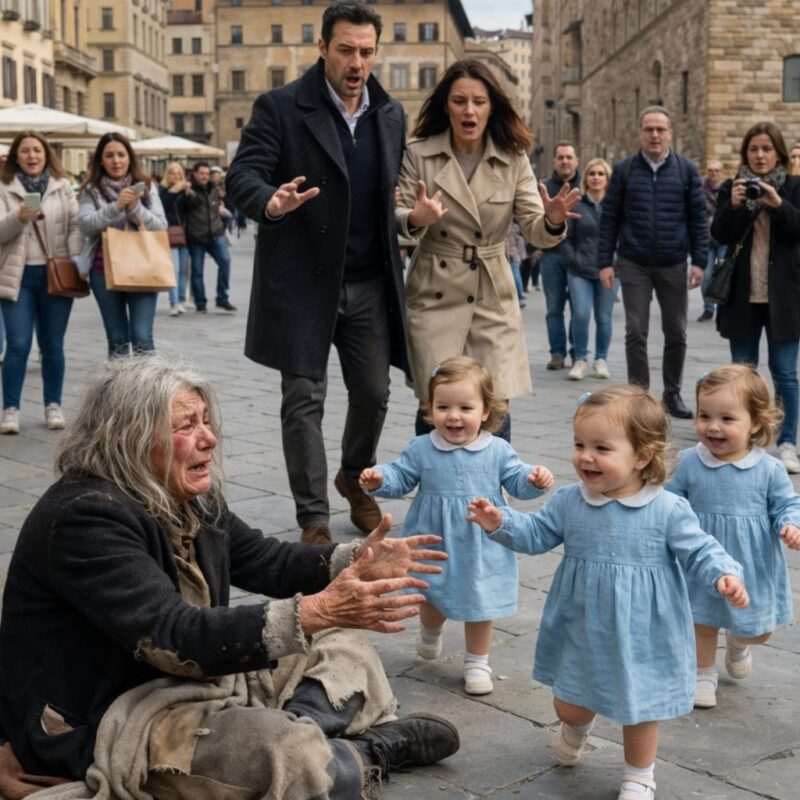
They had never said it before. They had no grandmother—no one they knew.
He stood frozen as the woman embraced them with a familiarity that felt deeply unsettling.
Forcing himself closer, Matteo spoke, his voice sharp with fear.
“Please step away from my children. Who are you?”
The woman lifted her gaze calmly. There was no confusion in her eyes—only recognition, and something heavier… something like grief.
“They came to me,” she said quietly.
One of the girls turned toward Matteo.
Not toward his voice—but directly toward him.
Her eyes found his.
“Papa,” she said softly, “why didn’t you tell us she existed?”
The words drained the strength from his body.
“You… you can’t see,” he whispered.
“Yes, we can,” another replied, resting her head against the woman.
“Only when she’s near.”
The world seemed to shift beneath him.
That evening, everything felt unreal.
The girls spoke with excitement, describing things they had never experienced—colors, light, reflections in water, movement in the sky. They weren’t guessing.
They remembered.
“We saw it,” one said simply.
“She helped us.”
That night, Matteo sat alone, unable to rest, staring at an old photograph of his late wife, Isadora. She had believed in intuition, in things beyond proof.
He hadn’t.
Now, doubt consumed him.
The next day, he returned to the plaza.
The woman was waiting.
Her name was Lucinda Morel.
And her story unraveled everything Matteo thought he knew.
Years ago, she had been forced to give up her child—Isadora—through deception and manipulation. The truth had been hidden from her, just as it had been hidden from him.
As she spoke, a terrifying realization took shape.
Someone close to his family had controlled everything—medical decisions, information, even the girls’ sense of reality.
They were never blind.
They had been made to believe they were.
When Matteo finally confronted the person responsible, there was no denial.
“I gave you stability,” she said coldly.
“They needed me.”
“You took their lives from them,” Matteo replied, shaking with anger.
The investigation exposed it all—false diagnoses, altered records, psychological control disguised as care.
Years of their lives, stolen.
But not beyond repair.
With time, proper treatment, and patience, the girls began to rediscover the world. Confidence replaced fear. Curiosity replaced limitation.
Lucinda became part of their lives gently, never forcing her place—only offering presence, warmth, and truth.
And slowly, the family began to heal.
Years later, Matteo transformed that pain into purpose. He created a center dedicated to helping children recover from psychological trauma.
On opening day, his daughters stood before a room filled with families.
“We were taught to live in fear,” one said.
“Then we learned how to see,” another added.
That night, as Matteo tucked them into bed, one of them whispered:
“Papa… everything makes sense now.”
He smiled through quiet emotion.
Because for the first time in years—
it finally did.