My Eight-Year-Old Daughter Gave Up Her Bus Seat for a Weak Old Man Everyone Else Overlooked. Months Later, He Walked Into Our Little Café and Changed Our Future.
The first morning eight-year-old Marisol Vega traveled to school by herself, she held tightly to the straps of her faded yellow backpack, trying to hide how frightened she felt. Before she left home, her mother, Elena, had gone over the same instructions again and again: stay close to the driver, count five stops after the overpass, and call the instant you arrive.
Letting her daughter ride alone broke Elena’s heart, but endless bills and exhausting shifts at a neighborhood diner left her with no realistic alternative.
Marisol quietly took a seat near the front of the bus, carefully counting each stop on her fingers.
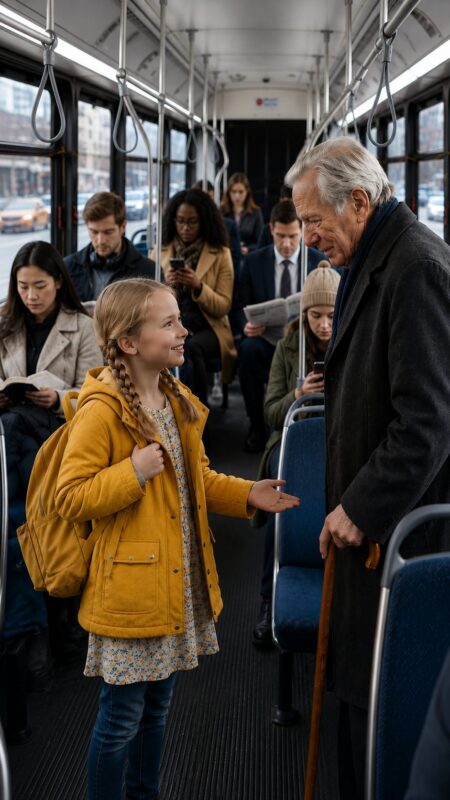
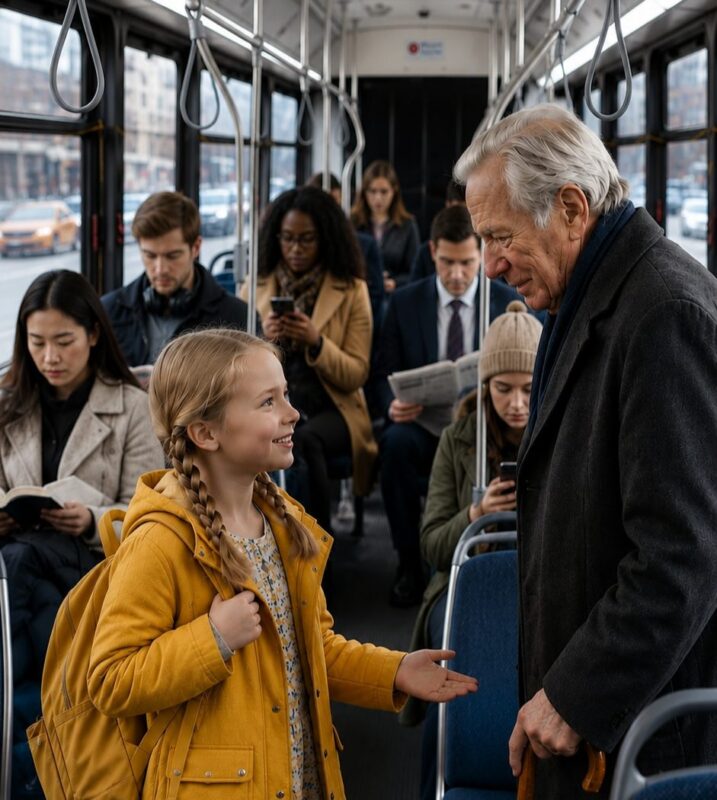
At the fourth stop, an elderly man climbed aboard. Supported by a silver cane, he struggled to steady himself as the crowded bus lurched forward. The priority seats were occupied, yet nobody moved. Most passengers kept scrolling through their phones, while others pretended not to notice him.
Marisol noticed.
She immediately stood.
“Sir, you can have my seat.”
The gentleman looked at her in disbelief.
“You’d really give it up for me?”
She nodded with a cheerful smile.
“I don’t mind standing.”
After settling into the seat, he introduced himself as Walter Bennett. During the ride, they spoke about school, bravery, and how hard her mother worked to provide for them. When Marisol reached her stop, she waved enthusiastically.
“Have a wonderful day, Mr. Bennett!”
She disappeared into the crowd without realizing that two discreet security officers had witnessed the entire exchange. Walter Bennett wasn’t simply another elderly passenger. He was the retired founder of one of the largest transportation companies in Texas.
His first instruction had nothing to do with business.
“Stay with that little girl until she’s safely inside the school.”
A few hours later, Elena received a phone call from one of Walter’s assistants. Panic immediately set in. She feared her daughter had been hurt.
Instead, she was invited to meet Mr. Bennett.
Although cautious, Elena agreed, requesting that they meet publicly at the diner where she worked.
Over coffee, Walter shared a painful chapter of his life.
Years earlier, he had lost his only granddaughter. Ever since, he occasionally traveled without revealing who he was, hoping to discover whether simple kindness still existed in the world.
“Today your daughter reminded me that it does,” he said quietly.
He placed a folder on the table.
Inside were documents providing Marisol with a full college scholarship, twelve months of housing assistance, and enough funding for Elena to finally open the catering business she had dreamed about for years.
Overcome with emotion, Elena slowly shook her head.
“I can’t accept something this generous.”
Before Walter could respond, Marisol gently squeezed her mother’s hand.
“You’ve always told me that kindness should never be pushed away.”
Walter smiled.
Within months, Elena opened Marisol’s Table, a modest catering company that quickly became a neighborhood favorite. Walter stopped by often—not as a wealthy donor, but as someone who felt like family. He celebrated birthdays, sampled every new recipe, and listened proudly to Marisol’s stories about school.
Still, not everyone believed Elena’s intentions were honest.
Walter’s son, Preston, accused her of taking advantage of his father’s generosity. Gossip spread quickly, and online articles suggested she had carefully planned the entire encounter.
Heartbroken, Elena packed every document Walter had given her, determined to return it all.
Walter refused.
The following morning, he invited reporters to an unusual press conference—not at corporate headquarters, but inside the small kitchen of Marisol’s Table.
Standing before dozens of cameras, he described the morning when a little girl had been the only passenger willing to stand so an elderly stranger could sit.
“In all my eighty-two years,” Walter said, “no business deal has meant as much to me as that simple act of compassion.”
He also made one fact perfectly clear: every dollar Elena had received came legally through his charitable foundation, which supported hardworking single-parent families striving to build better lives.
Public opinion changed almost instantly.
The rumors faded away. Customers filled Marisol’s Table every day, allowing Elena to expand the business and hire several single mothers from the surrounding community.
Eventually, Preston publicly apologized.
Walter accepted his apology with grace but offered him one lasting lesson.
“Never confuse wealth with character.”
Months later, during the restaurant’s grand reopening, every chair was occupied by neighbors, loyal customers, and friends.
Marisol lifted her plastic cup of lemonade.
“This is for Mr. Bennett,” she announced with a grin. “He finally found the family he was searching for.”
The room erupted in warm laughter.
Walter quietly brushed away a tear.
That day, he understood something money had never taught him.
A little girl hadn’t simply given him a seat on a bus.
She had guided him back to hope, reminding him that genuine kindness still exists—and that a single selfless decision can change far more lives than anyone could ever imagine.