The Day Everyone Took My Husband’s Side—Until the Truth Refused to Stay Hidden
The first thing I became aware of after I hit the ground wasn’t the agony.
It was the complete absence of concern.
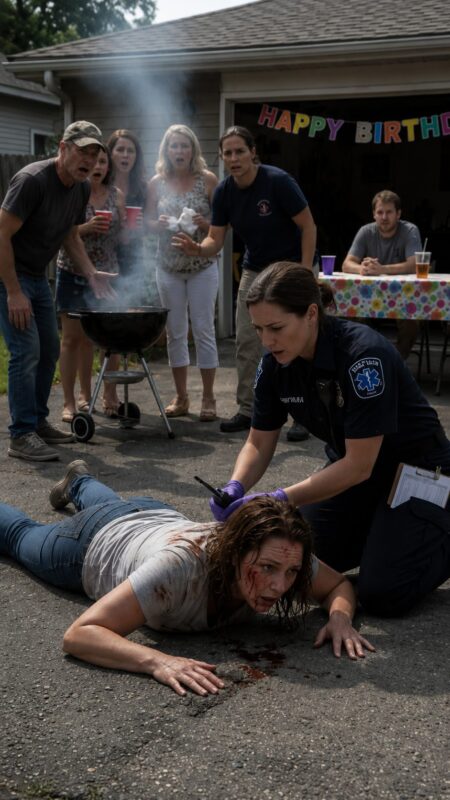
I lay frozen on the blistering driveway while cheerful voices, birthday music, and the aroma of grilled food floated from the backyard. Nearly twenty guests had gathered to celebrate my husband Leo’s birthday, yet no one rushed to my side.
My name is Judith Harper, and I teach English at the local high school. I was thirty-seven years old when my life changed forever.
For months, Leo had quietly rewritten my reputation. He told family members and friends that I exaggerated every ache, panicked over harmless symptoms, and constantly imagined illnesses. By the time my body finally failed me, everyone had already decided I couldn’t be trusted.
Only moments earlier, I had been carrying a bowl of sliced fruit toward the patio. Suddenly my knees buckled. My legs simply stopped responding, and I crashed onto the concrete. The bowl exploded into fragments beside me.
I struggled to push myself upright.
My legs wouldn’t obey.
“I… I can’t feel them,” I whispered, my voice shaking.
Leo didn’t even leave the grill.
“Ignore her,” he sighed. “She’s overreacting again.”
His mother, Freya, hurried over—not to help, but to lecture me for spoiling the party. She reminded everyone that every family gathering somehow became “another one of Judith’s dramatic performances.”
A few guests looked uncomfortable.
None of them stepped forward.
One neighbor quietly suggested calling an ambulance.
Leo waved the idea away.
“She’ll be fine,” he insisted. “She gets like this whenever she’s stressed.”
But I knew something was terribly wrong.
This wasn’t anxiety.
This wasn’t exhaustion.
This was fear.
Several minutes later, an ambulance arrived.
Paramedic Michelle Eastman climbed out, ignored the opinions surrounding me, and focused entirely on my condition. She checked my reflexes, measured my vital signs, and calmly asked detailed questions while everyone else stood silently watching.
Within minutes, she confirmed what I already suspected.
My paralysis was real.
Unlike everyone else, she believed what I was saying.
She asked whether I had experienced any unusual health problems before that afternoon.
I nodded.

For almost five months I had been living with numbness, shaking hands, blurred vision, dizziness, unexplained falls, memory problems, and crushing fatigue that never seemed to improve.
Then she asked a question that stopped me cold.
“Have you recently started taking any new medication, vitamins, herbal remedies, or drinks?”
I hesitated.
“My husband has been making me tea every morning for the last five months.”
For the first time all afternoon, Leo’s confident smile disappeared.
I explained that he insisted on preparing it himself because he said it would ease my anxiety and help me rest. Some mornings it tasted strangely bitter. Other times, I noticed a faint metallic aftertaste that lingered for hours.
Michelle’s expression became noticeably more serious.
When Leo attempted to interrupt, she met his eyes without hesitation.
“I’m asking my patient.”
It was the first time in years that someone had refused to let him speak for me.
As the questions continued, another troubling pattern emerged.
Every time I mentioned seeing a doctor, Leo found a reason to postpone it. Sometimes medical bills were supposedly too expensive. Other times he insisted I only needed more sleep, less stress, or a better attitude.
Lying there in the ambulance, I suddenly realized how many appointments I had canceled because I trusted him.
Before we even left the driveway, Michelle requested that law enforcement meet us at the hospital.
By the time sheriff’s deputies arrived, Leo no longer looked nearly as certain of himself.
Hospital specialists quickly discovered severe inflammation affecting my spinal cord. They immediately began aggressive treatment while detectives started examining the circumstances surrounding my illness.
Investigators collected the remaining tea from our kitchen and sent it to a forensic laboratory for analysis.
The physicians refused to draw premature conclusions. They explained that diagnoses required evidence rather than speculation. While toxicology experts completed their testing, the medical team concentrated on giving me the best possible chance of walking again.
Rehabilitation started within days.
Every exercise exhausted me.
Every tiny improvement demanded extraordinary effort.
One afternoon my physical therapist lightly brushed the sole of my foot.
“Can you feel this?” she asked.
For several endless seconds, there was nothing.
Then I blinked.
“I think… maybe a little.”
It wasn’t dramatic.
It wasn’t instant.
But it was the first undeniable sign that my nerves were beginning to respond again.
Meanwhile, detectives interviewed everyone who had attended Leo’s birthday celebration.
Away from his influence, memories became clearer. Guests remembered my trembling hands, my repeated requests to make medical appointments, the dizzy spells, the falls, and the way Leo always laughed off my symptoms before anyone else had a chance to take them seriously.
Piece by piece, the version of events everyone had accepted began to collapse.
The woman they had dismissed as unstable had been telling the truth from the very beginning.
And the man whose explanations no one had questioned was now the one answering difficult questions across an interrogation table, forced to explain the inconsistencies that had finally caught up with him.