My former husband invited me to his family’s Christmas celebration believing he knew exactly how the evening would unfold. To everyone in his world, I was still the “childless” ex-wife he had left behind—the lonely woman who supposedly couldn’t move on.
He expected me to arrive by myself.
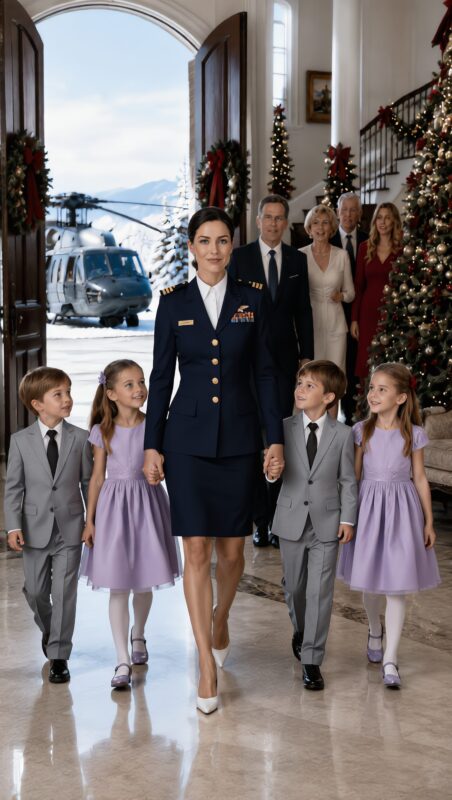
Instead, I stepped out of my car with four eight-year-old boys.
And when Grant saw their faces, every trace of confidence vanished from his.
Major Grant Ashford had recently announced his engagement to Natalie, and his prominent military family was holding Christmas dinner at their estate near Colorado Springs. For years, Grant had carefully controlled the story of our failed marriage. According to him, I had been bitter, unstable, and unable to accept that our relationship was over.
He had even persuaded his family that the pregnancy I mentioned before our divorce was something I had invented.
When his invitation arrived, my first instinct was to throw it away.
Carter, the oldest of my four sons, saw it before I could.
“Does his family even know we exist?”
I didn’t answer immediately.
I didn’t need to.
Carter studied my expression.
“Maybe it’s time they did.”
That was how Carter, Mason, Reid, Owen, and I found ourselves standing outside the Ashford estate on Christmas Eve.
Evelyn Ashford opened the front door.
Her welcoming expression disappeared almost instantly.
She stared at Carter.
Then Mason.
Then Reid and Owen.
Each boy had inherited the same striking gray eyes that had run through the Ashford family for generations.
Evelyn gripped the doorframe.
Before she could speak, Grant appeared with Natalie beside him.
He was smiling.
Until he saw us.
His eyes moved from me to the boys, and his face went pale.
Carter didn’t wait for an introduction.
“You’re Grant Ashford?”
Grant cleared his throat. “I am.”
Carter held his gaze.
“Are you also the person who told everyone that my brothers and I didn’t exist?”
No one in the room moved.
Grant turned toward me.
“What is this?”
Rather than answer, I walked to the dining table and opened the briefcase I had carried inside.
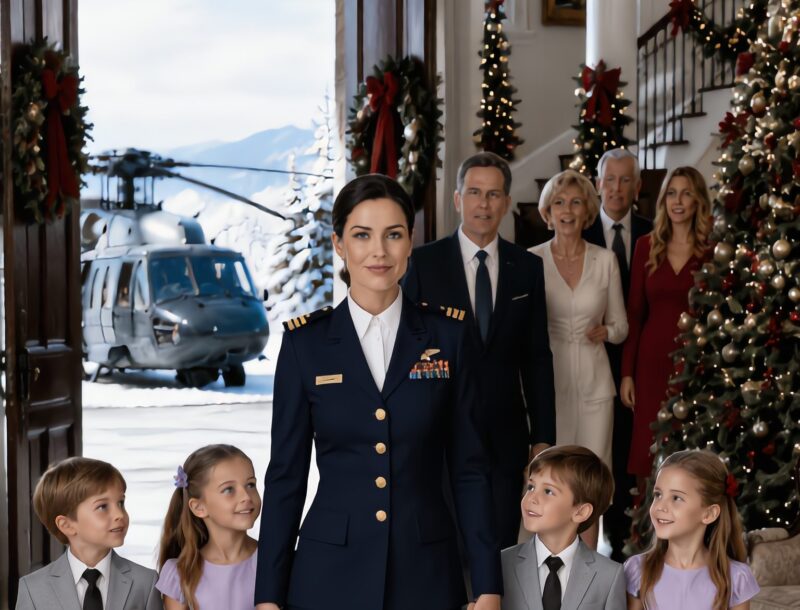
I began laying out documents.
Four birth certificates.
DNA results.
Hospital records.
Photographs taken shortly after the boys were born.
Then came seventeen certified letters I had mailed over the years.
Some remained unopened.
Across several envelopes, one word appeared in bold letters:
REFUSED.
Grant stared at them.
“I never received those.”
I had expected him to say that.
So I removed another document from the briefcase.
“This one was delivered to your military office.”
I placed the delivery receipt beside it.
Grant’s signature was clearly visible.
Natalie picked up the page and studied it.
Then she looked at him differently.
“You didn’t forget to tell people the truth,” she said. “You buried it because it was inconvenient.”
She moved away from him.
Evelyn looked devastated.
She insisted she had never known about the boys and had never received a single letter from me.
Eventually, records kept by the household provided an explanation.
Grant’s father, Harrison, had instructed staff to prevent my correspondence from reaching Evelyn.
Grant seized on that discovery immediately.
He blamed his father.
But Harrison’s interference couldn’t explain everything.
It couldn’t explain the certified letters Grant had personally rejected.
And it certainly couldn’t explain the document bearing Grant’s own signature.
Later that evening, I found him alone in the library.
There was something I needed to know.
“Did you ever see them?” I asked.
Grant looked confused.
“See who?”
“Your sons. Did you ever see photographs of them?”
Silence stretched between us.
Then Grant lowered his eyes.
“Yes.”
One word changed everything.
He admitted that Harrison had shown him photographs and hospital records roughly two months after the boys were born.
So Grant hadn’t merely suspected the truth.
He had known.
At the time, his next military assignment was already secured. Harrison had warned him that acknowledging four newborn children could lead to custody disputes, financial responsibilities, and complications that might interfere with his career.
I stared at the man I had once loved.
“So you erased four children from your life because they were inconvenient.”
Grant rubbed his forehead.
“I was scared.”
A bitter laugh escaped me.
“You were scared?”
I stepped closer.
“I was twenty-seven. I had four newborn babies depending on me. I barely slept. Medical bills kept arriving. Some days I didn’t know how I was going to make it through the week.”
Grant said nothing.
“I was terrified too,” I continued. “The difference is that I stayed.”
His shoulders dropped.
“You were afraid a promotion might disappear. I was afraid I wouldn’t be able to give four babies the life they deserved.”
There was nothing he could say to make those two fears equal.
Later, Carter found me.
His expression told me he had already guessed part of the truth.
“He knew about us?”
I chose not to lie.
“Yes.”
“From the beginning?”
“Not immediately. But he found out after you were born.”
Carter swallowed.
“And he still never came?”
“No.”
He stared toward the window.
After a while, he whispered, “Then I don’t want him to be my father.”
I pulled him close.
“You don’t have to decide what he means to you tonight—or tomorrow.”
Evelyn was different.
The boys understood that she had been deceived too.
She never demanded hugs, affection, or the title of Grandma. She simply asked for an opportunity to know them.
Then she did something more important.
She earned that opportunity.
Before we left the estate, Grant asked if he could say something to the boys.
They agreed.
“I know I haven’t earned the right to be called Dad,” he began.
Carter immediately answered, “You haven’t.”
Grant winced.
But he didn’t argue.
Instead, he admitted that he had spent years protecting his ambitions while pretending the consequences of his choices belonged to someone else.
Then Carter asked him one final question.
“If Mom hadn’t brought us here tonight, would you ever have come looking for us?”
Grant opened his mouth.
Nothing came out.
Finally, he said, “I honestly don’t know.”
Carter nodded.
“Then I can’t trust you.”
Grant looked at him.
“I understand.”
It wasn’t forgiveness.
But at least it was the truth.
In the years that followed, Evelyn became everything the boys could have wanted in a grandmother.
She attended school programs and competitions. She remembered birthdays without reminders. She learned which grandson loved science, which one preferred sports, which one could spend hours drawing, and which one asked a thousand questions before breakfast.
She didn’t try to compensate for eight lost years with expensive gifts.
She gave them time.
Grant took a slower path.
He began counseling and created financial accounts for all four boys without attaching expectations or conditions. More importantly, he stopped asking them to forgive him.
For the first time, he understood that forgiveness wasn’t something he could request on a schedule.
Trust had to be built.
Months passed before Carter agreed to spend supervised time with him.
When the visit ended, Carter climbed into my car and buckled his seat belt.
For several seconds, he said nothing.
Then he looked at me.
“He stayed.”
“What do you mean?”
“The whole time. Even when I got angry with him, he didn’t leave.”
I nodded.
Carter looked out the window.
“That’s still better than disappearing.”
It wasn’t forgiveness.
But it was a beginning.
Two years later, I met Miles Calloway, a pediatrician with an unusual talent for understanding when words weren’t enough.
He never attempted to become the boys’ replacement father.
He never competed with Grant.
He simply became present in our lives.
Science projects.
School performances.
Weekend competitions.
Parent meetings.
Bad days.
Good days.
Ordinary Tuesdays when nothing important happened.
Miles showed up for all of them.
Carter noticed.
One evening, he asked Miles the question I knew had been waiting inside him.
“Are you going to leave us too?”
Miles could have made a dramatic promise.
He didn’t.
“I can’t prove what I’ll do tomorrow by making a speech tonight,” he answered. “All I can do is keep being here.”
Apparently, Carter considered that answer scientifically testable.
He created a chart.
Whenever Miles promised to attend something, Carter added it.
Then he marked whether Miles actually came.
Weeks became months.
Months became years.
Every box was checked.
Three years after the Christmas that changed everything, we returned to the Ashford estate.
The house no longer felt like the place where four boys had arrived as unwanted evidence of a hidden past.
It felt warmer.
Different.
On one wall hung a photograph of Evelyn laughing while all four grandsons crowded around her.
The photograph occupied the exact place where Harrison Ashford’s portrait had once hung.
That evening, snow covered the grounds as Miles and I stepped onto the terrace.
The boys followed a few steps behind us.
Miles suddenly stopped.
Then he lowered himself onto one knee.
I covered my mouth.
He looked at me, then briefly at the boys.
“I’m not asking to take anyone’s place,” he said. “I’m asking to keep the place we’ve already made for each other.”
My eyes filled with tears.
Before answering, I glanced at Carter.
He folded his arms as though conducting one final evaluation.
Then he shrugged.
“He hasn’t missed a single box.”
I laughed.
“So that’s your approval?”
“It’s statistically convincing.”
That made me laugh even harder.
Then I turned back to Miles.
“Yes.”
Across the terrace, Grant stood quietly watching us.
There was no anger on his face this time.
Only understanding.
He finally seemed to recognize something I had learned years earlier.
I had never taken his family away from him.
I had never spent my life trying to punish him.
Grant had surrendered his place one decision at a time.
And eventually, someone else had built a place beside us by doing the opposite.
By staying.
By keeping promises.
By showing up.
That was the lesson Carter understood better than anyone.
And in the end, my greatest victory had nothing to do with Grant’s regret.
It wasn’t watching him confront his lies.
It wasn’t seeing his family discover the truth.
It wasn’t even knowing that he finally understood what his choices had cost him.
My greatest victory was watching Carter, Mason, Reid, and Owen grow up without carrying his denial as their burden.
They knew they had never been imaginary.
They had never been mistakes to conceal.
They had never been obstacles standing between someone and the life he wanted.
They were four boys who deserved honesty, security, and love from the moment they entered this world.
And as they grew older, they learned something even more important:
Being denied by someone did not make them less worthy.
Being abandoned did not make them less valuable.
And family was never defined by the person who disappeared.
Sometimes, it was defined by the people who kept showing up.