My Husband Abandoned Me While I Was Pregnant With Four Babies—Eight Years Later, I Returned and Exposed His Biggest Lie
Eight years after my husband walked away from me and our unborn children, he invited me to his family’s luxurious Christmas gathering.
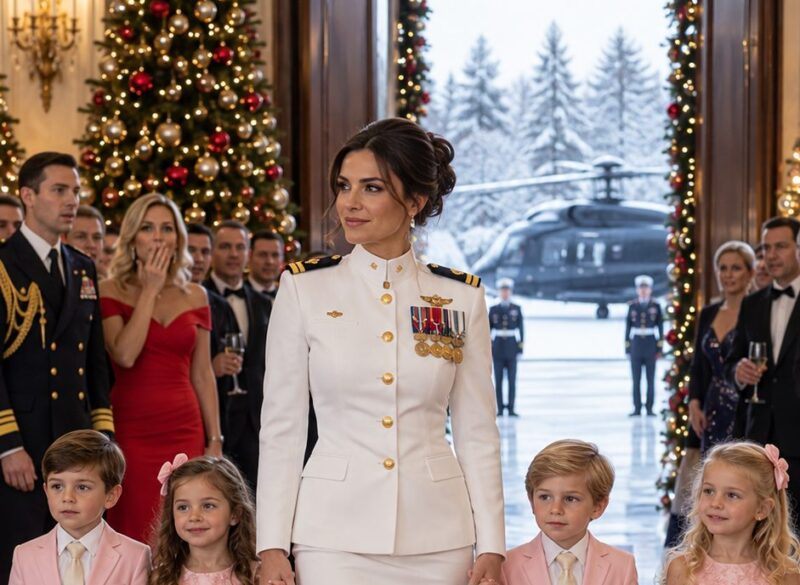
He expected to see the struggling ex-wife he’d abandoned.
Instead, I arrived in a military helicopter, dressed in my Navy command uniform, with four eight-year-old children walking beside me.
The moment Colonel Daniel Reynolds saw us, his confident smile vanished.
His fiancée stared at the children in confusion.
Then my son Noah stepped forward.
“Are you the man who told everyone we never existed?”
Daniel turned pale.
And before the evening was over, two military investigators would enter the mansion carrying evidence that threatened his entire career.
My name is Kesha Reynolds, and nine years earlier, I believed I’d married the man of my dreams.
Daniel was a rising military officer from a distinguished family. His father, General Victor Reynolds, had spent decades building a powerful reputation.
Daniel cared deeply about his career, his promotions, and the family name.
Unfortunately, those things mattered more to him than our marriage.
When I discovered I was pregnant, I expected him to be surprised but happy.
Instead, he looked furious.
“This couldn’t have happened at a worse time,” he said. “I’m being considered for promotion.”
I tried to explain that we could make things work.
Then the doctors gave me extraordinary news.
I was carrying quadruplets.
Four babies.
Four tiny heartbeats.
I cried with happiness and fear.
Daniel reacted differently.
“You’re lying,” he snapped.
I showed him the ultrasound images and medical records.
He pushed them away.
“You’re inventing this because you know I’m planning to leave.”
I begged him to come to an appointment.
He refused.
A few weeks later, divorce papers arrived.
During our final argument, I held the ultrasound photographs in front of him.
“Daniel, these are your children!”
He barely looked.
“I’m not ruining my career over some ridiculous story.”
Then he left.
I spent the following months trying to contact him and his family.
I sent letters, photographs, and medical updates.
Most came back unopened.
When my babies arrived earlier than expected, I faced the most frightening weeks of my life.
Noah, Ethan, Sophia, and Olivia needed specialized hospital care.
Every day, I sat beside their beds, praying they would grow stronger.
Daniel never appeared.
Not once.
Fortunately, I wasn’t completely alone.
Friends, colleagues, and fellow service members helped me through those exhausting months.
I learned to survive on very little sleep, organize four feeding schedules, and balance motherhood with my Navy responsibilities.
The years passed.
My children grew healthy, curious, and wonderfully different from one another.
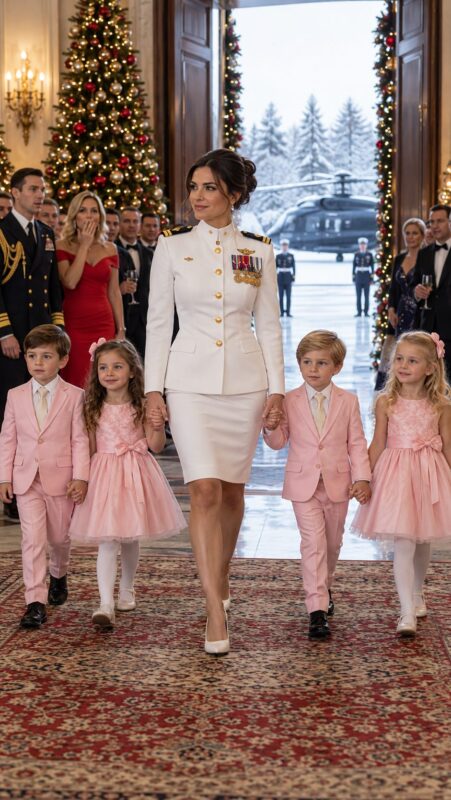
Noah was serious and protective.
Ethan loved science and anything mechanical.
Sophia was outspoken and adventurous.
Olivia was affectionate and always searching for ways to make people smile.
I continued serving in the Navy and eventually earned a senior command position.
We had built a good life.
Then, eight years after Daniel disappeared, his name appeared in my messages.
He was getting engaged.
His family was hosting an elaborate Christmas celebration at their Colorado estate.
And he wanted me there.
*It would be nice to catch up after all these years,* he wrote.
I stared at the invitation.
Not one word about our children.
Not one apology.
At first, I planned to ignore him.
But when Noah learned that his father’s family lived in Colorado, he asked something that stayed with me.
“Mom, does our grandma know we’re alive?”
I couldn’t answer.
That was when I decided to go.
Not to impress Daniel.
Not to embarrass him.
But because my children deserved answers.
On Christmas afternoon, we arrived near the Reynolds estate aboard an authorized military flight.
The children were excited and nervous.
I wore my formal Navy uniform, and each child carried a small Christmas gift.
The mansion was enormous.
Elegant decorations covered the entrance, expensive cars filled the driveway, and music drifted through the open doors.
When we entered the main hall, conversations stopped.
Daniel stood beside his fiancée, Victoria, surrounded by relatives and military guests.
He noticed me first.
“Kesha?”
Then he saw the children.
His expression collapsed.
Four eight-year-olds stood beside me, each carrying unmistakable traces of his features.
I approached him calmly.
“Daniel, these are Noah, Ethan, Sophia, and Olivia.”
He stared at them.
“What is this supposed to mean?”
“It means you’re meeting your children.”
Victoria looked between us.
“Daniel, you told me you didn’t have any children.”
Before he could respond, Noah stepped forward.
“Are you our father?”
Daniel swallowed.
“I… I didn’t know.”
I opened the folder I’d brought.
Birth certificates.
Hospital records.
Copies of letters.
Photographs from the children’s earliest days.
I placed everything on the table.
“You had eight years to find out.”
Victoria picked up one of the documents.
Her expression hardened.
“You told me your first marriage ended because Kesha didn’t want a family.”
Daniel reached toward her.
“Victoria, please.”
She pulled away.
“Four children, Daniel. You lied about four children.”
She removed her engagement ring and placed it beside the documents.
The room erupted into whispers.
Then two investigators entered.
One approached Daniel and identified himself.
“Colonel Reynolds, we need to discuss financial irregularities connected to the Lone Star Veterans Relief Foundation.”
Daniel stiffened.
The investigator explained that charitable funds intended for veterans had allegedly been routed into accounts associated with Daniel.
A formal investigation was underway.
Daniel turned toward me.
“You set me up!”
I met his eyes.
“No, Daniel. You made your own choices.”
Across the room, his mother Margaret was examining the returned letters.
Her hands trembled.
“Daniel, you told me Kesha had never given birth.”
He looked away.
Margaret approached me.
“Are these really my grandchildren?”
I nodded.
Her eyes filled with tears.
Then Olivia stepped forward.
“Are you our grandma?”
Margaret knelt.
“Yes, sweetheart.”
Olivia smiled shyly.
“Would you like a Christmas present?”
Margaret began crying.
“I would love one.”
That evening changed the Reynolds family forever.
But the full truth didn’t emerge immediately.
Investigators eventually discovered that General Victor Reynolds had intercepted several letters addressed to Margaret.
He had been determined to prevent anything that might embarrass the family or interfere with Daniel’s advancement.
Yet Daniel wasn’t innocent.
He had personally rejected my attempts to contact him.
He had refused to examine the medical documents.
He had chosen not to ask questions.
As the financial investigation progressed, his military career came under scrutiny.
He began counseling and arranged financial support for the children.
Margaret, meanwhile, asked whether she could become part of their lives.
I agreed, provided she respected their feelings.
And she did.
She attended school performances, remembered birthdays, and spent weekends getting to know each child.
She didn’t try to purchase their affection.
She earned it.
Daniel also requested contact.
The children agreed to supervised visits, although their feelings were complicated.
Sometimes they asked him questions.
Sometimes they barely spoke.
I reminded him that rebuilding trust would take patience.
During this period, I met someone unexpected.
His name was Aaron Bell.
He was a pediatric surgeon with a calm voice and an extraordinary ability to make children feel comfortable.
Aaron never treated my family as a burden.
He helped Ethan with science experiments, listened to Sophia’s endless stories, and patiently taught Olivia how to ride her bicycle.
Most importantly, he treated Noah with respect.
One evening, Noah asked him a question.
“Are you going to leave like our dad?”
Aaron didn’t rush to reassure him with grand promises.
Instead, he said, “I’ll do my best to keep showing up. You can decide whether you trust me.”
Noah thought about that answer.
The next morning, he created a chart.
Every time Aaron promised something and followed through, Noah marked a box.
A school concert.
A weekend outing.
A birthday celebration.
An afternoon helping with homework.
The marks accumulated.
Slowly, Aaron became someone the children could depend on.
Then another revelation shattered the fragile progress we’d made with Daniel.
A former aide to General Reynolds came forward during the investigation.
He had preserved documents from the time my children were born.
Among them were hospital photographs, medical updates, and records showing that Daniel had received the information.
Not merely the ultrasound images.
Photographs of all four newborn babies.
Reports describing their hospitalization.
Daniel had seen them.
He had known they existed.
And he had still stayed away.
When I confronted him, I struggled to remain calm.
“You saw their photographs?”
He nodded.
“Yes.”
“All four babies?”
“Yes.”
“You knew they were in the hospital?”
His eyes filled with tears.
“I knew.”
I stared at him.
“Then why didn’t you come?”
He lowered his head.
“I was afraid of what it would mean for my career. My father kept telling me to focus on my future.”
I shook my head.
“You were worried about promotions while I was sitting beside four hospital beds, wondering whether our children would be okay.”
Daniel began crying.
But I no longer needed his explanations.
The truth was enough.
When the children learned that their father had knowingly stayed away, they asked to stop their visits.
I supported them.
They deserved the freedom to decide when, or whether, they wanted to reconnect.
Months later, Margaret arrived with a small wooden box.
The former aide had given her four hospital identification bracelets that had been preserved with the records.
She handed them to the children.
Noah studied his bracelet.
Then he placed it beside our family photograph.
“Now there’s proof nobody can ignore,” he said.
I wrapped my arms around him.
Three years passed.
Our lives gradually settled into something peaceful.
Margaret became a cherished grandmother.
Daniel continued working through the consequences of his actions and respected the children’s boundaries.
Aaron remained exactly who he’d promised to be.
Dependable.
Patient.
Present.
That Christmas, Margaret invited us to celebrate at the Reynolds estate again.
This time, the atmosphere was completely different.
Photographs of my four children decorated the hallways.
Their drawings hung beside family portraits.
Margaret had even prepared separate stockings with their names embroidered across the top.
Daniel greeted us politely but kept his distance.
He understood that the children would approach him when they were ready.
Outside, snow covered the grounds.
Aaron was helping Ethan build a snow fort while Sophia organized an imaginary snowball tournament.
Olivia laughed as she chased Noah across the lawn.
I stood on the porch watching them.
Then Aaron approached.
He looked unusually nervous.
“Kesha, can I ask you something?”
I smiled.
“Of course.”
He took my hand.
“I know how hard you’ve worked to give these children a safe and happy home.”
My heart began racing.
“I don’t want to take anyone’s place. I want to keep building a future with all five of you.”
He knelt and opened a ring box.
“Will you marry me?”
Before I could answer, Noah shouted from across the yard.
“Mom! You should say yes!”
Everyone turned.
Noah ran toward us holding a piece of paper.
It was his chart.
Dozens of carefully marked boxes covered the page.
“Look! Aaron kept every promise!”
Tears blurred my vision.
I looked at the man kneeling before me.
Then at my children.
“Yes,” I whispered.
Aaron smiled.
I laughed through my tears.
“Yes, I’ll marry you!”
The children cheered and rushed toward us.
Aaron slipped the ring onto my finger as snowflakes drifted around us.
From the porch, Daniel watched silently.
For once, he didn’t attempt to explain himself or demand attention.
Later, while walking through the mansion, I noticed a new display near the family photographs.
Four tiny hospital bracelets rested inside a glass case.
Beneath them was a simple inscription:
THEY WERE ALWAYS HERE.
I stood there for several moments.
Eight years earlier, Daniel had tried to erase his responsibilities by pretending our children didn’t exist.
He believed his career and reputation mattered more than the family he’d abandoned.
But his absence hadn’t stopped us from growing.
It hadn’t prevented my children from becoming remarkable people.
And it hadn’t kept us from finding happiness.
I had spent years believing that the greatest victory would be making Daniel regret leaving.
I was wrong.
The greatest victory was realizing that we no longer needed his approval, his recognition, or his permission to be happy.
Our family was built on something stronger than wealth, influence, or a distinguished surname.
It was built on ordinary acts of love repeated every single day.
Because the people who truly belong in your life aren’t always the ones connected to you by blood.
They’re the ones who choose to stay, especially when staying requires effort.
And as Aaron joined our children beneath the glowing Christmas lights, I knew that the future we’d created was worth far more than the past we’d left behind.